‘Spassky Is Not One of My Seconds’: Gukesh Surprises Sindarov in World Chess Championship Draw
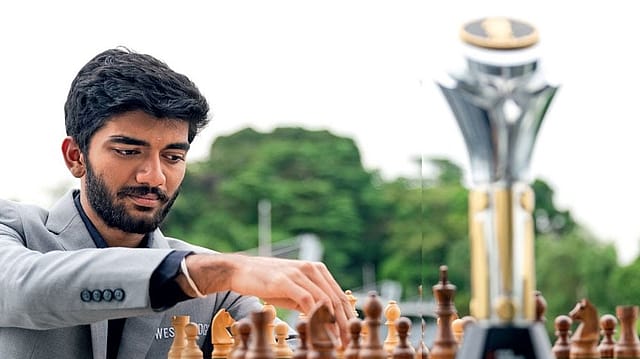
Javokhir Sindarov and his team had looked at the bishop move D Gukesh played on his fifth turn in Game 3 of the World Chess Championship. The challenger recognised it when it appeared on the board in Geneva. What surprised him was how much further the defending champion had looked.
Playing Black, Gukesh steered the Berlin Defence into a variation that former world champion Boris Spassky had used twice in 1988. Both those games ended in draws. So did this one, although Sindarov had some uncomfortable decisions to make before the players shared the point after 60 moves.
Asked afterwards about the Spassky connection, Gukesh offered one detail about his preparation. “Yeah, I can reveal that Spassky is not one of my seconds,” he joked, referring to the players who help a grandmaster prepare for a match. “But yeah, I was aware of the game,” he added, according to ChessBase India.
Anatomy Of A Stillborn Revolution
20 Nov 2026 - Vol 01 | Issue 01
Whatever Happened To The Cockroach Janta Party?
The fifth move Sindarov knew, and the eighth that followed
The first departure from the more familiar Berlin came when Gukesh chose 5...Be7, moving his bishop to e7 instead of playing the popular knight move 5...Nd6. The bishop move took the players into the Rio de Janeiro variation. After 6.Qe2 Nd6 7.Bxc6 bxc6, Sindarov captured on e5 with his pawn.
Gukesh now had another choice. He could continue along the Rio de Janeiro route by sending his knight to b7. Instead, he played 8...Nf5, entering the rarely seen Cordel variation. The line appeared more often in the 1980s and 1990s. Later examples include a 2013 game between Leinier Domínguez Pérez and Vasyl Ivanchuk and a 2019 encounter between Hovhannisyan and Haik Martirosyan.
“Today my opponent was really well prepared. We checked this move 5...Be7, but not that deep. I was surprised,” Sindarov said. Even so, his first assessment favoured White. He thought he had come out of the opening with a good position and began looking for a way to press.
Gukesh looks for a rook sacrifice
Gukesh was looking for winning chances of his own. On move 21, he brought his king to d7. His assessment was that Black had enough for equality, but he could see ways to ask more of Sindarov. One idea was to move a rook to b8 and then to b5. Another involved an exchange sacrifice on c5, giving up a rook for a minor piece in the hope of gaining enough in return.
“I think I played 21...Kd7, hoping for something. But I knew it shouldn't really be anything more than just fine for Black,” Gukesh said. He also examined a pawn push to e6 and several versions of the rook sacrifice. None gave him quite what he wanted. The move he singled out afterwards came from across the board. “I think the game got super interesting once he played 29. f4,” he said.
Sindarov holds on as the clock runs down
By the endgame, Sindarov had revised his early assessment. The advantage he thought he had with White had disappeared. With little time on his clock, he still had to find the moves to secure the half-point.
“In the endgame, I started to understand that the position was completely equal, and in the time trouble I was really very close to missing something. But I'm happy that I defended very well,” he said.
The last pair of rooks came off, leaving the players with opposite-coloured bishops and a position neither could win. The draw keeps the match level after three games. When play resumes after the rest day, Gukesh will have the white pieces and the first move.
With inputs from ANI