TIGER WOODS DUI CASE | Can Golf’s Greatest Comeback King Escape Himself Again?
Tiger Woods has spent a lifetime escaping from impossible places. From behind trees. From beneath bushes. From bunkers designed to punish ambition. From scoreboards that had already declared another golfer the winner.
He escaped a torn ligament to win the US Open. He escaped four back surgeries to reclaim the Masters. He escaped a mangled vehicle with his right leg intact and returned to Augusta 14 months later.
Golf calls these recoveries. Life has begun calling them warnings.
On Wednesday, Woods is expected to enter a Florida courtroom and change the not-guilty plea he submitted after a rollover crash near his Jupiter Island home in March. Court records do not disclose what the new plea will be or whether an agreement has been reached with prosecutors. A change-of-plea hearing cannot be reported as a guilty plea before Woods formally enters one.

Zeroing In on ECI
09 Oct 2026 - Vol 05 | Issue 41
Constitutional legitimacy versus political opportunism
The direction of travel, however, has changed. Woods had earlier sought a jury trial. He is now scheduled to appear before Martin County Circuit Judge Darren Steele for what his lawyer, Douglas Duncan, described as a plea conference.
The courtroom will be far removed from Augusta National. Yet Woods will arrive carrying every mile between them.
The Morning the Car Rolled
According to the arrest report, Woods was driving his Land Rover along a residential road on Jupiter Island on March 27 when he attempted to pass a pressure-cleaning truck.
His vehicle crossed double lines, struck the truck and rolled onto its side. The collision caused approximately $5,000 in damage. Nobody was injured. Woods told a deputy that he had been looking at his phone and changing the radio station when he failed to notice the vehicle slowing ahead of him.
The police account went further than distracted driving.
Deputies said Woods appeared lethargic and was sweating heavily. His eyes were reportedly bloodshot, and his pupils were described as “extremely dilated”. He showed signs of impairment during roadside exercises, according to the affidavit. Woods recorded zero alcohol on a Breathalyser test. Officers reportedly found two pills in his pocket that were later identified as hydrocodone, an opioid pain medication. He told police that he had taken “a few” prescription medicines but refused to provide a urine sample at the jail.
He was charged with driving under the influence involving property damage and refusing to submit to a lawful test. Both are misdemeanours.
Woods pleaded not guilty. The court subsequently allowed him to travel abroad for inpatient treatment. Prosecutors were granted access to relevant medical and prescription records under confidentiality arrangements approved by the judge. The allegations remain to be adjudicated. The presence of prescribed medication does not, by itself, establish unlawful impairment. Nor does a zero-alcohol reading dispose of a DUI allegation, which can involve drugs or medication.
What makes the case resonate beyond one damaged truck is repetition. This is not the first time Woods, prescription drugs and a vehicle have converged in public. It is not even the second crash to threaten the closing chapters of his life.
Hello, World
Tiger Woods introduced himself to professional golf with two words.
“Hello, world.”
He was 20 when he said them in 1996. By the following April, the world understood.
Woods won the 1997 Masters by 12 strokes, completing the tournament at 18 under par. At 21, he became its youngest champion and the first golfer of Black heritage to wear the green jacket.
The victory was larger than the margin. Augusta National had admitted its first Black member only seven years earlier. Woods walked across a course carrying golf’s history of racial and social exclusion and transformed its future before reaching the 18th green. He did not simply defeat the field. He changed the dimensions of the sport.
Television audiences expanded. Prize money grew. Sponsors arrived. Golf courses began lengthening themselves to contain him. Children who had never seen the sport as theirs began copying his fist pump.
Woods possessed an almost industrial capacity for dominance. He won the US Open, Open Championship and PGA Championship in 2000, then captured the 2001 Masters to hold all four major titles simultaneously.
The achievement became known as the Tiger Slam. He would spend a record 683 weeks as the world’s top-ranked golfer. His 82 PGA Tour victories remain tied for the most in history. His 15 major championships place him behind only Jack Nicklaus’s 18.
Statistics, however, describe only part of the occupation.
When Woods wore red on Sunday, other golfers appeared to play against accumulated dread. A leaderboard bearing his name seemed less like information than a threat.
He made winning appear inevitable. That illusion would not survive the driveway.
The Crash That Opened a Private Life
In November 2009, Woods crashed his Cadillac Escalade into a fire hydrant and tree outside his Florida home.
The accident was minor. The life it exposed was not.
Reports of extramarital relationships multiplied. Sponsors reconsidered their association. Woods announced an indefinite break from golf and later acknowledged infidelity. His marriage to Elin Nordegren ended in divorce.
For an athlete marketed through control, privacy and almost robotic competitive discipline, the collapse was complete. The public had known the golfer in red, the prodigy trained by his father, the global corporate asset and the champion who rarely revealed anything that could not be expressed through a score.
Suddenly, Woods was not merely being beaten. He was being investigated by the culture that had helped construct him. The episode altered the relationship between athlete and audience. Every comeback would henceforth contain two Tigers: the golfer attempting to win and the man asking to be reconsidered.
Woods returned to competition at the 2010 Masters and finished tied for fourth. He recovered the world No. 1 ranking in 2013. The talent remained. Then his body began collecting the cost.
The Body That Would Not Stop
Woods had already won the 2008 US Open while competing with a torn anterior cruciate ligament and stress fractures in his left leg.
He defeated Rocco Mediate over 91 holes, forcing an 18-hole playoff and then sudden death. Woods later revealed the extent of the injuries and underwent surgery. It became part of his legend: pain could be ignored if victory was close enough.
But pain does not disappear because an athlete defeats it on television. His knees required repeated procedures. His back became the greater problem. Between 2014 and 2017, Woods underwent four back operations. He withdrew from tournaments, attempted returns and disappeared again.
His swing had been rebuilt repeatedly to protect one damaged part of the body from another. The movement that created his greatness was also implicated in dismantling him.
By 2017, he had fallen outside the world’s top 1,000. The most dominant golfer of his generation could no longer bend down comfortably to pick up a ball. Then police found him asleep behind the wheel.
Zero Alcohol, Five Drugs
In May 2017, officers discovered Woods in a stationary car on a Florida road. The engine was running. He appeared confused and struggled through field-sobriety exercises.
His Breathalyser reading was 0.00. A toxicology report later identified five drugs in his system, including painkillers, the anti-anxiety medication Xanax, the sleeping drug Ambien and a substance containing THC.
Woods said he had experienced an unexpected reaction to prescribed medication following back surgery. He entered treatment and later pleaded guilty to reckless driving as part of a diversion programme. He received probation, a fine, community service and regular drug testing. Reuters reported at the time that the original DUI charge could be expunged if he completed the programme.
The mugshot became another image Woods could never take back. His eyelids drooped. His face appeared swollen and exhausted. The man who once stared down opponents without blinking appeared barely able to recognise the camera.
It seemed less like the photograph of a fallen celebrity than the medical chart of a body that had been asked to keep performing after it could no longer negotiate with pain.
A few months earlier, Woods had undergone spinal-fusion surgery. Few expected him to contend for another major championship. Tiger Woods specialises in making reasonable predictions look foolish.
The Roar Returned
On April 14, 2019, Woods walked towards the 18th green at Augusta wearing Sunday red. Francesco Molinari had begun the final round with a two-shot lead. Woods stayed close, waited for the course to begin collecting mistakes and moved ahead.
When his final putt dropped, Woods raised both arms.
The roar returned. He had won the Masters for the fifth time, 22 years after his first victory there and 11 years after his previous major championship. His children waited behind the green. Woods embraced his son, Charlie, in an image that echoed the hug he had shared with his father, Earl, after winning in 1997.
The victory became one of sport’s great resurrection stories. Woods had returned from disgrace, physical deterioration, surgery, addiction treatment and competitive irrelevance. He had not merely won another golf tournament. He had rewritten the ending that appeared to have been assigned to him.
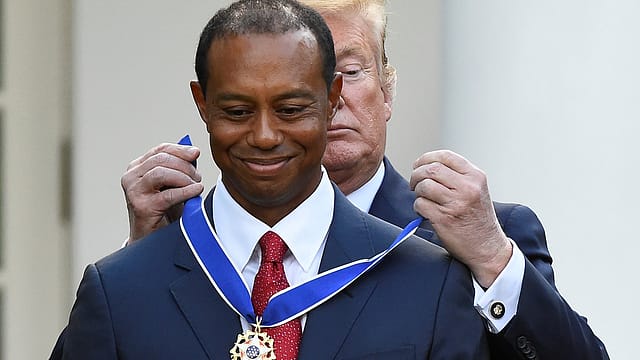
President Donald Trump awarded him the Presidential Medal of Freedom. Sponsors celebrated the restoration. Fans who once judged him rediscovered affection.
Sport is particularly generous to the redeemed when redemption produces a trophy. Augusta had taken Tiger out of the woods. Less than two years later, another road put him back inside.
The Leg They Nearly Amputated
On February 23, 2021, Woods lost control of an SUV on a downhill road outside Los Angeles.
The vehicle crossed the central reservation, travelled through opposing lanes, struck a tree and rolled. Investigators concluded that Woods had been travelling between 84 and 87 miles per hour on a road with a 45-mph speed limit. Authorities said he may have pressed the accelerator instead of the brake. No charges were filed.
The crash shattered bones in Woods’ lower right leg and severely damaged his ankle. Surgeons inserted rods, screws and pins. Woods later said amputation had been considered. This was no longer the familiar sports injury followed by rehabilitation photographs and a scheduled return.
Walking had become an achievement. Professional golf appeared almost beside the point. Then, in April 2022, Woods appeared at the Masters. Fourteen months after the crash, he walked Augusta National’s punishing slopes and completed all four rounds. He did not contend. He finished 47th.
It scarcely mattered. Woods had returned to the course on a reconstructed leg that doctors had considered removing. Reuters described his appearance as the setting for another storybook comeback.
The gallery did not require him to win. It needed him to walk.
When Comebacks Become Camouflage
Tiger Woods has returned so many times that comeback has become his second sport.
The first was competitive. The next was personal. Then came the surgical comeback, the moral comeback, the Masters comeback and the survival comeback.
Each return enlarged his mythology. It also created a danger. A comeback can reveal courage. It can also obscure the behaviour, illness or conditions that made the comeback necessary.
Woods’ injuries are real. So is the pain accumulated through decades of violent rotation, surgeries and rehabilitation. Prescription medication can be essential for patients living with severe or chronic pain. Dependence and impairment are medical issues before they become public morality plays.
But a vehicle removes the matter from the private realm. The current Florida case involves allegations that must be established through due process. Woods has not admitted guilt. The precise medication involved, its dosage, the timing of consumption and its relationship to his driving remain matters for evidence and the court.
Still, the March crash cannot be interpreted without remembering 2017 and 2021. The question is no longer whether Woods possesses the will to return. It is whether the culture surrounding extraordinary athletes has confused returning with recovering.
The Golfer Who Rebuilt Golf
Nothing that happens in the Martin County courtroom will erase Woods’ place in golf.
He transformed the sport’s audience, economics, athletic expectations and imagination. Players who grew up watching him now populate leaderboards built partly from the commercial expansion he created. He brought strength training into a culture once less demanding of athleticism. He made golf urgent for television. He expanded purses and sponsorships for competitors who would spend their careers trying to defeat him.
Woods won five Masters titles, four PGA Championships, three US Opens and three Open Championships. He completed the career Grand Slam three times. He remains the only golfer to hold all four professional major titles at once.
But legacy is not a museum cabinet into which uncomfortable evidence cannot enter. Tiger Woods is the 21-year-old changing golf at Augusta. He is the husband whose private life exploded into public view. He is the patient whose body was reconstructed repeatedly. He is the man found asleep in a running car. He is the father hugging his son after the 2019 Masters. He is the survivor learning to walk again. He is also the defendant preparing to change a plea after another rollover crash.
All of those men belong to the same story.
Taking Tiger Out of the Woods
The legal process will now determine the immediate consequences. Woods could plead guilty, plead no contest or enter another arrangement with prosecutors. Until he speaks in court, certainty would be irresponsible.
The more consequential outcome may lie outside the sentence. Woods travelled abroad for inpatient treatment after the March arrest. In June, he returned to public view to discuss the PGA Tour’s proposed schedule changes for 2028. He continues to chair its Future Competition Committee.
Golf has retained a place for him. The question is what he must do before golf welcomes him back onto a course.
Tiger Woods has nothing left to demonstrate about competitive courage. He has won through pain that would have stopped most athletes. He has returned from depths that would have ended most careers. He has survived himself often enough to make survival part of his brand.
This time, another dramatic appearance at Augusta cannot be the entire answer. The greatest recovery would not be another miraculous round, another walk up the 18th fairway or another Sunday roar. It would be a life in which rescue is no longer required. Tiger Woods spent his career finding a line through places from which no golfer was supposed to escape.
On Wednesday, he enters another difficult lie. For once, taking Tiger out of the woods may require him to put the clubs down.
With inputs from ANI & Agencies