33 Balls, No Runs & a Life Rebuilt: Nic Maddinson’s Long Road Back after Cancer
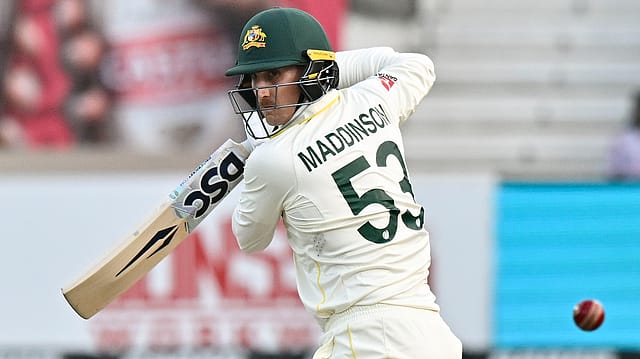
Thirty-three balls. No runs.
Nearly ten years to get back. Then this.
At Kingsmead in Durban, Nic Maddinson’s bat sent the ball into his own stumps. Marco Jansen had ended his first Test innings since December 2016. Australia were 24 for two. The comeback that had brought him across the Indian Ocean had acquired a brutal little entry in the scorebook: 0.
There would be plenty to say about that zero. About the selectors who had recalled him. About the wisdom of sending a 34-year-old who had gone more than 19 months without first-class cricket out to open against South Africa. About the state of Australian batting.
All legitimate questions.
But to understand the man walking back, the camera has to travel further. Back beyond the last Test, beyond the lost contract and the runs that never quite brought him another chance. Into a home where a small boy wanted his father to play.

Zeroing In on ECI
09 Oct 2026 - Vol 05 | Issue 41
Constitutional legitimacy versus political opportunism
And his father could not summon the energy.
THE GAME HE COULDN’T PLAY
During his treatment for cancer in 2025, cricket had receded from Maddinson’s immediate concerns. Getting out of bed could be difficult. So could the ordinary business of being a dad.
His older son, August, was two-and-a-half and wanted to play. Sometimes, Maddinson did not have the strength even to walk up the road and take him to the playground.
“To not be able to have the energy to do that was probably the hard thing,” he reportedly told AAP in January 2026.
A professional athlete lives by what his body can do. Run. Turn. Recover. Go again. In those months, the distance that mattered could be the stretch between home and the playground.
That is where this return begins to acquire its weight. Long before a selector could ask whether Maddinson could get through a Test, there were smaller, more intimate demands on his strength.
The wish to play belonged to two people in that house.
A SECOND BALL, A LONG ABSENCE
At 18, Maddinson had become the youngest New South Wales player to score a century on first-class debut, a record Kurtis Patterson broke the next summer. His T20 international debut against India in 2013 brought 34 from 16 balls. The talent was visible early.
The first time Maddinson played Test cricket, he made a duck.
In November 2016, Australia were rebuilding after a crushing defeat by South Africa in Hobart. Three new batters entered the side for Adelaide: Matt Renshaw, Peter Handscomb and Maddinson.
Maddinson’s introduction lasted two deliveries. Kagiso Rabada bowled him under lights with the pink ball. Against Pakistan, he followed with one and four in Brisbane, then 22 at the Melbourne Cricket Ground. Australia dropped him before the Sydney Test.
Three matches. Four innings. Twenty-seven runs.
A Test career can look absurdly small when compressed into numbers. The years spent getting there disappear. So does the work that follows an exit.
In February 2017, Maddinson stepped away from cricket for personal reasons. The contemporary announcement left his return date open. It is a reminder to resist tidying every departure into a neat sporting explanation. A player’s life is larger than the sequence of his dismissals.
Yet the cricketing task was clear enough: he had to build a record that could bring him back.
RUNS, THEN ANOTHER WITHDRAWAL
In 2018, Maddinson lost his New South Wales contract and moved to Victoria. His debut for his adopted state produced 162—and a broken arm in the same match.
Even the fresh start came with an interruption.
He returned after the Big Bash to make two more hundreds, finishing the 2018–19 Shield season with an average of 80.42. Under Andrew McDonald, his batting was acquiring the sustained substance that flashes of talent had promised.
By November 2019, the comeback conversation was serious. Across eight matches for Victoria over two seasons, he had accumulated 952 runs at 79.33, including a career-best 224. An Australia A game against Pakistan offered a route towards a Test berth.
He withdrew, citing mental health concerns.
The opportunity was there. So was a need to step away. Cricket Australia said it would give him time and support, and asked for his privacy to be respected.
This matters to the story because perseverance is often written as uninterrupted forward movement: keep going, endure, refuse to leave. Maddinson’s record contains withdrawals as well as returns. Looking after himself required him to leave the field at moments when his ambition could have kept him there.
When he returned, the runs continued. He finished that Shield season with 780 at 86.66, his most productive campaign to that point.
Then, in January 2023, an ACL injury took another year from his playing career. On his return to Shield cricket in the latter part of 2023–24, he made three centuries in four games. As Australia considered life after David Warner, Maddinson pushed himself back into the conversation.
A broken arm. A mental health withdrawal. A damaged knee. Different challenges, requiring different kinds of recovery. Each return had to be made on its own terms.
He went back to New South Wales for the following season. Another opening. Another difficult year ahead.
NINE WEEKS
His 2024–25 Sheffield Shield season produced 267 runs at 17.80. He was left out of New South Wales’ final match. Reporting on his subsequent return would connect his fatigue during that period with the cancer that had yet to be diagnosed; Maddinson himself was reluctant to make it an excuse.
He underwent surgery to remove a tumour. Then came news that the testicular cancer had spread to parts of his abdominal lymph nodes and a lung.
His wife, Bianca, was pregnant with their second child. Maddinson began nine weeks of chemotherapy in mid-May 2025.
By the second or third week, he had lost his hair. Medication used to manage side effects could leave him awake through much of the night. He described being drained and needing sleep, while sleep itself became difficult.
“It was the slowest and longest nine weeks,” he told Nine newspapers in an account published by Cricket Australia that October.
Nine weeks fits easily into a sporting timeline. A few words between diagnosis and recovery. Living through it is another matter: the treatment, the side effects, the repeated effort to get through the day.
There is no need to invent what Maddinson thought in those hours. The details he chose to share are enough.
His chemotherapy finished in mid-July. Two weeks later, he had a hit at Cricket NSW headquarters. It was his only batting session for a month. In September, he received news that the treatment had worked and began taking further steps towards playing again.
The family welcomed their second son, Wilder. Cricket would have to find its place in this life again.
LEARNING TO LEAVE THE CREASE
His return to the Big Bash in January 2026 supplied a revealing moment.
Playing for Sydney Thunder against Hobart Hurricanes, Maddinson reached 30 from 26 balls. David Warner was making a century at the other end. With the innings approaching its finish, Maddinson decided someone else could do more with the remaining deliveries.
He retired out.
Daniel Sams arrived and struck 16 from six balls. Thunder ultimately lost, but Maddinson’s decision deserved attention beyond the result. Here was a batter returning after illness, in a match carrying obvious personal significance, volunteering to end his own innings.
He explained the calculation plainly: Warner needed the strike, Sams had more power, and the team had discussed setting ego aside.
It would be too easy to turn that into evidence of a complete personal transformation. It was also a cricketing decision. But it showed a player comfortable enough to judge what the game required and act against the instinct to protect his own innings.
Later that month, he put his immediate ambition into five words: “I just want to play.”
THE CALL HE WASN’T EXPECTING
By September, the runs were coming again. Maddinson made 126 against Victoria in a one-day match, his first century in any format since March 2024. Brad Haddin, New South Wales’ new coach, had also entrusted him with the red-ball captaincy.
Then George Bailey called.
Maddinson thought Australia’s selection chair might want to discuss a younger player, or perhaps an Australia A trip to India. Instead, he was being summoned to South Africa and the Test squad.
The surprise had practical consequences. His manager, Peter Lovitt, went looking for spare pads and gloves. Maddinson collected his kit, organised his passport and prepared for a journey that had barely featured in the immediate plans.
Before departure, there was cricket in the hallway at the family’s Byron Bay home. August, hearing about South Africa, began naming the animals that lived there.
For his son, the destination offered creatures from books. For Maddinson, it offered a dressing room he had last occupied as a Test player almost a decade earlier.
He knew many of the people there. McDonald, who had helped him rebuild in Victoria, was now Australia’s coach. Renshaw, his fellow Adelaide debutant, was back too.
Their careers had taken different routes through the same long interval. Durban would bring them together again.
THE ARGUMENT AROUND HIS RETURN
There was a hard cricketing argument against the selection. Maddinson had not played a first-class match since March 2025. His most recent Shield season had been poor. Other batters had fresher red-ball records.
Matthew Hayden accused the selectors of “disrespecting first-class cricket”. McDonald defended Maddinson’s experience, his ability against pace and spin, and his flexibility in the batting order.
Those positions could be debated without diminishing what Maddinson had survived. Recovering from cancer could make his return moving; it could not, by itself, establish who should open for Australia.
That distinction became urgent when Jansen bowled him for zero.
A sentimental version of this story would hurry past the duck. It would reach for the illness as an answer to every criticism. But Maddinson was back in Test cricket, where the questions about runs, technique and selection still applied.
His return had restored the possibility of being judged as a cricketer, with all the discomfort that entails.
THE INNINGS AFTER ZERO
In the second innings, Maddinson made 48 from 38 balls before Anrich Nortje bowled him. He helped Australia accelerate towards a declaration and an eventual 214-run victory.
It was his highest Test score. It was also two runs short of a half-century, an innings that offered promise without settling his future.
Renshaw made 190 and 82 and took the Player of the Match award. Josh Hazlewood finished the chase with six wickets. Maddinson’s contribution occupied a smaller space in the match report.
His story can hold that proportion. It does not require him to become Durban’s hero.
Before the series, Maddinson had spoken of being more relaxed about cricket and more confident about how he wanted to play. The young batter trying to secure a place had spent years learning his game; the father returning after treatment had acquired reasons to value the day beyond its score. Cricbuzz.com
None of that means the duck could not hurt. He had wanted another Test chance for years. Ambition had survived alongside the changed perspective.
At Kingsmead, both were given room again. Thirty-three balls. No runs.
The scorebook will keep that zero. It will keep the 48 that followed, too. It has no column for the day a father has enough strength to play with his son again.