Ten Years on From the Miracle, Leicester City are Back Where Dreams Go to Die
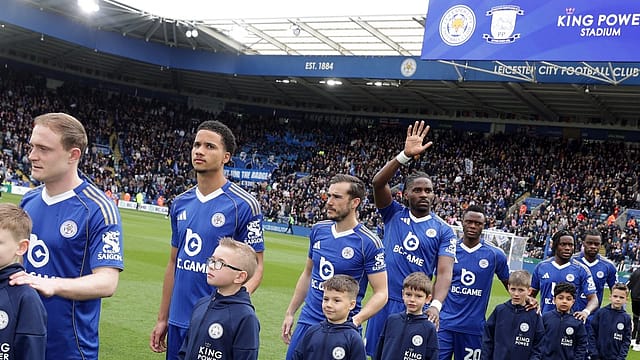
There is a particular cruelty in sport that reserves its harshest punishment not for the perennial also-rans but for those who once dared to touch greatness.
Leicester City, who a decade ago achieved what many still consider the most improbable feat in the history of professional football, winning the Premier League at odds of 5,000/1, have been relegated to England's third tier.
A 2-2 draw against Hull City at the King Power Stadium confirmed what had been creeping towards them all season.

Greening the Future
23 Jul 2026 - Vol 05 | Issue 30
Securing a sustainable India
For the first time since 2008-09, Leicester will play League One football.
Marc Albrighton, who gave thirteen years of his career to the club and played 313 games in a blue shirt, described watching the club unravel as something closer to grief than anger.
Was Leicester City's Premier League miracle the seed of their own downfall?
"Yeah, it's sad more than anything," Albrighton said. "I think there's a sadness that probably surrounds it about how it can just all fall apart so quickly."
Leicester are now only the second former Premier League champion to be playing in the third division of English football, joining Blackburn Rovers in that distinction. That company, and the speed of the descent, tells you something about the scale of what has gone wrong.
The argument that the miracle was itself the poison is not as paradoxical as it sounds. The title win of 2015-16 changed everything at Leicester, including, fatally, the club's sense of its own possibilities
For several seasons after that triumph, the club operated with admirable discipline. According to The Guardian, between 2016 and 2021, they funded ambition through smart sales, with N'Golo Kanté, Danny Drinkwater, Riyad Mahrez, Harry Maguire and Ben Chilwell all departing for significant fees.
How did Brendan Rodgers' spending gamble push Leicester City towards financial ruin?
But in the summer of 2021, under Brendan Rodgers, having narrowly missed out on Champions League qualification for the second consecutive season, the club decided to build rather than sell.
Less than £4 million was recouped from player sales that year, while the signings of Patson Daka, Boubakary Soumaré and Jannik Vestergaard cost an estimated £55 million.
Pre-tax losses that year tripled from £31.2 million to £92.5 million, a club record.
The following summer, Wesley Fofana, the linchpin of the defence, was sold to Chelsea for £70 million in an attempt to balance the books.
By the end of 2022-23, Leicester had been relegated from the Premier League while posting another £90 million loss. Three seasons of haemorrhaging money had brought them to the attention of financial regulators, and the consequences would prove catastrophic.
How did breaching Profit and Sustainability Rules seal Leicester City's relegation fate?
The single most decisive event of Leicester's 2025-26 Championship season came not on the pitch but in a commission hearing.
In February, an independent disciplinary body found that the club had breached Profit and Sustainability Rules during their 2023-24 Championship-winning campaign, having exceeded the permitted loss threshold by more than £20.8 million.
In a season where the margins between survival and the drop were razor-thin, the six-points deduction proved fatal.
Gary Rowett's side were left chasing a target they could never reach. Since the turn of the year, Leicester had won only two league matches. The six-point penalty, combined with a desperate run of form, left them seven points adrift of safety with two games to play.
"Just the fact of how disconnected everything is, in terms of hierarchy, playing staff, fans, city, everything that was sort of brought together ten years ago seems to be the complete contrast now,” Albrighton exclusively told Stats Perform.
How did Jon Rudkin go from Leicester City's greatest architect to its most scrutinised figure?
Much of the scrutiny has settled on Jon Rudkin, the sporting director whose association with Leicester stretches back thirty years.
It was Rudkin who built the academy system that produced Andy King, Ben Chilwell and Harvey Barnes.
It was Rudkin who, as director of football from 2014, oversaw the title win and then the FA Cup success of 2021.
But it was also Rudkin who presided over a transfer strategy that, once the discipline of necessity was removed, became, in the words of observers, rudderless.
The shrewd scouting that uncovered Kanté and Mahrez gave way to expensive signings on unsustainable Premier League wages, many of them without relegation clauses.
Even now, in the third tier, Leicester's wage bill stands at 82 per cent of turnover, a figure that would give any accountant sleepless nights.
Chairman Aiyawatt "Top" Srivaddhanaprabha has also faced criticism for the direction of the club since taking over following the death of his father, Vichai, in a helicopter crash in 2018.
Vichai was revered by the support in a way that went beyond ordinary affection, and his loss left a hole at the heart of the institution that was never adequately filled. That context does not excuse the financial mismanagement, but it does complicate any simple reckoning with blame.
Does Leicester City have enough left in the tank to fight their way back up?
Leicester are not a finished club, not yet.
They have the infrastructure, the history and, beneath the wreckage, sufficient resources to make a return to the Championship before long.
But the questions that now confront the board are not easily answered by a change of manager or a summer recruitment drive. They require a fundamental rethinking of how the club is run, who runs it, and what it is actually trying to be.
The questions go to the heart of what Leicester's story means. They challenged an order that, in English football, is sustained by enormous wealth and entrenched advantage.
For one astonishing season, they beat it. But the attempt to consolidate that victory, to climb through the gap they had opened up, proved beyond them.
The spending that followed, the losses that accumulated, the penalties that followed those losses: all of it traces back, in some measure, to the decision that winning the Premier League was not enough, that it had to be the beginning of something rather than an end in itself.
Ten years ago, Leicester made the football world believe that anything was possible. What the decade since has demonstrated is that, in English football at least, possibility comes with a price. And on Tuesday evening at the King Power, that account was finally settled.