RCB Slump Explained: What Went Wrong for Bengaluru in IPL 2026?
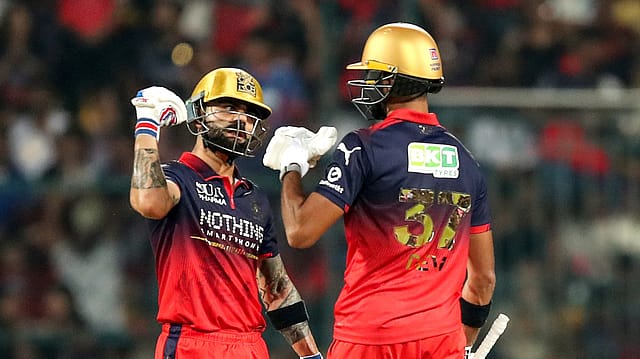
Defending champions Royal Challengers Bengaluru (RCB) have hit a worrying patch in IPL 2026, with back-to-back losses exposing cracks in what once looked like a title-ready campaign. Despite a strong start, their recent dip has raised serious questions about balance, consistency and strategy at a crucial stage of the tournament.
Currently placed fourth with six wins and four losses, RCB now face a tricky path ahead. Their upcoming clash against Mumbai Indians could define whether this slump is temporary—or something more structural.
Why has RCB’s middle order suddenly collapsed?
RCB’s strength early in the season was their explosive middle order. In the first five matches, batters from positions four to eight dominated, averaging 39.30 at a strike rate of 190.77, the best in the league.
But that momentum has vanished. In the next five games, the same group has averaged just 21—the worst among all teams—with a sharp drop in scoring impact. The frequency of collapses and “losing wickets in clusters” has made run-chases increasingly chaotic.
How big a blow is Phil Salt’s injury?
Phil Salt’s absence has disrupted RCB’s top-order stability. Before his finger injury forced him to return to the UK, he had scored 202 runs in six matches at a strike rate of 168.33, including two half-centuries.
RCB has remained silent publicly, even as “rumours and reports about them seeking replacements in Jake Frazer McGurk, Rahmanullah Gurbaz or Jonny Bairstow” circulate. While “Salt is back in India” as per recent visuals, his absence has already cost the team.

I.N.D.I.A. Falling
12 Jun 2026 - Vol 04 | Issue 75
The Unravelling of an Alliance
Jacob Bethell, brought in as a replacement, has failed to capitalise. Despite hype after a semifinal century, he has managed just 43 runs in four innings. The data suggests that “perhaps, opening is not his forte.”
Why is Romario Shepherd struggling to deliver?
Romario Shepherd, nicknamed “Super Mario,” has not lived up to expectations. Despite his reputation as a power-hitter, he has scored just 79 runs in six innings.
His struggles were evident in the loss to Lucknow Super Giants, where he “fumbled a 20 run chase in the final over, struggling against spin.” With the ball, his numbers are equally concerning, with an economy rate nearing 13.
What’s going wrong with Jitesh Sharma?
Jitesh Sharma is enduring a nightmare season. After a strong previous year, he has scored just 64 runs in eight innings at an average of 8.00.
His struggles are not just personal—they’re affecting team balance. His inability to “control the game causes Tim David and Romario to come in early,” disrupting RCB’s batting structure.
Are RCB’s bowlers failing under pressure?
Josh Hazlewood, often called “Hazlegod,” has not delivered consistently this season. While his overall numbers remain decent, his performances in defeats have been poor, with just three wickets at an average of 62.33.
RCB’s spin department has also lost its bite. Krunal Pandya and Suyash Sharma started well but have faded. In the last five matches, they’ve taken only five wickets with a strike rate of 30—the worst in the league during this phase.
The report notes a key issue: “Containment itself cannot help them.” Wickets are urgently needed.
Is Virat Kohli’s aggressive approach hurting the team?
Virat Kohli’s transformation into a high-strike-rate batter has been remarkable. This season, he has scored 379 runs at a strike rate of 164.06—his highest ever.
But this shift has come with a trade-off. Data shows that when Kohli plays longer innings (30+ balls), RCB usually wins. When he gets out early, results flip dramatically.
“In all four losses this season, Virat has faced less than 30 balls.”
His importance is underlined by another stat: RCB has scored 1,862 runs this season, with “896 runs (48.12 per cent) coming while he was present at the crease.”
The takeaway is clear—“Virat is still the glue that binds them all.” His early dismissals have triggered collapses, as seen in losses where he scored 0, 28, 19 and 32.
What lies ahead for RCB?
Despite the slump, RCB still has a strong squad with “a powerful roster of Indian, overseas batters.” Their versatility remains intact, but execution has faltered.
The challenge now is to recalibrate quickly. Whether it’s stabilising the middle order, managing Kohli’s role, or extracting more from their bowlers, RCB must find answers fast.
Because from here on, every match is not just about points—it’s about survival in the title race.
(With inputs from ANI)