PV Sindhu was struggling. Virat Kohli gave her one simple instruction — and then came the comeback
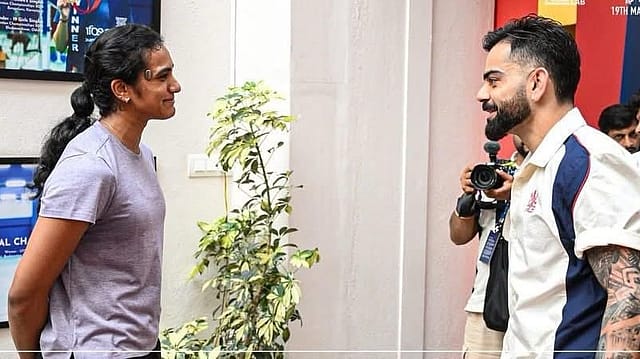
What do you tell an Olympic medallist when she tells you that nothing is working?
Cricketer Virat Kohli apparently kept it simple: Just show up.
Badminton champion PV Sindhu has now revealed how a conversation with the Indian cricket star during one of the lowest phases of her career changed the way she looked at competition, failure and herself.
Speaking on the latest episode of the Royal Challengers Bengaluru podcast, Sindhu described Kohli as “like my brother” and recalled meeting him when she was struggling. “He is like my brother I must say, because I remember when I was at my lowest you know I think I met him and I said you know nothing is happening. He just said that just show up, it is okay, just go out there and just show up,” she said.
Rise of the Pivotal Power
18 Sep 2026 - Vol 05 | Issue 38
The BRICS declaration is a strategic victory for Modi
It sounds almost too simple. But sometimes, when everything feels complicated, perhaps that is precisely the point.
When winning stops being the only thing
Sindhu knows what winning feels like. She is a two-time Olympic medallist, a former world champion and a five-time World Championships medallist. But the road back to the top has not been smooth.
The 31-year-old went through injury-hit seasons and a prolonged wait for another major title. By July this year, that wait had stretched to nearly two years. She did not hide how difficult it had been.
After winning the Japan Open, Sindhu told Hindustan Times that injuries and repeated comebacks had made it difficult to regain her rhythm. “It was quite a tough journey,” she said, describing the period of niggles, injuries and the work required to return to her level.
Then came Tokyo.
The conversation that stayed with her
Kohli's advice was not about footwork, fitness or badminton tactics. It was about turning up.
“He asked me to show up, anywhere and for anyting and just play my game. What would happen. You are not going to lose anything, you know what you are, how you have trained and show the world who you are. So I think it hit me and I think that conversation completely changed my perspective,” Sindhu said.
That distinction matters. Kohli was not promising her a victory. He was reminding her that the result was not the only thing she could control. Show up. Play your game. Trust the work. And let the scoreboard take care of itself.
Then came the Japan Open
A few months later, Sindhu had something tangible to show for that shift in perspective.
In July, she beat Japan's Akane Yamaguchi 21-17, 21-17 in the Japan Open final to become the first Indian to win the women's singles title at the tournament. Reuters described the victory as a major boost ahead of the World Championships. It was also Sindhu's first major title since the 2022 Singapore Open and her first tour-level title since the Syed Modi International in December 2024.
It was more than a trophy. For Sindhu, it was proof that the comeback was real.
And she has been clear that the work behind it involved much more than one conversation. Her coaching and support team worked on her speed, agility, strength, physical fitness and recovery. She mentioned that the team had been using data to identify the smallest gaps in her game and address them.
So no, Kohli did not somehow “fix” Sindhu's career. He gave her something far less glamorous — a way of looking at the struggle.
Why Kohli?
There is a reason Sindhu's conversation with Kohli resonates.
The two come from different sports, but they understand something about each other's world that most people don't: Pressure. Expectation. The strange experience of being celebrated for winning one day and questioned after losing the next.
Sindhu has spoken before about Kohli's ability to inspire her during difficult periods. In 2023, she shared that she had watched his interviews when things were not working out and drew motivation from his own struggles. The relationship has clearly continued.
In the latest podcast, Sindhu said she shares her victories with Kohli and recently met him again.
“Whenever I win, I just share my happiness saying that you know I have won this or that and recently I met him so it is always so good to meet you know a person who has achieved so much and to get few of those inputs from him, the way he thinks whenever he goes out there, looking at him how he shows up and how he plays and what he is, I think hats off to him for whatever he has done,” she said.
And now, Sindhu is showing up again
There is a neat symmetry to the story. The athlete who once told Kohli that “nothing is happening” is now back on one of badminton's biggest stages. The 2026 BWF World Championships are being held in New Delhi, and Sindhu began her campaign with a dominant 21-7, 21-11 victory over Ireland's Sophia Noble in the opening round. The win took her into the women's singles Round of 32.
She is chasing a record sixth World Championships medal. But perhaps the most interesting part of her comeback isn't the medal count. It is the mindset. Because elite sport has a way of making everything about the finish line. Win or lose. Champion or failure. Medal or no medal.
Kohli's advice offered Sindhu another way to see it. Sometimes the job is simply to walk onto the court. To play the game you have spent years learning. To trust the person you have become. And, when nothing seems to be happening, just show up.
(With inputs from ANI)