One Ball, Two Five-Fors: Why England Had to Saw a Cricket Ball in Half
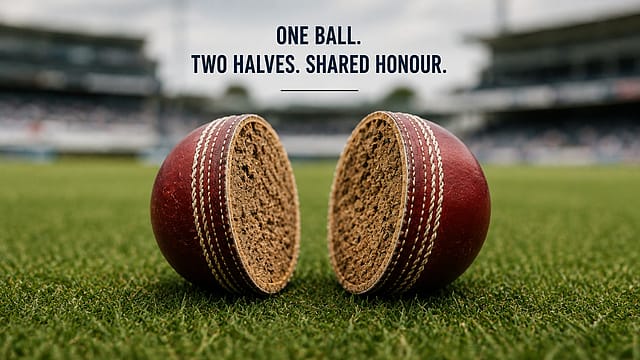
Every cricketer knows the tradition.
Take five wickets in an innings and the match ball is yours.
It sits on a shelf. Goes into a trophy cabinet. Becomes a story you tell years later.
But what happens when two bowlers take five wickets in the same innings?
At Headingley this week, England's Ollie Robinson and Josh Tongue found themselves facing precisely that problem.
And their solution involved a saw.
England vs Pakistan Produced an Unusual Cricketing Dilemma
The first day of England's Test against Pakistan had already produced plenty of drama.
Pakistan were bowled out for 171, with Robinson claiming 5 for 51 and Tongue finishing with 5 for 46. According to Reuters, the pair shared all ten wickets between them, putting England firmly in control of the match.
Rise of the Pivotal Power
18 Sep 2026 - Vol 05 | Issue 38
The BRICS declaration is a strategic victory for Modi
For a fast bowler, a five-wicket haul is cricket's equivalent of a striker scoring a hat-trick.
It's a milestone worth remembering.
Traditionally, the bowler keeps the ball as a souvenir.
The only problem?
There was only one ball.
And there were two heroes.
The Cricket Ball Custody Battle That Ended With a Saw
As the England players walked off the field, Robinson and Tongue realised they had a dilemma.
Who gets the ball?
According to Reuters, Robinson suggested an unusual compromise.
Why not split it?
Tongue agreed.
A member of the Headingley ground staff then did something not normally listed in the job description.
They cut the match ball in half.
Problem solved.
Half a ball each.
Half a memory each.
According to The Guardian, Robinson later joked that you do not come across many half cricket balls in life, making the keepsake even more unique.
Why the Match Ball Matters So Much in Cricket
To non-cricket fans, the whole episode might seem slightly absurd.
Why not just buy another ball?
Because that is not how sporting memories work.
The ball that takes a five-for is not just leather and cork.
It carries the story.
The swing that trapped a batter lbw.
The edge that flew to slip.
The roar from the crowd.
The scorecard.
The day.
Cricket has long treated match balls as treasured artefacts. Bowlers who take five wickets, hat-tricks or career milestones often keep them as mementos.
What made Headingley unusual was that tradition suddenly ran into arithmetic.
Ten wickets.
Two bowlers.
One ball.
Josh Tongue and Ollie Robinson Achieved Something Rare
The decision to split the ball was not simply about being polite.
It reflected how unusual the achievement was.
According to reports from The Guardian and Sky Sports, it is rare enough for two bowlers from the same team to take five-wicket hauls in the same innings that neither player wanted sole ownership of the memory.
Tongue himself admitted he had never seen anything like it before.
And perhaps that is why the image quickly travelled around the cricket world.
Not because of the wickets.
Because of the ball.
The Half-Ball That May Become Cricket's Most Unusual Souvenir
There is something wonderfully cricket about the whole story.
Only cricket could spend a day discussing the fate of a ball after dismissing an international batting line-up.
Only cricket could turn a logistical problem into a keepsake.
And only cricket could produce a souvenir that looks like it belongs in a science laboratory rather than a trophy cabinet.
Years from now, Robinson and Tongue may struggle to remember every delivery from that spell.
But somewhere in England, there will be two shelves.
On one shelf, half a cricket ball.
On another shelf, the other half.
And together, they will tell the story of the day England took ten wickets with one ball—and then cut it in two.