Henry Nicholls' Gritty Comeback: From Early Struggles to a Century Against India
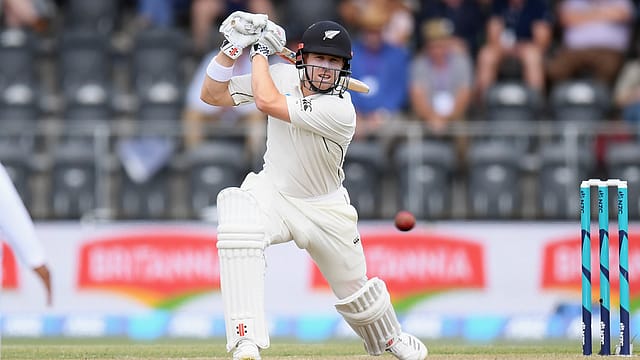
Tom Latham trusted the ball to go past his off stump. It hit the top of it. Two balls into the New Zealand captain’s innings, Henry Nicholls was required in the middle at the Basin Reserve. He had spent much of his Test career batting at No. 5, a position from which a man can at least finish putting on his equipment. Against India in Wellington, his working day began in the first over.
By lunch, he had seen four partners dismissed. The fifth, Tom Blundell, went with the score on 70. There is a particular cruelty in getting through an opening spell from Jasprit Bumrah only to find that he has taken three wickets at the other end. Whatever private satisfaction a batter might take in surviving him, the scoreboard rather spoils it.

The Wealth Issue 2026
06 Nov 2026 - Vol 05 | Issue 45
Portraits of Dreamers and Doers under 35
Then Glenn Phillips came in, and the shape of the day changed. At 107 for five, Phillips had 23 from 30 balls. Nicholls had 53 from 110. Both innings were doing exactly what New Zealand needed. Phillips could begin against a ball nearly 30 overs old because Nicholls had been there when it was three deliveries old. By the time Nicholls reached the 113 not out on the live card, he had faced 221 balls and hit 14 fours. The sixth-wicket stand had passed a hundred. India had earned the right to bowl at New Zealand’s tail before lunch. Well into the afternoon, they were still trying to get there.

The curious thing about Henry Nicholls is not that he can do this. New Zealand have known that for nine years. The curious thing is how recently they had decided they could do without him.
THE FIRST TIME, HE TOOK ON RABADA
Same ground, March 2017. South Africa had sent New Zealand in. Morne Morkel removed Latham; Kagiso Rabada took Kane Williamson and Neil Broom. Nicholls walked out at 21 for three, aged 25, without a Test hundred and with his place under scrutiny. It would make a tidy origin story to say he lowered his head and waited out the quicks. What he actually did was hit Rabada for three fours in an over.
The second boundary took him to his first Test hundred. The third took his partnership with BJ Watling past a hundred. Two milestones, separated by a ball: one secured the young man’s immediate future; the other explained why his team wanted him to have one. He made 118 out of 268.
That over is worth remembering before sticking the word gritty on Nicholls and moving on. Nobody hits Rabada for three boundaries in six balls by sheer force of character. The drives were there, and so was the cut. What distinguished Nicholls was that he could have those shots and decline to play them for quite a long time.
A year later, against England in Auckland, he took 228 deliveries to reach his second Test hundred. He finished unbeaten on 145. Asked afterwards about the innings, he spoke about the declaration: New Zealand wanted Trent Boult to have a hard ball under lights. Boult got Joe Root before the close. Nicholls had batted most of two hundred and fifty deliveries, and one of the things that pleased him was the timing of somebody else’s spell.
There is an excellent quiz question about the 2019 World Cup final. Who top-scored for New Zealand? Most people can summon Ben Stokes stretching for the crease, the ball flying off his bat, Martin Guptill’s throw in the Super Over. Rather fewer can summon the man who opened the batting and made 55 from 77 balls before Liam Plunkett bowled him. It was Nicholls. The most replayed match of his career is also the easiest one in which to forget him.
TWO HUNDRED NOT OUT. FOUR INNINGS LATER, OUT OF THE SIDE
In March 2023, back at the Basin, Nicholls made an unbeaten 200 against Sri Lanka. Williamson made a double hundred too. Four Test innings later, Nicholls was dropped. Between the end of 2023 and the tour of England in June 2026, his international red-ball career amounted to two Tests against Zimbabwe.
It is tempting to present that sequence as an injustice. It is more interesting as a selection problem. A double century tells you what a batter is capable of on his best day. It cannot tell a selector whether he is the best man for No. 5 next Thursday. Equally, once a player has been left out, there is no column in a Test scorecard for the runs he might have made. The side moves on. The player has to find an argument somewhere else.
Nicholls found his at Canterbury. In the 2025–26 Plunket Shield he scored 870 runs at 96.66. The average catches the eye; the detail that mattered for his future was where he made them. Canterbury used him at three and four. For much of his Test career, Williamson had occupied the ground between Nicholls and the new ball. In domestic cricket, Nicholls was going in early enough to find out what he could do without that protection.
That changes the meaning of the comeback. Had he simply piled up runs at five, he would have made a powerful case for getting his old job back. Instead, he gave New Zealand a reason to consider him for a different one. It also changes the way to read Thursday morning in Wellington. Coming in three balls after the toss had taken effect may have been an inconvenience. It was no longer unfamiliar work.
THE JOB WAS WILLIAMSON’S. THE INNINGS HAD TO BE HIS OWN
At The Oval in June, Nicholls made 150 not out against England. Afterwards, speaking about Williamson, he said: “I wasn’t going to replace him.” A curious thing to hear from the man batting in his position, until you consider the distinction. A team sheet needs another name at three. It does not need the new man attempting Williamson’s late dab to third man to establish his credentials.
Wellington offered a better definition of the job. Rachin Ravindra spent 50 balls making 15; he and Nicholls put on 39 after Devon Conway fell at 12 for two. It looked modest until Ravindra and Daryl Mitchell went one run apart. There was no grand turning point for Nicholls there, just the mildly brutal requirement to begin again with Blundell. Then to begin again with Phillips. What reads in the book as one long innings was, for the man playing it, a succession of partnerships, each with a different tempo and each beginning on India’s terms.
This is where the comparison with his first Wellington hundred comes good. In 2017, batting for his place, Nicholls took three boundaries off South Africa’s most dangerous fast bowler. In 2026, back in the side in a more demanding position, he let Phillips be the man who changed the pace. He was capable of playing either innings. The years had given him a better sense of which one belonged to him.
Go back to that first over. Latham shouldered arms; his off stump went. India had dismissed an opener for nothing and brought to the crease a man New Zealand once preferred to send in at five, then preferred not to send in at all. Two hundred and twenty-one balls into Henry Nicholls’ innings, India were still looking for a way past him.