‘One Defeat Cannot Decide Everything’: Harmanpreet Kaur on the Loss That Built a World Champion
At The Omaxe State in Dwarka, a stadium is still taking shape and Harmanpreet Kaur’s name is already waiting inside it.
The plans place the Harmanpreet Kaur Stand in the north pavilion’s lower bowl. More than 1,500 seats will rise close to the field inside the proposed 30,000-capacity ground. Part of it will become India’s first dedicated “Pink Stand”, conceived as a welcoming space for women and families.
On the afternoon of November 14, Harmanpreet walks into the same development in a leather jacket, cream trousers and boots. The occasion is a moderated interaction followed by questions from reporters. She has arrived as a former India captain, although the adjective still feels new. Six weeks earlier, she had ended a decade of leadership with five spare words: “Captaincy ends. The journey continues.”

The Wealth Issue 2026
06 Nov 2026 - Vol 05 | Issue 45
Portraits of Dreamers and Doers under 35
The journey has already carried her further than the girl in Moga could have sensibly planned. She has played more T20 internationals than any woman, led India more than 200 times across formats, won two Women’s Premier League titles with Mumbai Indians and become only the third Indian captain, after Kapil Dev and MS Dhoni, to lift a 50-over World Cup.

NINE RUNS FROM GLORY
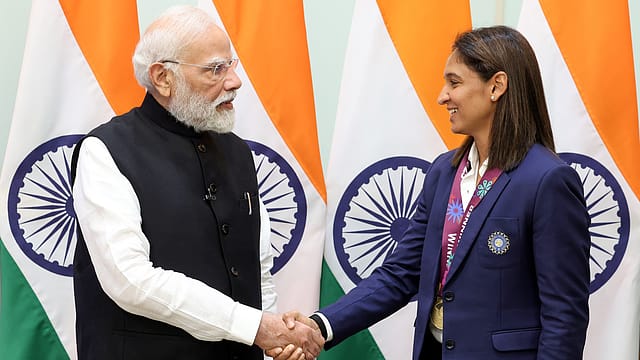
Yet when the conversation turns to Prime Minister Narendra Modi, she begins with the day she carried no trophy at all.
“We failed to win the World Cup even then, but he appreciated our work,” Harmanpreet tells OPEN Digital, recalling their meeting after the 2017 final. “The way he said, you have so much to achieve in the future. One defeat cannot decide everything.”
The defeat had been nine runs wide and close enough to touch.
At Lord’s on July 23, 2017, India were chasing England’s 228. They had reached 191 for three, with 38 required and seven wickets intact. Then the innings tightened, cracked and fell apart. India lost their final seven wickets for 28 runs. A team that could see the World Cup across the line was bowled out for 219.
Harmanpreet was 28. Four days later, the players met PM Modi in New Delhi. The Prime Minister told them that they had not lost alone; 1.25 billion Indians had carried the defeat with them. The women arrived disappointed and discovered that the country had begun looking at them differently.
The loss hurt. It also enlarged the stage.
“He motivated me, and that helped me grow as a player,” Harmanpreet says. “Whenever I got a chance to meet him, we went with a gold medal, we went with a trophy.”
She counts three meetings and three different endings. The first followed the Lord’s heartbreak. Another came with an Asian Games gold. The next followed the night India finally became world champions.
THE TROPHY THAT TOOK EIGHT YEARS
In November 2025, India met PM Modi again after defeating South Africa by 52 runs in Navi Mumbai to win the country’s first Women’s Cricket World Cup. Harmanpreet had helped break Australia in the semi-final with 89 during a record chase of 339. In the final, she took the catch that completed the victory, ran with the ball still in her hand and disappeared beneath celebrating teammates.
Eight years after Lord’s, she could place the trophy between herself and the Prime Minister.
Less than a year later, India beat Sri Lanka by 147 runs in Nagoya to retain the Asian Games title. It became Harmanpreet’s final assignment as captain. On October 6, she stepped down across all formats but made it clear that she would continue playing.
The progression sounds almost too orderly when compressed into a few paragraphs: defeat, promise, gold, World Cup, farewell. Careers are lived with more abrasion. Harmanpreet captained through near-misses, selection arguments, scrutiny and the peculiar burden placed upon a leader in a sport trying to grow while it competes.
PM Modi’s 2017 words did not erase the defeat. They prevented it from becoming a verdict.
His more recent advice asked her to turn achievement outward.
“He said one thing, that try to meet young girls, the young generation, because they dream big. So spend time with them,” she says. “Never miss that opportunity of engaging with youth.”
Harmanpreet has carried the instruction with her. “Whenever I get an opportunity, I spend time and engage with young boys and girls, so they can also get some motivation and start dreaming big.”
THE DREAM HER FATHER HANDED DOWN
The advice reaches backwards into her own story.
Before Harmanpreet became the girl other girls came to meet, she played near her home in Moga with local boys. She would tie her dupatta around her waist so it did not interfere with her run-up. Her father, Harmandar Singh Bhullar, worked as a clerk in the district courts and had played sport himself. He became her first coach.
“My father was a player,” she says. “He wanted to play for the country, but the family wanted him to get married and settle down. He didn’t get family support.”
When the same ambition appeared in his daughter, he refused to repeat the inheritance.
“He supported me and encouraged me,” Harmanpreet says. “Having your parents’ hands on your shoulder is the biggest thing. My family has been a constant source of support.”
That hand on the shoulder had practical consequences. Coach Kamaldeesh Singh Sodhi noticed the young cricketer and persuaded her father to let her train at his school and academy, around 30 kilometres from Moga. The family could not casually absorb the cost of private schooling and cricket equipment. Sodhi offered coaching and education without charging her.
The journey to training became part of the education. Harmanpreet learned early that wanting to play was only the beginning; somebody had to make the wanting possible.
“There is always risk, but when we focus on the game, it’s worth it,” she says. “I always wanted to play.”
The girl tying away her dupatta grew into the batter who untied Australia.
At Derby in the 2017 World Cup semi-final, Harmanpreet struck an unbeaten 171 from 115 balls. The innings remains the highest individual score by an Indian in a Women’s World Cup. It sent India into the final and turned her into the face of a team millions were discovering in real time.
LET THE SCOREBOARD SLEDGE
Australia has remained the opponent against whom her cricket acquires its sharpest edge.
Asked which team talks the most on the field, Harmanpreet answers without hesitation. “Australia. They don’t like anyone to perform better than them.”
Her answer carries interest rather than offence.
“When you play with the best teams, you have to take charge, come forward, fight for the target and enjoy it,” she says. “Defeating them is another level of enjoyment.”
Her response to a sledge requires neither insult nor theatre. “Score runs and win the match. That’s the aim. What can be the biggest sledging than this?”
She asks teammates “not to waste energy” replying. The scoreboard can conduct the argument.
This has always been Harmanpreet’s most recognisable register. Her best cricket is confrontational without needing a speech. The bat swing supplies the noise. Pressure does not merely accompany those innings; it concentrates her.
PRESSURE HAS WEIGHT, SOUND AND COLOUR
“Pressure is something which will always be there,” she says. “I perform best under pressure, so I enjoy it. I feel more focused.”
Her career supports the claim. The 171 came in a World Cup semi-final. The 89 against Australia arrived in another semi-final eight years later, with India pursuing the highest successful chase in Women’s ODI World Cup history. The final catch placed her beneath the ball that could end decades of waiting.
The pressure she describes is not abstract. It has weight, sound and colour.
“When I enter the stadium and I have pressure because we represent India, and then I see fans wearing a jersey with my name on it, it is pure love,” she says. “It’s not any single moment. Fans have always stood by me.”
At Dwarka, that relationship has been translated into architecture. A fan will eventually enter the new stadium, climb towards the north pavilion and sit inside a stand carrying her name. The woman who once searched the crowd for her name on a jersey will have it written across a section of concrete.
Harmanpreet is careful not to turn herself into a monument. Her answer about the Indian dressing room is “fun”. Harleen Deol is the teammate she most enjoys playing alongside. Chhole bhature remains her preferred food. When asked what she cannot live without beyond cricket, she refuses the premise.
“After my career ends, only then can I think of anything else,” she says. “For now, it’s only cricket.”
The response explains why relinquishing the captaincy did not sound like a farewell. Captaincy was one role within a life that cricket continues to organise.
WHEN WOMEN’S CRICKET BECAME A CONVERSATION
Asked what has changed most during her years in the game, she does not begin with central contracts, broadcast money, the WPL or larger crowds. Her answer is simpler.
“We now talk about women’s cricket,” she says. “Earlier it wasn’t like that.”
Her career sits across that change. When Harmanpreet made her ODI debut in 2009, an Indian woman signing for an overseas T20 league had not happened. She became the first Indian cricketer, male or female, to join Australia’s Big Bash League in 2016. Seven years later, she captained Mumbai Indians to the first WPL title. In 2025, she lifted a World Cup before a home crowd and passed the trophy towards Mithali Raj and Jhulan Goswami, the women whose careers had carried the game towards that night.
The Pink Stand is part of the same continuum. Omaxe says it was developed in consultation with Harmanpreet and designed to make live sport more welcoming for women and families. Its 1,500-plus seats will offer a close, elevated view of the field.
Those seats also complete a family circle.
Harmandar Singh could not pursue his sporting dream because support ran out. His daughter played because he made sure hers did not. She became India’s World Cup-winning captain. Now a stadium section bearing her name is being designed to make it easier for other girls and their families to enter.
The father’s interrupted dream did not disappear. It changed bodies.
Harmanpreet says she would thank her younger self for “dreaming big”. Asked who she might have been without cricket, the answer lands with none of the ceremony surrounding her achievements.
“I would be nothing,” she says.
Outside, The Omaxe State continues to rise. One day, the Pink Stand will fill with spectators. A girl may sit there in an India shirt, close enough to hear the bat meet the ball, and decide that the distance between watching and playing is not as large as she had imagined.
That is the future PM Modi asked Harmanpreet to meet. It is also the future her father once placed a hand upon.