First Ball, Final Wicket & Manav Suthar: The Spinner Who Can Bat
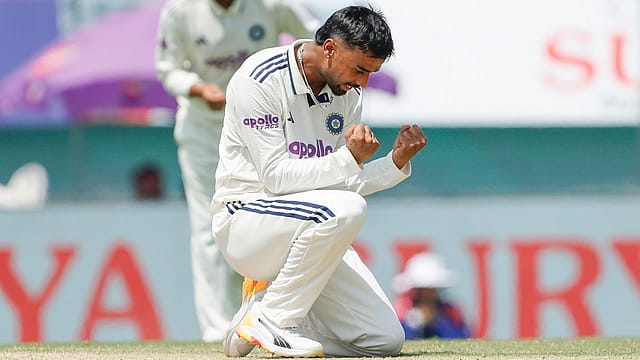
The first ball drifted towards Dinesh Chandimal.
Then it changed its mind. It curled in, gripped the Galle surface and turned away, brushing Chandimal’s glove before settling into Rishabh Pant’s hands. Manav Suthar had entered the attack in his first overseas Test. He needed one delivery to strike.
Several hours later, Sri Lanka’s last batter Lahiru Kumara charged at him. Suthar slowed the ball down, shortened the length and dragged Kumara towards a shot he could never reach. The ball spun past the bat. Pant whipped off the bails.
Suthar had begun Sri Lanka’s slide with his first ball. He closed their innings with his final one.

Rise of the Pivotal Power
18 Sep 2026 - Vol 05 | Issue 38
The BRICS declaration is a strategic victory for Modi
In between came 21.4 overs, four wickets, a bruising counterattack from two Sri Lankan batters and another clue that India may have found far more than a left-arm spinner.
Suthar finished with 4/76 as Sri Lanka were dismissed for 284, leaving India with a first-innings lead of 178 at the end of Day 3 of the opening Test in Galle. Chandimal fell first. Lahiru Udara followed. Prabath Jayasuriya ran out of patience. Kumara ran out of his crease.
The scorecard captured the wickets. It missed the larger possibility.
Three days before the Test, India captain Shubman Gill had explained why Suthar mattered to the team’s balance. India had arrived in Sri Lanka without some of its usual all-round options. Gill needed specialists to stretch themselves. He needed runs from lower down the order. He looked at Suthar and saw a potential Test No. 8.
“He has great skill with his bowling and the potential to be a really good number eight batsman as well,” Gill said.
Suthar responded with 24 runs and a 55-run seventh-wicket partnership with Dhruv Jurel. Then he took four wickets.
For his father, that batting promise carries a delicious twist.
‘Make Him a Batter the World Fears’
When Jagdish Suthar took his young son to Dheeraj Sharma’s cricket academy in Sri Ganganagar, Rajasthan, he reportedly arrived with a clear ambition.
“Make him a batsman the world fears.”
The dream lasted 48 hours.
Sharma watched the boy bowl and delivered his verdict: “Sir, this fellow is made to be a spinner. Don’t stop him. He is my responsibility now,” Sharma reportedly said in his profile in The Indian Express.
The coach had spotted what the father had missed. There was something in the smooth action. Something in the fingers. Something in the way the ball left the hand, dipped towards the batter and bit the surface.
Suthar began as children often do, swinging tennis and rubber balls around when he was six or seven. Jagdish, a physical-education teacher, encouraged him to play. At 10 or 11, Manav entered Sharma’s academy and began turning childhood obsession into repetition.
The family’s finances soon tightened. The ₹500 monthly academy fee became difficult to sustain. Sharma waived it. The boy stayed.
Suthar reportedly would sometimes train alone at empty nets. During the off-season, he could bowl 30 to 40 overs of spot bowling across three or four hours. He would bat for 15 overs, bowl for 20, then repeat the cycle.
One patch of ground. One target. Ball after ball. “Spot bowling helped me develop bowling on a tappa, put more body into my deliveries,” he underlined in one of his interviews with ESPNcricinfo.
Years later, after taking six wickets on his Test debut, Suthar reduced his craft to the same stubborn principle. “Bowling at the same spot is important. Test cricket is about patience.” At Galle, patience handed him the first wicket immediately. Then Galle tested his own.
When the Wickets Stopped
Sri Lanka had crumbled to 90/5 before lunch. Suthar had removed Chandimal for four and Udara for 27. Kuldeep Yadav and Ravindra Jadeja had joined the assault. India appeared ready to tear through the innings.
Then Sonal Dinusha and Niroshan Dickwella dug in. They swept. They defended. They punished width. Dickwella also received a life when KL Rahul dropped him at slip off Suthar on 20. The wickets dried up. The partnership swelled to 146.
Dickwella made 80. Dinusha marched to his maiden Test century. Suthar kept returning, adjusting his pace, testing the surface and asking the same questions. This was closer to the Test cricket he had spent years preparing to play. The instant celebration had passed. Now came the grind.
Suthar eventually removed Jayasuriya for his third wicket before luring Kumara out of his crease to complete the innings. His four wickets combined with Jadeja’s three to keep India firmly ahead despite Sri Lanka’s recovery. Dark clouds eventually ended play before India could begin its second innings.
Two Tests into his career, Suthar has 11 wickets from three innings: 6/33, 1/29 and 4/76. The numbers have arrived quickly. The journey did not.
The Long Route to India
Suthar made his first-class debut for Rajasthan in February 2022. The following Ranji Trophy season pushed him forward: 39 wickets from six matches, the most for Rajasthan.
India’s development system began calling.
He represented India A and India Emerging. At the 2023 Emerging Teams Asia Cup, he took 10 wickets in five matches. A year later, he ripped through India D with 7/49 in the Duleep Trophy. In the same competition, he scored 82 against India B and strengthened the case that had first lived in his father’s imagination. The spinner could bat.
Suthar’s lower-order game continued to grow. In January 2026, he produced the most emphatic proof: 120 against Himachal Pradesh, followed by seven wickets in the match.
The India call began to feel possible. He refused to wait for it passively.
Even while playing the IPL in 2026, Suthar practised with the red ball. The tournament demanded short spells, instant variation and survival inside a batter’s game. His mind wandered towards longer spells, tighter lines and a cap he had chased since childhood.
“When my name came up in the team, I was practising with the red ball during the IPL as well, thinking about how I would approach things if given the opportunity,” Suthar later recalled.
He also offered a line that explains the hours in empty nets and the appetite for long spells.
“If you enjoy bowling, you can bowl 20-25 overs without even realising it.”
Six Wickets and a Phone Full of Emotion
The opportunity arrived against Afghanistan in New Chandigarh in June 2026.
Gautam Gambhir and Gill told Suthar he would make his Test debut. Kuldeep presented him with the cap and delivered a speech Suthar would later describe as deeply motivating.
The moment reached far beyond the dressing room.
“It was a very proud moment because, ever since I started playing, it had been my dream, my father’s dream, and everyone’s dream for me to play Test cricket for India,” Suthar said.
Red-ball cricket, he added, had “meant everything” from his U-19 days through the Ranji Trophy. His family did not travel to the ground. They were superstitious. Jagdish later revealed that the family had also stayed away from Manav’s IPL debut, and it had gone well. They decided to repeat the ritual for his first Test. Their absence changed nothing about what the cap meant.
The boy whose academy fees had once strained the family walked into Test cricket and took 6/33 in Afghanistan’s first innings. He added another wicket in the second, scored 28 and collected three catches. India won by an innings and 300 runs, its biggest Test victory by an innings margin.
Suthar walked away with the Player of the Match award. “It’s an unreal feeling. Top of the world feeling,” he said.
His 6/33 became the second-best innings return by an Indian bowler on Test debut, behind Narendra Hirwani’s 8/61 against the West Indies in 1988. He became only the second Indian this century, after Amit Mishra, to take five wickets in his maiden Test innings.
Yet the most revealing part of his post-match assessment lay elsewhere.
Suthar spoke about his stock delivery. About recognising that the pitch was slow. About putting more effort into the ball. About resisting the temptation to chase wickets merely because the surface had begun to assist him. The debut produced history. His explanation returned to discipline.
The Batter Returns
Galle offered the next examination. Afghanistan had introduced Suthar to Test cricket at home. Sri Lanka asked whether his control would travel.
It did. The pitch offered turn, although Dinusha and Dickwella showed that survival remained possible. Suthar conceded runs, lost a wicket to a dropped catch and watched a sixth-wicket partnership drag Sri Lanka back into the contest. He still finished with four. His batting supplied the quieter evidence.
India had slipped from 288/2 to 377/6 when Suthar joined Jurel. Another wicket could have exposed the tail and kept the total within Sri Lanka’s reach. Suthar stayed for 42 balls, scored 24 and helped add 55. India crossed 400 and eventually reached 462.
Gill’s words from before the Test had begun to acquire substance. “At this level, you need a bit of experience, belief, and confidence,” the captain had said of Suthar’s batting. “That will only come once you’re out there playing and scoring runs.”
A Test No. 8 cannot survive on promise. India has spent years understanding the value of cricketers who lengthen the batting without weakening the bowling. The standard is brutal. Suthar has played two Tests. His batting remains a project.
But India has started investing. And perhaps Jagdish Suthar’s original dream never truly died. It merely changed shape. He wanted a batter the world would fear. Dheeraj Sharma gave the boy a ball. The boy bowled alone for hours, hammered the same patch of earth, climbed through Rajasthan and India A, practised with a red ball during the IPL and carried his father’s dream into the Indian dressing room.
In Galle, Manav Suthar struck with his first ball. With his last, he finished the innings. Somewhere between the two, India’s search for its next Test No. 8 took one significant turn.
(With inputs from ANI)