Australian Open: Alcaraz Topples Djokovic to Become Youngest Career Grand Slam Winner
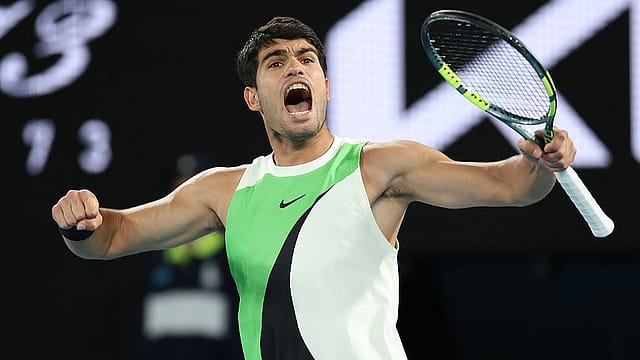
For three hours and two minutes on Sunday night, Melbourne watched tennis tilt on its axis.
When Carlos Alcaraz finally drove a forehand deep into the corner and saw Novak Djokovic’s reply sink into the net, the 22-year-old Spaniard collapsed onto the blue hard court—arms splayed, chest heaving, history secured.
The scoreboard read 2-6, 6-2, 6-3, 7-5. But the moment read much bigger.
With that win, Alcaraz claimed his first Australian Open title, completed the Career Grand Slam, and became the youngest man in the Open Era to do so. He also denied Djokovic a record-breaking 25th Grand Slam, extending a wait that now feels as psychological as it is physical.
“It’s a bit weird seeing Rafa in the stands,” Alcaraz said later, glancing up at Rafael Nadal, watching from the arena. “It’s such an honour playing in front of you. Thank you for being here.”
A final loaded with history
This was never just another final.
Alcaraz arrived chasing the one major that had eluded him. Djokovic walked in defending his most faithful kingdom—Melbourne, where he had won 10 titles and compiled a staggering 104–10 record.
The contrast was stark: Youth versus endurance. The future knocking. The past refusing to leave.
Djokovic struck first.
At 38, the Serbian produced a masterclass in controlled aggression in the opening set—constructing points with surgical precision, breaking early, and dictating play as if the years had never caught him. Alcaraz looked rushed, misfiring under pressure as Djokovic sealed the first set with authority.

The BJP Nation
08 May 2026 - Vol 04 | Issue 70
Now all of India is in his thrall
But the question lingered: how long could that level last?
Momentum shifts and youth asserts itself
The answer came early in the second set.
At 1-1, a brutal net cord fell Alcaraz’s way, helping him break serve. It was a small moment—but decisive. From there, the Spaniard found rhythm, depth, and patience. Djokovic’s serve lost bite. His groundstrokes lost weight.
Alcaraz surged, levelling the match, then breaking twice in the third set to take control.
Still, Djokovic would not fold.
In the fourth set, he fought off six break points early and clawed his way back into contention, forcing tense baseline exchanges and testing Alcaraz’s nerve. At 5-5, with the title on a knife’s edge, Djokovic blinked—clattering a forehand into the net on championship point.
And that was that.
Respect across the net
The first act after the finish was not celebration, but respect.
Djokovic climbed over the net to embrace Alcaraz—warmly, sincerely—acknowledging a passing moment.
“The work you have been doing is historic—legendary,” Djokovic told him during the presentation. With a grin, he added: “You’re still young, so I’m sure we’ll be seeing each other many more times over the years.”
Alcaraz returned the tribute in kind.
“I want to talk about Novak,” he said. “What you’re doing is inspiring—not just for tennis players, but for athletes around the world. It’s an honour sharing the locker room and the court with you.”
A legacy moment for both
For Alcaraz, the numbers now place him among the giants.
He becomes the sixth man in the Open Era to complete the Career Grand Slam—joining Rod Laver, Andre Agassi, Roger Federer, Rafael Nadal, and Novak Djokovic. At 22 years and 272 days, he is the youngest ever to do it. He is also the youngest man to win seven Grand Slam titles, surpassing Björn Borg.
For Djokovic, the night carried a quieter weight.
“I didn’t think I’d be standing at the closing ceremony of a Grand Slam again,” he told the crowd. “Who knows what happens tomorrow, let alone the next six or 12 months. But it’s been a great ride.”
It was his 21st Australian Open appearance. And perhaps—though no one dared say it aloud—not guaranteed to be his last.
The torch doesn’t drop. It’s handed over. This Australian Open had threatened to drift quietly into memory.
Instead, it ended with clarity. One era acknowledged. Another announced.
Alcaraz didn’t just win a title in Melbourne. He stepped fully into history—while Djokovic, ever gracious, stood close enough to remind the world what greatness looks like when it yields.
(With inputs from ANI)