Masters of the Game: India’s spectacular defence of the T20 World Cup at home hinged on a high-risk, high-reward strategy
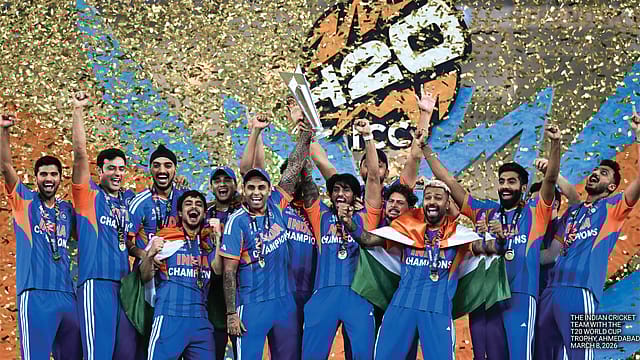
IN WHAT MADE for a surreal scene at the Narendra Modi Stadium long after India had won the T20 World Cup, Sanju Samson sat all alone. This moment has gone viral on social media since, but it was visible from the distant stands of the ground in Motera, packed to its tall rafters an hour after the final had ended, most eyes focused on the smaller celebration choreographed by the dancing Indian contingent of Hardik Pandya, his girlfriend, Ishan Kishan and Shivam Dube.
A short distance away from his dancing colleagues, Samson placed himself on the edge of the stage that would soon conduct the presentation, wholly undisturbed. In this solitude, he had a pleased look on his face, quietly smiling to himself with a vacant gaze into the middle distance. Here was a man who had just scored a rollicking innings of 89 in the final, following an essay of 89 in the semifinal, which in turn had followed an unbeaten 97 in a virtual quarterfinal—back-to-back-to-back, a feat so unprecedented that it will perhaps never repeat itself in a cricket World Cup. Yet, not one person on the field, be it his teammates, those of the opposition, coaching staff or administrators—all abundantly present on the green lawn—approached him.
This visual, in many ways, was the very essence of India’s historic third T20 World Cup win, the first team to defend a title and the first to win this trophy at home—a symbol of how the victory belonged to no one in particular and everyone together at the same time. This, despite the campaign having witnessed several great individual performances, starting with Samson and ending with Jasprit Bumrah, like it was on Sunday night (March 8) and several other nights right through the tournament. But head coach Gautam Gambhir—used to Samson-esque performances in World Cup finals when he was a cricketer—will be the first to tell you that these great bowling and batting knocks witnessed in the 2026 edition were designed such that personal glories were translated into greatness for the collective.
Survival Instinct
22 May 2026 - Vol 04 | Issue 72
India navigates global economic turmoil with austerity and smart diplomacy
“Because ultimately, in that dressing room, your 97 or 98 will be appreciated as much as 100. And that will not happen just by speaking, it will happen through our actions,” said Gambhir, speaking at the presser after collecting his first world trophy in a coaching role. Which then explains Sanju’s near-century misses on three separate occasions, what with him having his foot pressed against pedal. The coach has a name for this strategy, a phrase that will soon become unanimous with this World Cup campaign—“high-risk, high-reward”.
“I always believe that high-risk, high-reward is the only way to play a T20 format. And that you don’t fear losing a game of cricket to win a game of cricket. If you start fearing to lose a game of cricket, you will never win. And that’s why, my ideology with the captain [Suryakumar Yadav] was very simple—we will not play a match to score 160-170. I would rather accept that we get all out at 100, but that 150-160 takes you nowhere… If you play high risk, that’s when you make 250-260 runs.”
This strategy, of course, backfired almost instantly, during India’s opening game against the US in Mumbai—where they found themselves at 77/6 at one perilous stage, only to be rescued by a counter-attacking captain, who scored 84 not out. But far more significantly, it properly backfired in the first match of the Super 8s, when India lost to South Africa in Ahmedabad by a whopping 76 runs. This ensured that every match hereon had become a do-or-die game for India, yet, in Gambhir’s own words, his all-or-nothing strategy didn’t change. “I never thought that now let’s play a little subdued. All were knockout matches. But despite that, if you play that kind of cricket, that’s when you give yourself the best chance to win big tournaments.”
But here’s the key point to read between Gambhir’s lines. The high-risk, high-reward gameplan didn’t just apply to match-day scenarios. It was also implemented under-the-hood and behind-the-scenes, such as in structural renovations to the playing eleven. Thus, when it was least expected following the loss to South Africa, Gambhir and his think-tank turned to the forgotten man of Indian cricket, Sanju Samson.
LIKE THE DRUMMER of a rock band who is always around but only ever noticed for his mistakes, Samson, the prodigy from Kerala who had made a great splash on his arrival over a decade ago, was now 31, languishing and had made an uneasy peace with the sidelines. He was part of the 2024 T20 World Cup winning squad, but didn’t feature in a single game. Then, when the likes of Rohit Sharma and Virat Kohli retired from the format, making ample room for him at the top, India filled those spots with the young and fearless who had taken T20 cricket by storm in recent IPLs—the likes of Abhishek Sharma, Tilak Varma and Ishan Kishan.

The only problem with this top-3 that formed an alliance just in time for this World Cup? All were lefties, and were often susceptible to the cunning plan employed by all opposition teams of using an off-spinner with the brand-new cherry. Samson played only one game in India’s group stage, and that too due to Abhishek’s illness. But when the chips were down in the Super 8s, he was summoned to partner up with Abhishek at the very top. And boy, did he arrive.
“Great things come to those who wait,” said captain Surya, soon after Samson rocked this World Cup with perhaps its finest knock against the West Indies in Kolkata, that unbeaten 97 being the highest score by an Indian at the T20 World Cups in a successful chase (eclipsing Kohli’s two unbeaten 82s), while the chase itself was the highest India had successfully managed at the world event—196 for victory. Opener Sanju was present for every run of it, having scored half of them without as much as playing a false shot, even as the other half was barely patched together for the loss of half the Indian side.
“I have only played maybe 60 games, but I’ve seen around 100 games [from the dugout] and I’ve seen how the greatest people have finished such games,” Samson said in Kolkata. Like us, and all those who witnessed it, he too thought it was his finest hour, calling it “one of the greatest days of my life,” only to be in a position to repeat the feat over and over again at the pointier end of the tournament—the semis and the finals.
Against England at Wankhede, Samson was dropped very early in his innings by the opposition’s leader, Harry Brook. Far from being cautious, he gunned his way to the first of his twin 89s, leading India to a total of 253. The next highest score on a belter of a batting track, incidentally, was Dube’s 43. It is now safe to say that without Gambhir and Samson’s high-risk strategy, the side would not have been able to eke out the narrowest of wins, by just seven runs. Which, in turn, is the very meaning of high reward.
Then, come the all-important final, for which close to 1,20,000 spectators took their seats, making it the most-watched World Cup finisher in history, chase-loving India was made to bat first. It made for a strange spectacle, with red-hot Samson and stone-cold Abhishek seeing off the first two New Zealand overs for a total of 12 runs, only to bash 80 from the next four overs to achieve the highest-ever powerplay total by India in T20 cricket—92/0 after six overs. The risk-taking here was so intense that a suitable reward followed suit, so much so that the result was all but in the bag for the hosts with 34 match-overs to spare.
But make no mistake, without Abhishek’s crucial fifty in the final, without Kishan’s consistency at No 3, without Dube’s cameo with the bat and bowling that all-important final over in the semis, without Axar Patel’s three glorious catching moments at the Wankhede, without Pandya’s all-round effort as a new-ball bowler and death-overs finisher with the blade, without Tilak’s selfless role as a floater in the batting order and without Bumrah’s once-in-a-lifetime skillset with the ball and his uncanny ability to produce yorkers and wickets at will, Samson, Gambhir and India could not have won this World Cup as comfortably as they ended up doing.
Which is perhaps why this World Cup victory is different from the four others that India has won across the two white-ball formats, given that they were all eponymous with their captains. 1983 will always be remembered for Kapil Dev, 2007 and 2011 for MS Dhoni, 2024 for Rohit Sharma (and, in this case, Kohli too). On the other hand, 2026 is not Surya’s World Cup. As the captain slapped his cheeks playfully on his way to the stage to lift the trophy, he was lifting it on behalf of a strategy, a team and a nation, all of which came together when it mattered to make this India’s World Cup.