At Full Speed: Arjun Erigaisi in 2025
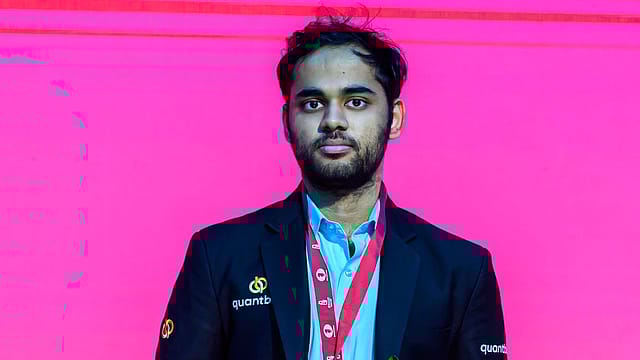
Few chess players have had as good—and as heartbreaking—a year as Arjun Erigaisi. 2025 was the year his talent, tenacity and tactical audacity converged into a defining arc, announcing his arrival at the highest levels of world chess and carving his name beside legends of the game. But there was also a significant upset—a quarterfinal loss at the World Cup shut the door on his 2026 Candidates bid, effectively delaying any world title challenge until 2028.
Erigaisi entered the year a rising star, a player whose dynamic style and willingness to enter sharp complications made him both feared and admired. Yet few could have predicted the sweep of accomplishments that awaited him. What began as a season of solid performances soon gathered momentum, propelling him into the global spotlight with a series of results that, piece by piece, stitched together a breakthrough year.
Between late February and mid-March, he accomplished a rare online feat by winning three consecutive Chess.com Freestyle Friday events, a streak widely noted as a first for an Indian player and exceptional in its own right. Mid-year, Erigaisi also played a starring role in Team MGD1’s victory at the 2025 FIDE World Rapid Team Championship in London, with his board-one win in the decisive final-round match helping seal the title. These victories signalled a competitive maturity and adaptability across formats, an ability to thrive under the relentless time pressure and tactical volatility that define elite rapid and blitz play.

India's Action Hero
27 Mar 2026 - Vol 04 | Issue 64
Riding the Dhurandhar Wave
The real crescendo on the world stage came at the 2025 FIDE World Rapid Chess Championship in Doha. In a field crowned by classical and rapid heavyweights, Erigaisi produced a sustained performance with 9.5/13 points. This tally earned him the bronze, placing him among the top three in one of chess’s most gruelling formats. He finished in a four-way tie, with Magnus Carlsen winning the title and Vladislav Artemiev taking silver. It was a landmark result for Indian chess. Erigaisi became the only Indian male player since Viswanathan Anand to finish on the podium at a World Rapid Championship.
Against Carlsen, widely regarded as the most formidable rapid-and-blitz player of the modern era, Erigaisi defended with a kind of stoic exactness, outgunned in material, yet resourceful enough to grind out a draw that travelled far beyond the single half-point it earned. His third-place finish secured him a quota for the pilot event of the Total Chess World Championship Tour, a new FIDE-approved initiative, with the pilot planned for October 2026.
Just days after his rapid success, Erigaisi returned to the board for the FIDE World Blitz Championship, the fast-paced sibling of the rapid event that demands instant calculation and psychological resilience. There, he was the embodiment of consistency. Across a marathon of 19 games, Erigaisi scored an impressive 15 points, finishing atop the leaderboard and qualifying for the knockout phase. His run included a win over Carlsen himself—an encounter that became instantly memetic as Carlsen slammed the table in frustration after the loss, drawing criticism from fellow grandmasters and a familiar churn of debate about conduct under pressure.
In the semifinals, Erigaisi faced Uzbekistan’s Nodirbek Abdusattorov, a former World Rapid Champion and one of the most difficult opponents to outcalculate at blitz speed. The match did not go in his favour: Erigaisi lost 2.5–0.5, ending his bid for the world title. Yet he still finished the championship with the bronze medal, replicating his rapid success and completing a rare double podium at the World Rapid and Blitz Championships—the first such double for an Indian since Anand.
The importance of this double podium cannot be overstated. Erigaisi has demonstrated a remarkable breadth of skill, adjusting his thinking and risk thresholds across time controls with a fluidity few can match. His accomplishments over that championship week became a national talking point in India, sparking congratulatory messages from Prime Minister Narendra Modi.
And yet, Arjun Erigaisi’s 2025 season was also shaped by what narrowly eluded him. His most direct path to the Candidates Tournament ran through the FIDE World Cup held in Goa in November, where the top three finishers would qualify for the eight-player field that determines the next World Championship challenger. Seeded among the favourites, Erigaisi played to expectation through the early rounds, including a hard-fought victory over Levon Aronian, and reached the quarterfinals with his candidacy very much alive. There, however, his run ended in rapid tiebreaks against Wei Yi, a defeat that simultaneously knocked him out of the tournament and shut the door on his Candidates qualification by this route. Because the Candidates winner becomes the challenger to the reigning world champion in the biennial cycle, and no other qualifying pathways remain for Erigaisi in this cycle, Erigaisi will not have an opportunity to compete for the World Chess Championship title in 2026. As a result, his next realistic shot at the title match will fall in the 2028 championship cycle, under the next Candidates qualifying cycle.
By the time Erigaisi arrived in Doha for the World Rapid and Blitz Championships later in the year, that disappointment still lingered in the background. And yet, he not only delivered his best performances at these events but he also won the Jerusalem Masters, defeating Viswanathan Anand in an all-Indian final after the rapid portion ended level and the contest spilled into blitz tiebreaks.
Where 2024 had seen him reach new heights like crossing the 2800 Elo threshold and contributing to India’s Olympiad gold, 2025 saw him sustain that promise and translate it into repeatable world-class outcomes—medals on the biggest fast-chess stage, a marquee title win against Anand, and a team world championship to underline the breadth.