Argentina vs England: Is It Now Time To Call Out Football’s Biggest Double Standard?
Whenever England and Argentina meet on the football field, memories of their bitter history resurface with enormous intensity with many commentators endlessly waffling about the ‘Hand of God’. Whenever the two sides clash in a World Cup, supporters of the Three Lions invariably bring up Diego Maradona’s first goal against England in the 1986 quarter-final in Mexico City, arguing that England were robbed. What commentators rarely mention is the controversial ‘ghost goal’ in the 1966 World Cup final that proved crucial to England winning its one and only FIFA World Cup.
Modern goal-line technology and the Video Assistant Referee (VAR) would almost certainly have settled the debate. Alternatively, anyone can form their own opinions after watching videos from the time. Geoff Hurst struck the ball against West Germany hitting the underside of the crossbar before it bounced. The referee awarded England goal although pundits have since then argued that the ball never fully crossed the line. England eventually defeated West Germany 4–2 after extra time at Wembley Stadium.

The Age of Anger
31 Jul 2026 - Vol 05 | Issue 31
A raging generation makes the government relent. What's next?
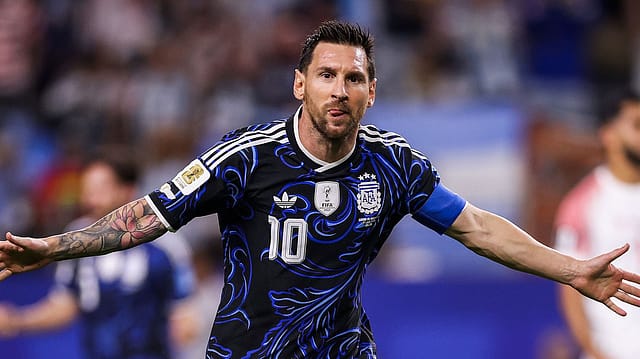
Maradona himself once taunted England by saying Argentina had beaten them in 1986 with two unforgettable goals – the Hand of God and the Goal of the Century – unlike England, which, according to him, had won its only World Cup with a phantom goal. The context here is, of course, the latest match in which Argentina came from behind after conceding an early goal -- Enzo Fernández equalised in the 85th minute before Lautaro Martínez headed home a stoppage-time winner with Lionel Messi providing both assists.
More than four decades have passed since the Falklands War of 1982 and the thrill in Argentina of defeating England first by deceit and then by brilliance in 1986 has naturally faded. Yet commentators remain fixated on that quarter-final match because, obviously, Maradona’’s legacy has not dimmed an ounce. His status as Argentina’s greatest football icon endures.
Now, England vs Argentina rivalry is older than 1986.
Seven days before the final that gave England their only World Cup title in 1966, they defeated Argentina 1–0 in the quarter-final at Wembley on July 23, 1966. Geoff Hurst scored the only goal, but the match is remembered less for the football than for its extraordinary hostility. Often called the “Battle of Wembley” or the “Battle of 1966”, it saw Argentine captain Antonio Rattín sent off over fouls. But since he refused to leave the pitch, he had to be escorted away by police. The controversy surrounding the match later helped prompted FIFA to introduce the yellow and red cards.
Although their 1962 World Cup meeting was relatively uneventful, the rivalry reignited in 1998 when David Beckham was sent off after kicking Diego Simeone. England's 1–0 victory in the 2002 World Cup, thanks Beckham's penalty, was widely seen as his redemption and tensions were high in that match.
Their history is much older than 1982
Again, the political tensions between Argentina and England, however, are much older than the Falklands War. We will always remember the conflict of 1982 and the footballing revenge of 1986 because, as Martin Amis wrote in The Guardian in 2004, “1986 brought him his nationalist apotheosis: he captained Argentina in the World Cup, and they won it. He was 25.”
Amis also observed that in South America it is often said that the key to understanding Argentines lies in their view of Maradona's two goals against England. While the second goal – the “Goal of the Century” – is celebrated across the world as one of football's greatest individual efforts, many Argentines cherish the Hand of God even more because of what it symbolised in the aftermath of the Falklands War.
Whether Amis was right or not, the roots of Anglo-Argentine hostility stretch much further back.
In Argentina, they are remembered as the Reconquista and the Defensa, collectively known as the British invasions of the Río de la Plata, two failed British invasions between 1806 and 1807.
The John Carter Brown Library at Brown University describes them as “a series of failed British military campaigns that played a significant role in the rising momentum of Argentine and Uruguayan independence movements and, in a counterintuitive way, laid the groundwork for British commercial dominance in South America during the nineteenth century”.
According to the library, the first invasion resulted from an expedition launched by Commodore Sir Home Riggs Popham. British forces under General William Carr Beresford occupied Buenos Aires on June 27, 1806, before being driven out by troops led by the French-born Santiago de Liniers. The second invasion followed Britain's capture of Montevideo in early 1807. General John Whitelocke led an assault on Buenos Aires in July but underestimated fierce urban resistance. He was defeated and agreed to withdraw British forces from the Río de la Plata, bringing the campaign to an unsuccessful end.
True, defeat lingers longer in the memory than victory.
On July 16, 2026, Argentina’s players celebrated their World Cup semi-final victory over England with a banner “Las Malvinas son Argentinas” with reference to the Falkland Islands that took place 44 years ago, which ended in a decisive British victory, leaving a lasting imprint on Argentine national consciousness.