Playing the Social Game: America’s fastest growing Pickleball sport is powering a recreational surge in urban India
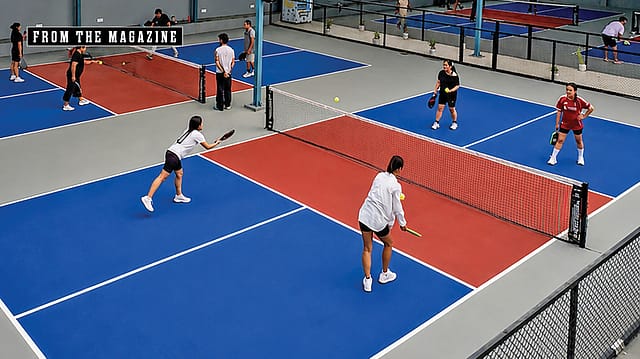
SMASHVILLE, A TINY racquet sport club located on Chennai’s busy East Coast Road (ECR), sits between a wedding hall and a massive Mughlai restaurant. So, when a car pulls up by its gate (framed by a hoarding announcing the presence of tennis and pickleball courts under a picture of Roger Federer executing a backhand) and a party of four—two children, father and grandmother—steps out on a weekday evening, I assume that they have parked by the wrong entrance. But they make their way into Smashville in a group, pick up their paddles and are ushered by the club’s assistant to the only vacant pickleball court.
There, for an hour between 7 and 8PM under short floodlights, they indulge in a round of doubles—an eight-year-old girl and her father on one side; the grandmother and a 10-year-old boy on the other. To the metronomic soundtrack of paddle on plastic ball, the family swat forehands and backhands, shout out scores, laugh on occasion and chat away, all while sweating profusely. When the hour is complete, they return their paddles, jump back into the car and drive away.
“What you saw there is the very essence of why pickleball has spread like wildfire all over India, as well as globally,” says Navneeth Baskaran, owner of Smashville. “Tell me one other sport, or recreational activity in this case, that allows three generations to participate together on a court, with the sport itself being equally easy and simultaneously challenging to all of them? There really is nothing else like it, that’s the primary reason for its enormous success.”
The fact that Navneeth says this from deep inside the only tennis facility – a clay court – on the premises isn’t lost on anybody. Navneeth used to be a professional tennis player, a national champion at the Under-14 level in India and also once a No7 doubles player in NCAA’s Division 2 in the US. When he was done with his tennis career and looked to get into coaching kids in his mid-30s, Navneeth was certain of building his own academy. He chanced upon a plot of land in Injambakkam, ECR, that could either fit two tennis courts in all; or one tennis court and a bank of pickleball courts. The choice was a no-brainer.
“The pickleball trend had already caught on by the time I leased this land in 2024. Also, more to the point, four pickleball courts can be built in the space it takes to host one tennis court,” he says. “I made three because I wanted it to be of international quality, the surface I chose was Rebound Ace, which was used in tennis in the Australian Open, with enough space for floodlights between them.”
It is on these pickleball courts, rented by the hour, that Navneeth truly runs his business. The solitary tennis court is used to coach the odd child with pro-tennis ambitions. During my dusk visit of Smashville, I saw two kids being coached by Navneeth, whereas the three pickleball courts rotated over in sets of 12, all through the evening. “That’s how it is all over Chennai now, for sure. Perhaps all over India and globally too.”
It certainly is. In nearby Kilpauk, an old tennis club has wholly metamorphosed into a pickleball centre to keep up with the demand. They weren’t alone. Khar Gymkhana in Mumbai converted portions of its racquet-sport arena into dedicated pickleball venues amid surging popularity. In the National Capital Region (NCR), where space isn’t a constraint, entire pickleball-exclusive centres have sprouted out of nowhere, such as Pickleball Kingdom in Gurugram, spread over 20,000 square feet with eight indoor courts, including two tournament-level courts.
“Pickleball Kingdom is a very popular pickleball franchise in America, the largest brand there, and I am responsible for bringing it to India,” says Bhanu Gulatti, the 48-year-old director and co-founder of BAQ Wizards, the company that partnered with Pickleball Kingdom for this market. Unlike Navneeth, Gulatti had no past in playing sport at a serious level, but when he had enough of his corporate life and wanted to do something on his own, he let the market trends dictate his future. “The pickleball boom is real, so I went to the US to see what I could do about it. That’s how we got the pan-India master franchise rights for Pickleball Kingdom,” he says. “After a successful run in the US for the last five years, the brand has entered India with us and they have now announced Europe as the next Pickleball Kingdom market.”

So, why has pickleball, out of all the recreational activities out there, become the new cultural fad? “It isn’t a fad. The market tells you that it cannot be a fad when it is the one sport that allows simultaneous competition across all age groups. It is a diverse sport where men and women can play together. It has created an opportunity for entire families to come together and spend their evenings in a non-sedentary way,” says Gulatti.
How many of his courts are usually occupied, I ask. “It is right now 8PM on a Tuesday evening, as we speak,” he says, chuckling. “Six out of my eight indoor courts are full.”
PICKLEBALL’S ORIGINS ARE surprisingly humble. The sport was invented in 1965 in Washington, when three friends—Joel Pritchard, Bill Bell and Barney McCallum—improvised a game to entertain their bored children using a badminton court, ping-pong paddles and a perforated plastic ball. For decades it remained a largely recreational American pastime, particularly among older adults. Then came the pandemic, and before anyone could blink, the sport had exploded.
“Pickleball is the fastest-growing sport in the United States,” stated an article in The Athletic, published in February 2025, going on to explain why tennis’ first couple, Andre Agassi and Steffi Graf, went on to invest heavily in the sport via Joola, one of pickleball’s leading equipment brands. The Athletic article also casually name-dropped some other American celebrities caught up in the pickleball whirlwind, either as casual players or owners of professional pickleball teams, such as Bill Gates, Leonardo DiCaprio, Tom Brady and LeBron James.
The celebrity culture in Mumbai, too, has sponged on to the pickleball craze. While the paparazzi were once summoned to suburban gyms to catch a glimpse of up-and-coming movie stars post-workout, now the daily-wage photographers make a beeline to these new racquet clubs. Although he may not be a celebrity yet, pickleball does have a professional face in India, and his name is Armaan Bhatia.
At 28, Bhatia sits at the centre of Indian pickleball’s rapid ascent. He isn’t just India’s top-ranked player, but the best in Asia. For someone of his pedigree, it is remarkable that Bhatia stumbled upon the sport almost by accident as recently as late 2020, when a pickleball court appeared at his home club, Khar Gymkhana. A former competitive tennis player, he picked up a paddle out of curiosity, entered his first tournament in Goregaon in May 2021 and won it.
“That’s when I took the call to play pickleball full-time. I wasn’t sure how it would go. I knew I was good at it, but it was still a risk,” he says. The gamble paid off. Today, Bhatia is among the world’s leading doubles players and at the heart of India’s fledgling professional circuit. Like Navneeth and Gulatti, but with a paddle in hand, he spotted pickleball’s potential long before much of the country did.
“I saw that the sport was growing at a very rapid rate and knew instinctively that it would grow further,” he says. “Which it has, although it is still in a very nascent stage globally. The scope is infinite.” That growth, he believes, boils down to one word. “Accessibility. Court rentals are a lot cheaper than tennis and padel, and the entry point is much lower. It is much easier to pick up a paddle and start playing. That is essentially why it is catering to an Indian audience, where the sport is growing faster than most places in the world.”
Affordability is only half the story. The dimensions of the game, Bhatia argues, have created a sport that is as much about conversation as competition. “The size of the court is small, so it lends itself really well to players being social with each other. There are lots of conversations and laughs. That’s very unlike playing doubles in tennis, which is a lot quieter and more serious because the court area is much bigger.”
His observation echoes what Navneeth had witnessed at Smashville. “If you want to play tennis properly, it’ll take you five years simply to learn how to hit the ball correctly, with topspin and consistently over the net,” he said. “In pickleball, you pick up the paddle and you’re on.”
Bhatia also smiles at the oft-repeated claim that pickleball is easier on the body than tennis. Easier to pick up, yes. Easier to excel at, not quite. He says this while nursing a partially torn meniscus after weeks of overuse. “Yes, I would say it is easier at the entry level. It is easier to learn and hit the plastic ball with friends. You just need to know how to get the ball over the net. But it is tough to get a lot better at it. That’s when the wear and tear happens.”
The sport’s other criticism is that it risks becoming an expensive hobby before it becomes a mass pastime. Professional-grade paddles can cost upwards of `18,000 and, unlike tennis racquets, have a limited lifespan. “If you’re playing pickleball professionally without a paddle sponsor, it gets expensive,” Bhatia says. “A paddle can cost about `18,000. Unlike a tennis racquet, where you simply replace broken strings, a paddle eventually delaminates—the glue separates from the core—and once that happens, it can’t really be used again. It will have to ride that elite hump before it becomes massy.”
Yet, he believes that transition is already underway. “The sport is already growing in rural areas. The trend has moved well past the metros. There was a time until last year when even I struggled to find a court whenever I came back to Mumbai. Now that’s not the case. Academies have sprung up all over the place. It’s much easier to find courts close to where you’re staying.”
When Bhatia speaks about the future, however, he is less interested in his own career than in the sport’s. “I unfortunately won’t still be competing when pickleball goes to the Olympics, considering my age. But that’s when there will be a real boom in India and around the world. I’d love to be playing for India then. If I can’t, I’d love to be coaching someone who wins an Olympic medal for India.”
The Olympics can wait. For now, pickleball’s quiet revolution is unfolding elsewhere. It is in the sight of three generations sharing the same court. It is in tennis clubs willingly surrendering precious real estate to a game few Indians had heard of until recently. And it is in the unmistakable tak-tak-tak of a perforated plastic ball echoing through neighbourhood clubs across the country, be it at dawn or dusk. n