A Broken Shoulder, a Local Train and a Pistol: How Suruchi Phogat Shot Her Way into the Indian Jersey
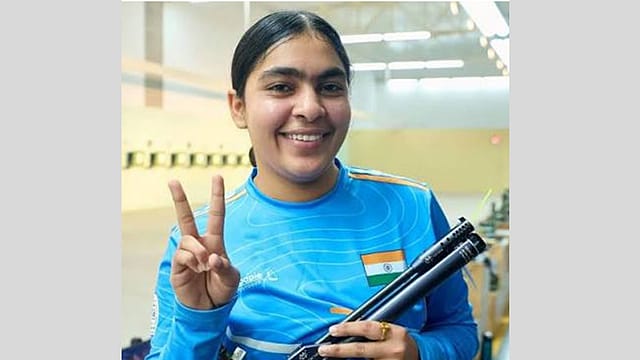
The pistol was packed. The Indian jersey did not exist.
Suruchi Phogat was 13 when she began boarding a local train from Haryana’s Jhajjar district with her father and two brothers. Their destination was the Guru Dronacharya Shooting Academy in Bhiwani. The journey there and back stretched across nearly 100 kilometres. Training swallowed another four hours.
Nobody at the stations knew her name. Nobody inside the train had any reason to remember her face.
Her father, retired Army havildar Inder Singh Phogat, had already watched one sporting dream collapse. He had wanted his daughter to wrestle. Haryana had supplied the tradition, their village had supplied the hero and Inder had supplied the ambition.

Zeroing In on ECI
09 Oct 2026 - Vol 05 | Issue 41
Constitutional legitimacy versus political opportunism
Phogat had entered an akhada at 11. Then her shoulder broke. The fracture took nearly a year to heal. Wrestling became too dangerous. A pistol entered the space left behind.
Seven years later, the girl travelling without a name or national jersey would stand inside the world’s finest shooting ranges wearing one. “When I started shooting, nobody knew me,” Phogat reportedly said in one of her interviews. “I was just a normal 13-year-old girl who didn’t even have an Indian jersey. Today, wearing that jersey is something I’m genuinely proud of. For me, it represents how far I have come.”
The jersey carries more than the national colours. It carries the memory of a wrestling mat she had to leave, a shoulder that refused one future, train compartments that carried her towards another, a father who reorganised his life around her ambition and the thousands of shots fired before the world learnt her name.
The Dream Her Father Chose
Before Phogat was born, another athlete from Sasroli village had shown Inder Singh Phogat how far sport could carry someone.
Virender Singh, better known as “Goonga Pehalwan”, was Inder’s cousin. Their homes stood less than a kilometre apart. Virender had won gold at the 2005 Melbourne Deaflympics and would grow into one of India’s most decorated deaf wrestlers.
Phogat was born the following year, on April 28, 2006. By then, Inder had found a dream for her. He wanted his daughter to wrestle.
Phogat joined a local academy at 11. The choice fitted the geography and the family. Haryana had long turned its akhadas into assembly lines for champions. The Phogat surname carried its own sporting resonance, although Suruchi’s family was separate from the celebrated Phogat sisters of Balali.
A year into her training, the plan splintered. Phogat fractured her shoulder. According to a media account of her early years, the injury took almost a year to heal. Her father feared that another fall on the mat could damage it again.
The girl still wanted a life in sport. The father had to find a sport that would not send her crashing onto the injured shoulder.
Shooting appeared to offer an answer. “I didn’t think twice when switching from wrestling to shooting,” Phogat later reportedly underlined. “All I wanted was to be a sportsperson and win medals.”
The dream survived. Only the weapon changed.
The Train to Bhiwani
Shooting had not called out to Phogat through some grand childhood revelation. She arrived at it through injury, circumstance and her father’s refusal to let one broken plan end the journey.
Once she held a pistol, however, something clicked. One account from those early years says that Phogat took barely three days to understand the weapon at a makeshift range. Soon, Inder took her to Bhiwani, where coach Suresh Singh ran the Guru Dronacharya Shooting Academy.
That decision created the family’s daily railway ritual.
Phogat, her father and her two brothers travelled roughly 100 kilometres by local train for her training. The girl who would later attempt to hold her body perfectly still first had to build her career in motion.
The train moved. Stations arrived and vanished. Hours accumulated.
At the range, Phogat trained for four more.
The journey demanded money, time and an entire family’s stamina. Inder retired from the Army and focused on his daughter’s shooting career. The brothers travelled with them. One athlete pulled several lives onto the same track.
Then Covid stopped the trains and locked the academies. For a young shooter, an extended break could disturb everything the body had begun to remember: how to grip the pistol, raise the arm, regulate the breath, control the tremor and release a shot without allowing thought to sabotage technique.
Sasroli, however, had another soldier waiting.
Kargil War veteran Anil Jakhar ran the Kargil Shooting Academy close to the Phogat home. Jakhar had suffered serious injuries during the war, trained at the Army Marksmanship Unit in Mhow and later opened his range in the village.
When the pandemic closed Phogat’s usual route to Bhiwani, Jakhar’s range kept it alive.
“I remember the day Suruchi’s father brought her to my range,” Jakhar recalled in a PTI report. Their house, he said, was “a stone’s throw” away. He remembered Inder’s commitment and his desire to see Phogat develop into an accomplished shooter like Manu Bhaker.
That proximity became providence. While the sporting world stalled, Phogat continued firing. After the restrictions eased, she returned to training with Suresh Singh. Her technique still needed rebuilding. So did her temperament.
‘Coach, You Are Wasting My Time’
A pistol rewards control. Phogat arrived with urgency.
Her early matches could drag beyond the allotted time. She trained for long hours but struggled to compress that work into the 75 minutes available during competition. Suresh Singh began dismantling the problem.
First, he kept her away from competitions. They trained for two months before entering one match. Then they returned to practice for another two months. Slowly, Phogat learnt to handle one competition a week.
She did not always appreciate the process. “If you want to succeed, control your impulses,” Singh remembered telling her. Phogat, young and impatient, shot back: “Sir, you’re wasting my time.”
The exchange, recounted by Singh in an interview with The Times of India, reveals the raw material beneath the medals. Phogat possessed hunger before she possessed patience. Her coach had to prevent the former from devouring the latter.
Eventually, the girl who accused him of wasting her time began calling him before important matches. “Sir, I have five minutes before I go in. What should I do?”
A short conversation would clear her head. Then she would enter the range. The shooter who once struggled to finish within the clock later swung towards the other extreme. She began firing extraordinarily quickly. At her fastest, Phogat could finish a 60-shot qualification round, for which competitors receive one hour and 15 minutes, in about 30 minutes.
The speed rattled convention. Even Chinese shooters reportedly began watching her. Phogat had found the rhythm after a selection trial in Bhopal where she had finished with barely 10 or 15 seconds left. The stress convinced her to speed up. Her scores improved, so she kept accelerating.
National pistol coach Samresh Jung later urged her to slow down after a poor shot and rest her arm. Phogat admitted that delaying a shot could pull down her scores. The task before her became subtler: preserve instinct without allowing haste to seize control.
Shooting looks almost motionless to an outsider. The target does not charge. No opponent crashes into the athlete. There is no finish line towards which the shooter can sprint.
The violence unfolds within.
“People look at shooting and think, ‘What is so difficult? You just have to stand and shoot,’” says Phogat. “They don’t see what is happening inside you. Controlling your thoughts, your breathing and your emotions while every shot matters, that is the real challenge.”
From Wheat Fields to World Cups
Back in Sasroli, Phogat did not live like a manufactured prodigy.
She helped with household chores, worked on the family farm and operated agricultural machinery. Singh once remarked that if she had not been competing at a World Cup, she might have been harvesting wheat at home.
By the end of 2024, she was harvesting gold instead.
Phogat swept the women’s, junior and youth individual titles at the National Shooting Championships. Team and mixed-team victories helped take her haul to seven gold medals. At the 2025 National Games in Uttarakhand, she defeated a powerful field containing Asian Games champion Palak Gulia and experienced international shooters.
Phogat and Palak were level after 16 shots in the final. Suruchi responded with a 10.7 and a 10.8.
The contest broke open. The two shots captured something that medal counts cannot. Pressure did not squeeze Phogat. It sharpened her. In April 2025, she arrived in Buenos Aires for her first senior ISSF World Cup. She won the women’s 10m air pistol gold with 244.6. Days later, she travelled to Lima and defeated double Olympic medallist Manu Bhaker in the final. Phogat scored 243.6, finishing 1.3 points ahead of the woman who had transformed Indian shooting at the Paris Olympics.
The victory created an irresistible comparison. Both shooters came from Jhajjar. Both had trained under Singh. Both had broken through while young. Phogat resisted turning admiration into rivalry. She said she competed against herself. “Gold medal jeetne ka shauk hai,” she said after Lima. She enjoyed winning gold and entered every competition trying to improve. In Lima, she added a mixed-team gold with Saurabh Chaudhary.
Munich came next. Phogat shot a national record of 588 in qualification and won another final, completing three consecutive individual World Cup victories in her first international senior season. The girl nobody knew had begun making victory look alarmingly routine. It wasn’t.
When the Shots Stopped Landing
The ascent cracked later that year. At the World Championships in Cairo, Suruchi shot 577 in qualification and finished 14th. There would be no individual final. At the Asian Championships in Shymkent, her score slipped to 574 and left her 12th.
The shooter who had swept the first three World Cup stages had stumbled at two of the season’s most important events.
This is where Phogat’s relationship with failure becomes more revealing than her relationship with gold. “A medal is not the only thing I take away from a competition,” she says. “If I don’t win, I look for the mistake. Maybe my technique was wrong, maybe something was missing. I find it, learn from it and come back better.”
She did not carry the defeats as wounds. She carried them as information.
Phogat concluded that she needed more patience even when she was shooting well. Confidence had powered her rise; overconfidence could distort it. There was also pain in her elbow, an issue that had troubled her since April 2025 and required regular physiotherapy.
In December, she reached the ISSF World Cup Final in Doha. During qualification, she shot 586. In the final, something loosened. She stopped worrying about the score and slipped into what athletes call the zone, a place where training takes command and conscious thought finally gets out of the way. “I was in such a good rhythm that I just didn’t bother about my scores,” she later told the Hindustan Times. “I was in a flow and wanted to keep going.”
She finished with 245.1. Gold. A junior world record. The performance erased neither Cairo nor Shymkent. It proved she could absorb both.
Suruchi carried that recovery into 2026.
She won mixed-team silver with Samrat Rana at the Asian Rifle and Pistol Championship in New Delhi. At the Munich World Cup, she scored 242.1 to beat Esha Singh by 0.9 points and lead an Indian one-two. The official ISSF record now lists five World Cup gold medals, a World Cup Final title and the junior world record against her name.
The Asian Games in Aichi-Nagoya will present a different test. Expectation now travels with her. Opponents study her speed. Coaches search for refinements. An elbow must be managed. Every victory enlarges the distance from the anonymous 13-year-old on that Haryana train, but it also raises the weight carried by the 20-year-old in the Indian jersey.
Phogat says she will enter the Games without staring at the scoreboard. “At the Asian Games, I don’t want to think about what the result will be. I just want to fight for every shot, give my 100 per cent and leave the range knowing I gave everything I had for that medal.”
Years ago, a broken shoulder shut one door before Phogat could discover where it led. Her father found a pistol. A local train supplied the road. A Kargil veteran protected the journey when the world closed. A coach taught an impatient girl how to command the battle inside her.
Now, when Phogat raises her arm, the body holds still. Everything that brought her there moves through the shot. And the jersey tells her how far she has travelled.
(With inputs from ANI)