4,244 Runs and Counting: Smriti Mandhana Tops India’s T20I Charts
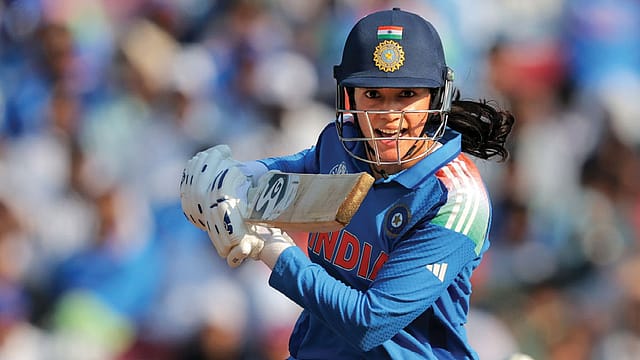
Some nights don’t pick a lane. They celebrate you. Then they undercut you. They hand you a record—and quietly take the result away. In Durban, Smriti Mandhana had one of those nights.
A flick here. A push there. No drama, no flourish. Just 13 runs. Barely a cameo. And yet, somewhere between those runs, something shifted in Indian cricket’s record books: 4,244.
That number now belongs to her. With it, Mandhana moved past Rohit Sharma to become India’s highest run-scorer in T20 Internationals—across men and women.
It didn’t come with fireworks. It didn’t wait for a big innings. It arrived quietly, almost casually, the way consistency usually does.
That’s been her story. Not one towering peak—but a long, steady climb. 155 innings. Over 4,000 runs. An average north of 30. A strike rate that keeps the scoreboard moving. One century. Thirty-three fifties. Numbers built less on noise, more on repeatability.
She doesn’t storm into records. She accumulates them. And yet, even as Mandhana crossed a milestone that had stood in the men’s game, the night refused to turn into a clean celebration.
Cricket rarely allows neat endings. India posted 157/7. A total that felt competitive, then slightly undercooked, then—eventually—not enough.

War on Iran: The War That No One Won
10 Apr 2026 - Vol 04 | Issue 66
And the price of surviving it
Harmanpreet Kaur stitched the innings together with a composed 47*. Shafali Verma and Jemimah Rodrigues added brisk contributions. There were moments when the total hinted at lift-off.
But it never quite took flight. The finish slowed. The push never came. And in T20 cricket, hesitation shows up quickly on the scoreboard.
South Africa didn’t hesitate.
Laura Wolvaardt anchored the chase with a measured 51. Around her, the innings moved with clarity. Annerie Dercksen stayed unbeaten on 44, closing the game without fuss. A six-wicket win. No panic. No rush. Just control.
That contrast defined the night. India had the headline but South Africa had the finish.
And Mandhana sat at the centre of that contradiction. What do you do with a record that arrives on a losing night? Celebrate it? Of course. It’s historic. It resets a benchmark. It places her alongside the most prolific names in the format—just behind Suzie Bates in the all-time women’s T20I charts, and in the broader conversation that includes Babar Azam on the men’s side.
But also park it. Because the series has just begun. Because the result stings. Because the job, as always, moves on. That’s the rhythm elite players learn to live with. Moments don’t wait for context. They arrive when they want. Mandhana’s did. Not in a century. Not in a match-winning knock. In a brief stay at the crease that quietly tipped history in her favour.
This almost feels fitting. Her career has rarely chased spectacle. It has built through presence. Through showing up, again and again, and adding—runs, innings, impact—until the weight becomes undeniable. That’s how records like this are made. Not in a night. Across many. Still, the larger picture lingers.
India now trails in the five-match series. The next game comes quickly, at the same venue. There’s little time to sit with milestones, even ones this big. The format doesn’t allow it. The calendar doesn’t pause for it. So, the reset begins almost immediately.
For Mandhana, the record will stay. The number won’t move back. But everything else will. Form. Pressure. Momentum. Narrative. And maybe that’s the most telling part of this story. A player reaches the top of a chart—and still walks off the field with unfinished business.
(With inputs from ANI)