Why Modi Will be India’s Most Consequential PM
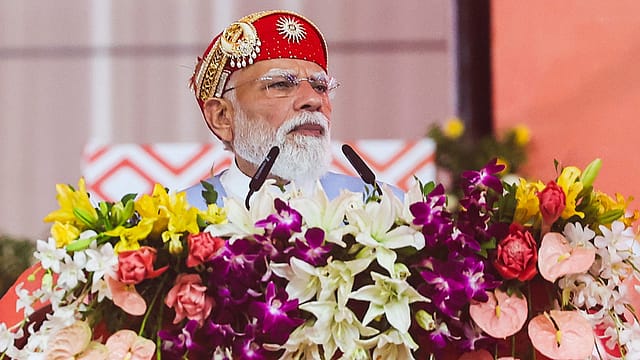
There isn’t much doubt that Narendra Modi is set to be India’s most consequential Prime Minister. This became apparent in his first term when he led the Bharatiya Janata Party (BJP) to 282 seats in the 2014 Lok Sabha election after the party received a record 17 crore votes. There was something special about the warm and balmy evening Modi was sworn in on May 26, 2014. The dappled shade had a magical quality as light streamed down on the forecourt of Rashtrapati Bhawan. The mood was palpably upbeat and at the back was a contingent from Gujarat brimming with good cheer and anticipation. The Gujarat model had come to Delhi.
As he took charge, Modi turned his attention to “wicked problems” that defied resolution for decades even as governments and prime ministers changed. The Jan Dhan bank accounts, toilets for every rural household, electrification of all villages, a new insolvency law and the rollout of a Goods and Services Tax (GST) topped the new government’s agenda alongside a pragmatic foreign policy with a strong economic orientation and a determined effort to eliminate corruption in high places, particularly in defence deals.
What Rahul Gandhi Wants
28 Aug 2026 - Vol 05 | Issue 35
He is desperately courting the angry youth. That won't be enough to credibly challenge Modi
Not a Cosmetic Change
It was, of course, far from clear whether Modi would win a second and then a third term. But a dispassionate observer would have recognized that the change was not cosmetic. Modi was reworking the grammar of governance as well as politics bringing an unprecedented level of effort and attention to reducing the friction in government. The PRAGATI (Pro-Active Governance and Timely Implementation) platform began to clear projects stuck for years. The new Prime Minister was a careful listener, usually intervening during official meetings to make a point or two that often focused the discussion on its essentials. In his public speeches he began to emphasize delivery of services and the Jandhan-Aadhar-Mobile (JAM) trinity became the cornerstone of a new governance framework that touched every aspect of a citizen’s life.
When on June 10, 2026, Modi surpasses Jawaharlal Nehru to become India’s longest democratically elected continuously serving Prime Minister, he would cross a landmark. Nehru’s tenure after the first Lok Sabha election when he was sworn in on May 13, 1952 till May 27, 1964, adds up to 4,398 days. From May 26, 2014, to June 10, Modi would have been PM for 4,399. Indira Gandhi’s consecutive term as PM from January 24,1966, till March 24, 1977 is 4,077 days. Modi surpassed this on July 25, 2025. While this will be a unique feat for a non-Congress P M, the date is another milestone a remarkable career that is far from over.
Work To Be Done
Speaking at a diaspora event in Netherlands on May 16, Modi recalled the mandate of the 2014 election and said the faith and support of crores of Indians is the driving force for his energy and focus on public good. The cut and thrust of politics is about hard choices and acts of assertion and accommodation sometimes appear indistinguishable. But through the clamor of politics, Modi has stuck to his faith in governance and the belief that it will be rewarded. The meeting of the Union Cabinet on June 3 took decisions to establish a aviation fuel stabilization fund to help the stressed air travel sector, a scheme for phasing out old trucks and buses in Delhi, a coastal highway from Rameshwar to Paradeep, four-laning of four highway sections in Bihar and Telangana and upgradation of another highway in Madhya Pradesh. Almost every cabinet meeting deliberates on similar decisions that are aimed at nudging India along the path of Viksit Bharat.
Leadership is never easy and Nehru’s advantage as the chosen heir of Mahatma Gandhi did not spare him the travails of a traumatic conflict with China. But he led a party that enjoyed a vast lead over all other challengers. Modi’s rise has been much more rugged. To begin BJP stood isolated for years due to its advocacy of a Ram mandir, uniform civil code and support for the abolition of Article 370. Modi roughed it out for years as a karyakarta and his talent for politics was not instantly recognized. He had to work his way, pushing open closed doors and proving his credentials in a packed field that was not always even. He had to accept a party diktat to stay out of Gujarat to supplicate a rival and even after he became chief minister only a revolt in the BJP national executive at Goa in April, 2002, prevented his removal. A Supreme Court-monitored investigation was to later conclude Modi had no culpability in the 2002 violence.
Sab ka Saath
“Sab ka saath, sab ka Vikas” is not just a slogan for Modi. As chief minister, Modi understood that growth matters and economic freedom will lift all boats even though the weaker sections need extra attention. Ahead of the 2014 Lok Sabha election, Modi’s critics mounted a sustained campaign to claim that Gujarat’s social indicators were only middling. They chose to ignore the improvements in Gujarat’s standings given its legacy deficits such as a large tribal population that had received sporadic attention. By 2012, the poverty rates of marginalized communities had declined and large minorities like Muslims fared better than in many other states. Primary school drop out rates fell and female literacy rates rose. Today, Gujarat’s unemployment rate is 1.1% and it provides employment to lakhs of workers from less industrialised regions with remittances sustaining households in their home states.
As chief minister, Modi displayed an early grasp of technology and its use in governance with SWAGAT (State Wide Attention on Grievances by Application of Technology), an IT-based system that allowed citizens to register complaints that were tracked and resolved. Today almost every state has a “CM window” for similar purposes. At a time when regular electric supply was a mirage, he launched the “jyotigram” scheme for rural electrification. Gujarat became fully electrified in 2006 and 24x7 three-phase power supply a reality. This vastly helped small businesses, encouraging cold storages, retail of frozen products and sharply reduced use of diesel generators. Modi launched “Vibrant Gujarat’ in 2003, a bold move to pull Gujarat out of the negativity and hatred in the aftermath of the 2002 riots and at a time he was under pressure to prove his leadership. There was a strong representation from Japan and domestic majors also participated in the first edition of an event that has become a marquee event. Today, the Gujarat government organizes conferences that have yielded large investments as renewable energy and reduced gaps between different regions in the state.
Tenacity and Self Belief
Modi became Prime Minister at a time when coalitions were considered the only viable model since neither Congress or BJP were seen capable of winning a majority on their own. Nehru’s long tenure as Prime Minister happened at a time when Congress dominated politics and no other political party was even distant competition. Before the 2014 election, no political savant visualized that BJP and its allies would win all Lok Sabha seats in Gujarat, Himachal Pradesh, Uttarakhand, Rajasthan and Delhi and a staggering 73 of 80 seats in Uttar Pradesh and 42 of 48 seats in Maharashtra besides near-sweeps in others. “Ab ki Baar Modi Sarkar” caught the imagination of the nation and powered BJP to an impressive win. Modi has displayed a rare tenacity and self-belief in pursuing his goals as a repeat win in 2019 was followed by a sub-par 240 seats in the 2024 Lok Sabha poll.
The setback could have been de-moralising but the Prime Minister got back to work and while the Opposition made the mistake in misreading key aspects of the mandate -- failing to recognize the regional-caste-community aspects of the results -- Modi got down to reviving BJP’s fortunes one state at a time. Congress banked heavily on caste-based mobilization in Haryana while BJP used messages of growth, development and a counter-social polarisation. The support the party received from urban areas stood out. Elections in Maharashtra delivered a gratifying victory over the Maha Vikas Aghadi (MVA) with BJP and breakaway Shiv Sena and Nationalist Congress Party (NCP) winning handsomely. BJP ousted Aam Admi Party (AAP) from Delhi next and then retained Bihar. More recently, it won a hard contested battle in West Bengal. BJP failed to dislodge Jharkhand Mukti Morcha (JMM) in Jharkhand and its strategies did not work in Tamil Nadu. Though it won just three seats in the Kerala assembly, its prospects are appear due to a decline in the Communist Party of India (Marxist)’s appeal. In every election, Modi has unhesitatingly hit the ground communication with crores of voters.
Moving Towards Prosperity
The decade gone by has seen a swift reduction of extreme poverty and Prof Arvind Panagariya, professor of economics at Cornell and the first vice-chairperson of Niti Aayog, defines the task of moving India towards “broad-based prosperity” as India’s central challenge. “Countries that have reached high-income status — whether the older industrialised economies of the West or the newly industrialised economies of East Asia — have done so by shifting a substantial share of their workforce into productive employment in industry and services, accompanied by massive urbanisation,” has written. He points out that in India, 46% of the workforce remains in agriculture and another 40% is self-employed or employed in enterprises with nine or fewer workers, according to the PLFS, 2023–24 and that this indicates significant underemployment. “Moving labour out of agriculture will require the creation of remunerative jobs in industry and services on a large scale. If such employment opportunities materialise, urbanisation will follow, either through migration from rural to existing urban centres or through the transformation of currently rural regions into urban spaces,” writes Prof Panagariya.
Modi’s is laser-focussed on his objective of setting India on the road to sustained progress and the Prime Minister is totally immersed in assembling the building blocks of “Viksit Bharat.”