What’s Beyond Maya?
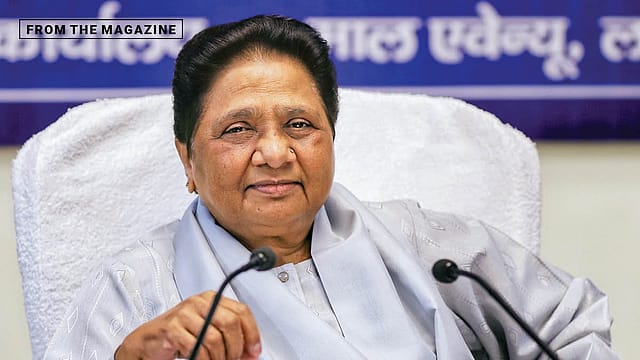
One would think that for a political party that has to soon face a crucial election, the Bahujan Samaj Party (BSP) would be busy galvanising its cadre and reaching out to its voter base. Instead, the party is preoccupied with a question that should have been settled long ago: Who comes after Mayawati?
In the past few weeks, Mayawati herself has turned this question into a joke. She had first settled for her nephew Akash Anand as her political successor. Then he was removed. After he apologised, he was brought back, only to be pushed aside again. Earlier this month, his younger brother Ishan Anand was asked to move into his place. But just a few days later even he was shown the door. Mayawati later said her brother Anand Kumar would continue assisting her in running the organisation and if he wanted, he could ask his daughter Deepika to help him manage party activities. For a party whose influence in Uttar Pradesh (UP) has declined dramatically, this strange game of musical chairs suggests that BSP is a party that will find it difficult to renew itself without loosening the grip of the once-extraordinary woman who built it along with her mentor Kanshi Ram.

Zeroing In on ECI
09 Oct 2026 - Vol 05 | Issue 41
Constitutional legitimacy versus political opportunism
There was a time when Dalit voters flocked to BSP. In a party that was built on the sweat and blood of Kanshi Ram, Mayawati’s very presence was an argument; it was an argument that a Dalit woman was capable of occupying the chief minister’s chair, carrying a force that went well beyond electoral arithmetic. She faced flak for creating her living memorial, but for her supporters the statue of Behenji holding her handbag was simply an inscription of history that had rarely been allowed to occupy public space. It was something Mayawati understood deeply; she was aware that this symbolism gave millions of Dalits the conviction that their vote had the capability of producing power.
Look at how this power has weakened over years. In the 2022 Assembly election, BSP received just over 12 per cent vote and won just one seat; in the 2024 Lok Sabha polls, it scored a zero in UP, its vote share falling below 10 per cent. Many argued that Dalit voters had stopped voting as a bloc. That is true, but it is also true because BSP could no longer sustain their political imagination. Meanwhile, the Bharatiya Janata Party (BJP) made inroads among non-Jatav Dalits; the Samajwadi Party (SP) has strove to bring Dalits into its broader PDA coalition. Also, with the rise of young Dalit leaders like Chandrashekhar Azad who became an MP in 2024, a clear message went out that more confrontational politics can exist outside BSP.
In view of this, the succession drama inside BSP is more consequential than it might appear. When he began, Akash Anand, it seemed, had recognised the problem and begun to somewhat address it. He was young, had received an education abroad, and had a certain comfort with social media. He also spoke a political language different from the old leadership. The party’s core voter is ageing and, for the first time, there was a possibility that the nephew could build a bridge to voters so young that they have no personal memory of the time Mayawati became chief minister for the first time in 1995. He could have made the party line contemporary again. In this game of throne, what came across clearly is that Mayawati has difficulty letting the centre hold without her being it.
Now, her decision, as it happens, came with her usual justifications in the name of her mentor, who she said was opposed to political inheritance through family. That is true since Kanshi Ram had the vision that saw him choosing Mayawati as his political heir; that ensured the party did not become a family enterprise. But Mayawati’s current banking on that justification is a contradiction because the party has not produced a second generation of leaders with even a fraction of her authority. The problem is also the fact that in BSP everything has continued to flow from Mayawati, which has resulted in a vacuum when it comes to the gradual emergence of leaders.
The coming elections will test Mayawati’s relationship with her core base. She still has something no other Dalit leader comes close to—political recognition built over decades. There are families which carry that emotional charge, of her getting off a chopper and sitting like a don on an oversized sofa with everyone else sitting a few feet behind her. But in a country where Dalit aspiration has also seen a sea change, it will be foolish on her part to assume the young will inherit this political memory automatically. The party, like everyone else, will have to speak to a new generation that seeks welfare beyond caste and the possibility of a good life. BSP under Mayawati has failed to explain what it has to offer to this lot.
That is why the 2027 election may be less important for BSP in terms of the number of seats it wins than for what it reveals about the durability of the political constituency Mayawati created. If the party can recover some of its lost Dalit support, particularly among younger and non-Jatav voters, one can argue BSP has still some life left in it and that it has not hit terminal decay. If it cannot, the question becomes much harder: Does this decline mark the end of a particular form of Dalit politics in UP or simply its transition to something else?
That it may have transitioned must not be dismissed. The political consciousness that led to the rise of BSP has not vanished. The questions of power, representation and whose history is visible remain intact. It is just that the vehicle through which these questions are expressed may have changed.
For now, Mayawati remains firmly in control of BSP. Akash is out, Ishan is out, and the succession question has once again been postponed. Outside the party office, voters are making their own calculations. They will remember what Mayawati gave them, but they will also look at what BSP can give them now. The party can no longer afford to ignore this distinction. Mayawati’s great political achievement was to convince Dalits what their vote could do; her greatest challenge now is to persuade them that the party still has their welfare in mind and that it will continue to do so even when she is gone.
The empty chair at the centre of BSP is not simply waiting for an heir; it is waiting to be claimed by someone who can speak the new language of politics to a new generation.