A Generational Shift: VD Satheesan is Kerala's First Post-Independence-Born Chief Minister
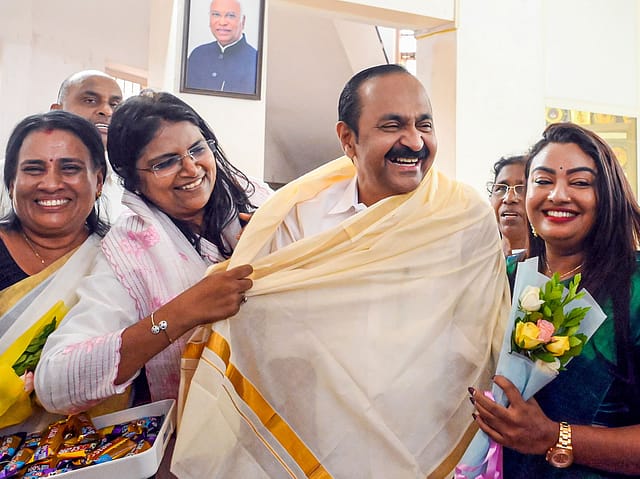
THE CONGRESS ‘HIGH COMMAND’, LED BY Rahul Gandhi and others, has finally chosen outgoing Opposition leader VD Satheesan as the next chief minister of Kerala, putting an end to 11 days of dithering, whispers and anxiety over who would be Kerala’s next chief minister. Yet, the episode, characterised by heavy political intrigue, fierce one-upmanship and factional sparring, exposed the central leadership’s skewed priorities and its push to install a favoured candidate at the helm, not necessarily the most suitable one, though, in the end, without success.
There is no denying that the May 4 results in Kerala were a day of reckoning for the outgoing 10-year-old Pinarayi Vijayan government, which suffered a crushing defeat, and a euphoric turning point for the Congress party, whose landslide return to power surpassed expectations and shattered Left bastions long considered impregnable.

Losing Memory
16 Oct 2026 - Vol 05 | Issue 42
The making of a medical and social emergency
What immediately followed was a political tug-of-war and backroom manoeuvring that dulled the celebrations as the fight for the chief minister’s position intensified among three contenders. It turned ugly due to aggressive public displays of hate and toxic trolling on social media and offline by their supporters. As always, local TV channels chased social media to generate outrage. True, a power struggle was along expected lines, but the extent to which it got prolonged and the Congress’ inept handling of the situation have, ironically, generated a lot of mirth, both offline and online, with memes being churned out in large numbers.
A section of the Malayali public took pains to be creative and put in a lot of hard work. For instance, one of the videos that went viral shows an angry youth darting into the home of a guest worker over something he had told him. Some of his friends try to restrain the youth, who is carrying a stick to thrash the non-Malayali making a living in Kerala. They ask their friend what happened, but he does not immediately disclose much. One of his friends asks: “Did he say something bad about your dad?” The angry man says no, adding that it would not have been a cause for his wrath. Then, he blurts out in helpless anger, “He called me a guy who doesn’t have a chief minister.” On hearing this, his friends also get infuriated and run here and there to pick up sticks before returning to confront the guest worker, who is not directly shown in the video. Many more such videos and memes, offering a peek into Malayali creativity at a time of grave political crisis, soon surfaced.
That Congress insiders, sympathisers and a section of political pundits attributed all this internecine wrangling to “internal democracy” and “triumph of free speech” the party claims to champion, only invited greater ridicule and sharper jokes.
The irony is that Kerala is undergoing a generational shift in the true sense.
Born in 1956, the oldest among the chief minister contenders from Kerala, Ramesh Chennithala was barely three years old when his party, with the help of a rainbow alliance of communal and casteist forces, led the infamous Liberation Struggle against the communist government of EMS Namboodiripad in the late 1950s. The first communist government in Asia that was elected through the ballot in 1957 fell victim in 1959 to that coalition of unlikely bedfellows in a project to unseat communists, apparently at the behest of American agencies. KC Venugopal, the second contender who is Rahul Gandhi’s right-hand man and considered unsuitable as a troubleshooter because of his reported ignorance of politics outside of Kerala, was born in 1963. The high command’s final choice for chief minister, the third contender, Satheesan, the former opposition leader in the Kerala state Assembly, who is widely credited with turning the tide in favour of Congress in this election and the youngest among the trio, was born in 1964.
Which means that Kerala, for the first time, will get a Congress chief minister unconnected to the Liberation Struggle, the movement that produced a generation of the state’s Congress ministers and chief ministers, including R Sankar, K Karunakaran, AK Antony and Oommen Chandy. It is also the first time Kerala has had a chief minister born after Independence.
It is therefore jarring that such a generational shift is accompanied by intrigue, anger and machinations, an anti-climax to the May 4 victory that saw Congress trouncing the ruling CPM, and the coalition it leads, the Left Democratic Front (LDF). In fact, the Congress leader who led the election campaign from the front, Satheesan, was born on the cusp of two generations. He belongs to Generation Jones, or what they call late boomers, bridging the gap between Baby Boomers (1946–1964) and Generation X (1965–1980) while both Venugopal and Chennithala are Baby Boomers.
This is not the first time Kerala has seen such inordinate delays in choosing a chief minister. The Left victory in 1996 saw days of hectic parleys between the CPM politburo and a section of the state leadership following the shock defeat in the polls of VS Achuthanandan. Finally, the party state unit settled on EK Nayanar, who had not even contested polls, voting out demands by his rival camp within the party for making a woman, Susheela Gopalan, as chief minister. It was a case of Achuthanandan exacting political revenge with the blessings of the central leadership.
Much earlier, in 1960, when the Congress-Praja Socialist Party (PSP) and Indian Union Muslim League (IUML) alliance came to power in the elections held after a period of President’s rule following the dismissal of the EMS government through a controversial use of Article 356, days of talks involving Congress leaders at the Centre and state as well as religious leaders and heads of caste organisations concluded amidst high tensions. They chose PSP’s Pattom Thanu Pillai, widely seen as a difficult man to get along with, as chief minister and R Sankar of Congress as deputy chief minister. It took two more years, until Pillai was named a governor, for Congress to get its first chief minister in Kerala with R Sankar promoted to the post.
Meanwhile, it is learnt that the high command had earlier favoured Venugopal for the post for a variety of reasons. First, he is seen as close to the Nehru-Gandhi family, which, according to sources, was also keen to move him out of Delhi, where he is not regarded as an especially effective organisational hand. However, after consultations with Kerala leaders, the high command is understood to have viewed it as unwise to trigger two bypolls at this juncture: one to bring Venugopal into the state Assembly, and another for the Alappuzha Lok Sabha seat he currently represents. Again, they also factored in what was seen as public sentiment, which, whether organic or orchestrated, appeared to favour Satheesan. They also took into account the views not only of their legislators but also of their allies, especially IUML, which backs Satheesan. IUML has long played a key role in ensuring Congress victories in the Wayanad Lok Sabha seat now represented by Priyanka Vadra.