DK Shivakumar: The Loyal Strongman
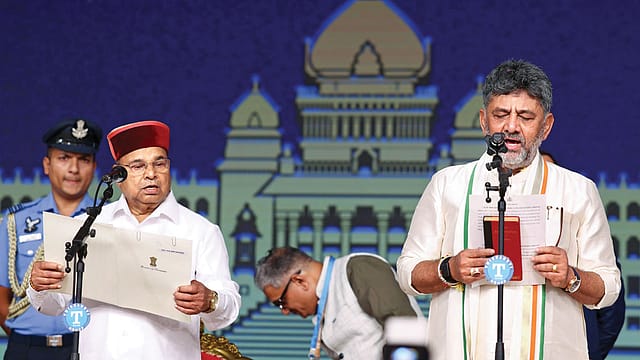
A DAY BEFORE HE took oath as chief minister, 64-year-old DK Shivakumar said his loyalty to the Gandhi family comes from a lifetime of political debt. They had given him his chances and he owed them his fidelity. He invoked Indira Gandhi, Sonia Gandhi’s refusal of the prime minister’s post and Rahul Gandhi’s Bharat Jodo Yatra to argue that his duty lies in accepting the job entrusted to him and to do it faithfully. Gratitude to Delhi goes hand-in-hand with the authority of the new chief minister. Shivakumar stuck to script, conveying that he was not a regional satrap who forced Delhi’s hand but rather a trusted custodian of the high command.
A Kannada newspaper featured Shivakumar on the front page as Shiva himself. But the oath-taking on June 3 along with 13 cabinet colleagues at Lok Bhavan was deliberately restrained. There were few people and even less spectacle. Congress President Mallikarjun Kharge, Rahul Gandhi and Congress chief ministers were in attendance. Siddaramaiah, the man Shivakumar replaced, was present too, his appointment to the Congress Working Committee (CWC) signalling an unwilling shift. For a man who had achieved a burning ambition, the event was curated to look like an amicable transfer of authority rather than a conquest. Shivakumar would be all too aware that he had made it whereas many challengers had failed. The list of almost-chief ministers includes Sachin Pilot, TS Singh Deo, and Jyotiraditya Scindia, the last having sought fortune elsewhere. These leaders had been worthy challengers with youth, caste, resources and charisma, but they were unable to project undying fealty. They may have also lacked the resources Shivakumar can command.
Shivakumar’s ascent is marked by a political identity different from Siddaramaiah’s. Siddaramaiah was always somewhat larger than Congress, the architect of the AHINDA (Alpasankyataru- Hindulidavaru-Dalitaru) coalition, a social bloc that was also a personal following welded together to outsmart masters of backward politics. Shivakumar praised Siddaramaiah and the Gandhis in the same breath, which allows him to inherit power without appearing to have seized it. He sought the blessings of Janata Dal (Secular) patriarch HD Deve Gowda and former BJP Chief Minister BS Yediyurappa hours before taking oath. The contrast with Siddaramaiah’s own history is revealing. Siddaramaiah was once close to Deve Gowda but never acknowledged any debt following a bitter falling out. Shivakumar’s fulsome acknowledgement of his patrons and political foes is a softer touch.
A Vokkaliga born in Doddalahalli, Kanakapura, Shivakumar lost his first contest in 1985 to Deve Gowda, a defeat that would become a defining rivalry in his political life. He won Sathanur in 1989 at 27 and has not lost an Assembly election since. After moving to the Kanakapura seat in 2008, he has held a succession of portfolios—energy, water resources, Bengaluru development—which have made the constituency his fief. He is among the wealthiest men in Karnataka politics, a builder of colleges and businesses, whose declared assets are staggering. In 2019, the Directorate of Enforcement (ED) arrested him in a money-laundering case. The Income Tax department had earlier raided him during the 2017 Gujarat episode when the party hid 44 legislators at a resort outside Bengaluru to keep BJP from poaching them. Shivakumar moved in with them, stayed through the raid, and escorted them to vote. He is the man Congress calls when a government wobbles. He is also a rare Congress leader who combines a strong caste base, organisational skill, fundraising capacity, electoral success, and a willingness to publicly embrace Hindu religiosity.
Shivakumar’s rise shows Siddaramaiah no longer controls the next step. A Kuruba, Siddaramaiah came up in the Lohiaite and Janata fold and rose under Deve Gowda as an educated backward-caste face. He broke with Gowda when the latter chose son HD Kumaraswamy over him, and crossed to Congress in 2006 at Sonia Gandhi’s invitation. He was not an easy fit and the party’s old guard never stopped calling him an outsider. Siddaramaiah is, by the reckoning of his own colleagues, the only senior Congress leader in Karnataka with no business empire. He was chief minister from 2013 to 2018, returned in 2023, and leaves, according to his PR team, having overtaken D Devaraj Urs as Karnataka’s longest-serving chief minister. Urs is seen as the benchmark of backward-class power in Karnataka, architect of land reform and backward caste mobilisation. To pass him is to surpass a complicated history, points out author and journalist Sugata Srinivasaraju, who has tracked Siddaramaiah’s career.
The transfer of power marks a new Congress game plan. The authority of the high command not only prevailed but ensured a bloodless coup unlike in Punjab in September 2021, where veteran leader Amarinder Singh quit in humiliating circumstances, or the prolonged and messy power tussle in Rajasthan between Pilot and Ashok Gehlot. Looking ahead, Congress hopes Shivakumar’s credentials as a Vokkaliga, an influential agrarian caste, along with the support of Muslims, Dalits and a section of OBCs will be a powerful combination in the run-up to the 2028 state elections and the 2029 Lok Sabha polls. Despite ousting BJP from office in 2023, Congress could not repeat the performance in the 2024 General Election. The party is also counting on Shivakumar’s organisational skills and his ability to inject the right dose of welfare and populism. Congress hopes the change will bring the curtain down on a distracting power struggle over a reported ‘deal’ to split the tenure between Siddaramaiah and Shivakumar, one the former never acknowledged. Shivakumar must now deal with political demands arising from a caste survey Siddaramaiah accepted just before he quit and a strong Hindutva mobilisation by BJP which poses a significant threat despite not having a clear chain of command.
Siddaramaiah’s final months were shadowed by the Mysuru Urban Development Authority (MUDA) case. The allegation was that 14 compensation sites, valued at about `56 crore, were allotted to his wife for land acquired by MUDA at Kesare. The matter gathered steam after the governor granted sanction for prosecution. The Lokayukta police later filed a B-report, saying there was not enough evidence to proceed, and a special court accepted it in January. But the closure is now under challenge. In March, the Karnataka High Court issued notice on a petition questioning the special court’s acceptance of the B-report, and in April ED moved the high court against the same closure. The ticking case may well limit the former chief minister’s future moves.
Siddaramaiah’s claims of having delivered the AHINDA bloc to Congress are challenged by commentators like Srinivasaraju, who argues the Congress vote share barely moved under him. It was about 35 per cent in 2004, 34.8 in 2008, 36.6 in 2013, and 38.1 in 2018. In 2013, his first win, Congress added less than two percentage points over 2008 and gained 42 seats, helped by the split in BJP after Yediyurappa broke away and the emergence of B Sriramulu’s BSR Congress. In 2018, Congress won a higher vote share than BJP, 38.1 per cent to 36.4, and still lost, finishing with 80 seats against BJP’s 104. Siddaramaiah lost his home seat of Chamundeshwari by 36,042 votes and survived in Badami by 1,696.

In 2023 came a surge, with a 42.9 per cent vote share and 135 seats, and post-poll analyses credit it to Congress’ welfare guarantees, a revolt of the rural poor, and the inept choice of BS Bommai as Yediyurappa’s successor. He was unable to counter allegations of a “40-per-cent-commission government”. Muslims, Dalits, and even a chunk of Vokkaligas who deserted JD(S) helped Congress win. The five guarantees may have moved more voters than Siddaramaiah’s caste mobilisation.
Asked if Siddaramaiah was the last of Karnataka’s mass leaders, senior Congress leader RV Deshpande declined the premise. “You will have to watch,” he said. “You can’t say somebody is first or somebody is last.” Another cabinet minister was blunter, conceding that a decade ago the leader had real sway over the AHINDA vote and that things have since changed. The high command’s actual wager is that whatever goodwill Siddaramaiah commands can be transferred to his successor while it retains value. Deshpande was confident Siddaramaiah would support the new chief minister “with no stone unturned”, before adding, “What is life without such challenges? Shivakumar is a very capable man and he has a chance to prove himself now.”
In 2023 the question before Congress was not only who deserved the chair but who could best lead the government. Siddaramaiah was experienced with budgets, welfare schemes and legislative management. Making Shivakumar chief minister could have pitched the party into a polarising internal fight. So the compromise was Siddaramaiah got first claim to be chief minister and Shivakumar became deputy chief minister and remained state chief. The door to succession remained open. Bengaluru infrastructure, fundraising, candidate management, daily war-room politics and keeping MLAs satisfied before the election cycle is Shivakumar’s terrain. He is not being elevated only as a reward. He is being deployed for the more difficult half.
BJP has been quick to observe that Congress no longer has a single OBC chief minister. Last month in Tamil Nadu, actor Vijay’s two-year-old party fell just 10 seats short of a majority in a House of 234 powered by the highest turnout the state has recorded by assembling a constituency that answered to no caste sum. “Mandal politics’ use-by date is over,” argues Srinivasaraju. Leaders who represented the old ways of caste-based polarisation have declined without ripples, he says, citing Nitish Kumar, Lalu Prasad, and others. Caste has not disappeared from Indian politics though and it still structures access, aspiration and local power. What has changed is that it has run into newer forms of accommodation and organisation. Karnataka Congress has retired its caste warrior and promoted an organiser. But it has also made G Parameshwara deputy chief minister. Three Dalit ministers, including Priyank Kharge and KH Muniyappa, cover both wings of a longstanding community split. The 14-member cabinet spans eight communities: two Vokkaligas including the chief minister, three Lingayats, two Kurubas including Yathindra Siddaramaiah, three Dalits, a Muslim, a Christian, a Scheduled Tribe minister and a Reddy. Congress is aware that a Vokkaliga-fronted government is useful ammunition for BJP’s backward-caste consolidation machine. The cabinet’s breadth is the first answer to that problem.
A Vokkaliga in the chief minister’s chair is a refutation of JD(S)’s hold over the community. Last November, the head of the Adichunchanagiri monastery, the community’s most powerful seer, declared Shivakumar should be chief minister. Kumaraswamy objected that monasteries should stay out of politics. Shivakumar asked whether Deve Gowda would ever have been chief minister without a seer’s blessing. JD(S) is squeezed between a Congress that can appeal to the Vokkaliga base and a BJP capable of acquiring newer constituencies. In a tight contest BJP may well want JD(S) by its side, but the party’s utility has declined.
The harder question is what Shivakumar does with the office. Cabinet formation, KPCC control, the management of Siddaramaiah’s loyalists, regional balances, cabinet berth demands and caste equations are all being negotiated. Congress now commands 138 of the 224 Assembly seats and faces no threat. He cannot run as an outsider against the last three years because he was the deputy chief minister, in charge of a city he did not transform and irrigation works that produced no major change. The Social and Educational Survey, or the caste census, sits on Shivakumar’s desk, counting the Vokkaligas in ways his own community distrusts.
But there is a bigger problem. A mass leader in Karnataka needs a personal constituency beyond caste. A story of grievance and a shrill political language have been bread and butter for regional leaders. Siddaramaiah was seen to have the right social formula with a hard secular edge. Shivakumar’s story is more about loyalty, resourcefulness and patience. His power can be visibly transactional but he can use networks to formidable effect. Having spent most of his career proving himself, Shivakumar has two years to emerge as a leader in his own right.