West Bengal: Chronicle of a Split Foretold
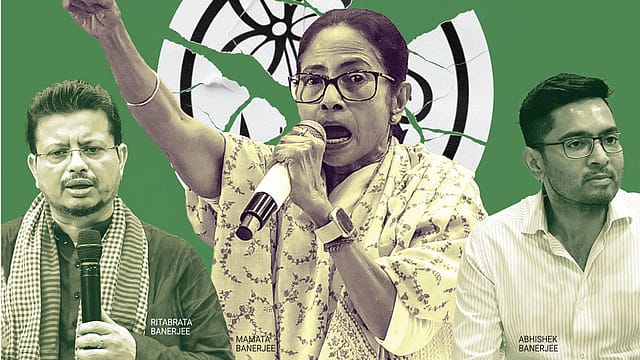
THE ART OF surviving when out of power is demanding, particularly after a long spell in office. An almost untrammelled exercise of authority aided by obsequious officials picked for loyalty can create a bubble immune to any reality check until it is too late. Honest feedback is discouraged, and an heir apparent with no qualification other than familial ties worsens the situation. Being in the opposition is a test of leadership, as the shield of a public-funded Praetorian guard is no longer available and a searing sense of loss fuels discontent in the ranks.
For most of her long career in politics, Mamata Banerjee has battled adversity. Even when Congress was at its peak, her situation in West Bengal, where Marxists ruled with an iron hand, was very different. Her uneasy equation with Sonia Gandhi led to her exit from Congress, formation of the Trinamool Congress (TMC) and two spells as an ally of the Bharatiya Janata Party (BJP). But her alliances with Congress were even more disappointing, and she finally ousted the Left Front in 2011 on her own steam after the communists blundered in Nandigram.
The momentum of her win in 2011 powered her to a second term in 2016. As politics abhors a vacuum, the diminution of the Left and Congress opened the doors to BJP, which began to make itself felt in a state seen as culturally alien to the advocates of Hindutva. Though TMC won again in 2021, the battle was closer than the result suggests, and while it lost, BJP found in Suvendu Adhikari, a one-time lieutenant of Mamata, a credible homegrown Bengal leader. Five years later, a clean-up of electoral rolls and effective deployment of Central forces neutralised TMC’s strongarm tactics and a resurgent BJP won a famous victory.
An early sign that Mamata had not read the altered circumstances was her refusal to resign after defeat, insisting the Election Commission and BJP had cheated her of a win. If the idea was to display grit, it did not work. Trinamool MLAs and cadres were quick to learn the lesson. They kept a low profile and controversial Trinamool leader Jahangir Khan withdrew from the Falta repoll. If there were any doubts about just how much things had changed, Diamond Harbour MP Abhishek Banerjee, Mamata’s nephew and anointed successor, was pelted with eggs when he visited Sonarpur on May 30. Social media is full of videos of young people with BJP flags shouting “Jai Sri Ram” with newfound abandon. The celebrations did not stop even a month after the results.
Amid such chaos, the TMC brass slipped up as it sought to appoint its nominee as the leader of opposition since Mamata lost both the seats she contested. Two MLAs, Ritabrata Banerjee and Sandipan Saha, complained to Speaker Rathindra Bose that their signatures in support of TMC veteran Sobhandep Chattopadhyay were forged. A CID inquiry was swiftly ordered, and a panicky Trinamool leadership expelled the two MLAs. This released them from the party whip, and rumblings within TMC deepened. Soon, Ritabrata Banerjee submitted a list of 58 MLAs and his claim to be recognised as the leader of opposition was quickly accepted. Was there a wink and nod from BJP? Amistakeinpolitics canbecostly, asnoquartersareevergiven.
The more astute observers of Bengal politics point out that Trinamool was never a coherent proposition and essentially comprised interest groups. Once the glue of power that held the arrangement was gone, only self-interest remained. The presence of 17 Muslim MLAs in the rebel bloc is revealing—Mamata had fiercely projected herself as a benefactor of the community, holding BJP at bay. It would have been wiser to have suspended Ritabrata Banerjee and Saha rather than expelling them. Whether an MLA ‘expelled’ by his party can be the leader of opposition is likely to be the subject of a court process. With 58 MLAs raising the banner of revolt, the official camp has lost out.
Trinamool is not the only party to feel the heat after defeat. In the recent past, Shiv Sena led by Uddhav Thackeray and the Nationalist Congress Party (NCP) led by Sharad Pawar have suffered similar fates. There is an element of similarity in that the rebellion in all three parties was at least in part sparked by t he choice of family nominee as political successor. The developments in Bengal on June 3 were labelled ‘ Maharashtra model’, but the truth is that they would have happened any which way. During its 10 years in the opposition post its shock defeat in the 2004 Lok Sabha polls, BJP suffered several bouts of internal unrest. But it was better equipped to weather the storms given its ideological base and supervision of the Rashtriya Swayamsevak Sangh. Congress has suffered more splits, but the Gandhis are still seen as indispensable.
During the election campaign, Mamata ended a speech with the observation—preceded by phrases like “khuda hafiz” and “inshallah”—that “raha Trinamool toh phir milenge (If Trinamool survives, we will meet again).” Did she have an inkling of what was in store? It was unlikely the leader could have anticipated the pace at which Trinamool unravelled. Now, while she is reduced to a faction, the possibility of a split in the parliamentary party is not ruled out. As far as BJP is concerned, the party is likely to see developments in a tactical light. It is unlikely to accept the rebels in its fold as this will go down badly with cadres and supporters. On the other hand, the breakaway Trinamool faction, as the main opposition, will keep the Left and Congress from occupying the opposition space in Bengal, at least for a while.
The rebels made Abhishek and political consultancy I-PAC the subject of their ire while urging Mamata to be the “chief adviser” of their project, which they claim to be the “real” Trinamool. The idea is quite unworkable. For one, it will mean Mamata abandoning Abhishek, and the rebels are unlikely to accept subordinate status. The breakaway NCP under the late Ajit Pawar did essay an alliance with the original faction in the Maharashtra municipal corporation elections and the experiment failed spectacularly. The lesson is not likely to be missed.