The Cockroach Protest is a Clash of Narratives
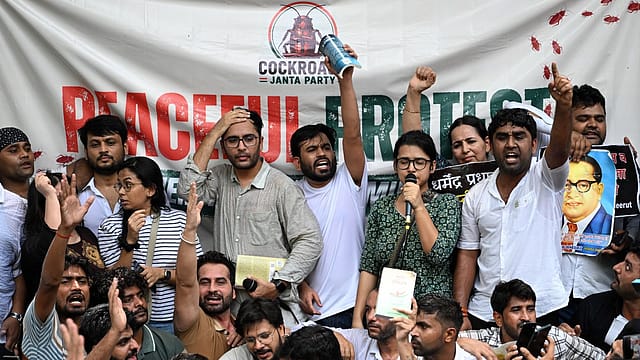
On June 6 a large number of youtubers, bloggers, television and social media channels and print media journalists descended on the designated Jantar Mantar protest site next to the famous dosa-idli food joint that has catered to office goers, visitors and epicures for years. Within the police barriers adjoining the food vendors to one side and the Free Church on the other was where action was to unfold with the arrival of Cockroach Janata Party (CJP) leader Abhijeet Dipke.
Having received permission for the protest, Dipke reached the spot by where a few hundred people had gathered in front of the Janata Dal (U) office by mid-morning. A few enterprising souls perched on the office wall despite police warnings that they might invite injury. Some just to get a view and others keen on taking photos from a vantage. A non-functional mike proved a hitch but the proceedings got underway with speeches centered on the leak of the NEET exam papers but also spelling out a diffused set of grievances. It was a bit of a mix.

Losing Memory
16 Oct 2026 - Vol 05 | Issue 42
The making of a medical and social emergency
A Hindutva Voice
All around the site, protestors were handing out their take on the event and reasons for being there. At a corner, near a tea seller, a different scene was unfolding. A young woman in a salwar kameez with a dash of red tilak on her forehead denounced the protest as a front for sympathisers of terrorists and separatists intent on harming India. “These people here have nothing to say about what happened at Pahalgam. Was not religion an issue? Then why did they ask victims which religion they belonged to before killing them? The organisers of this protest say they oppose communalism but ask them of their views on this,” she said. When a reporter sought to pin her down, asking whether she had nothing to say about education and problems related to the paper leak, she said “Do you think these people are bothered about education? Shall I show you pictures of the organisers with Umar Khalid?” The reporter persisted, “I want to talk about education…” “Let see you ask the questions I asked to these people,” came the reply.
The sideshow gained traction and the protestors were far from pleased. “Why are you listening to her. Who is she? Talk to us,” yelled a bearded man. Soon the “dissenter” was surrounded by a restive crowd and for a moment it looked that things might get out of hand. But fortunately they did not and the heated arguments remained just that while three women police personnel kept a watchful eye. The young woman, who identified herself as Ridhima Sharma from Jaipur, denied any link to an organization. Describing herself as an interior decorator, she stood her ground against an aggressive crowd that kept trying to question her motives and arguments. One CJP supporter declared himself as “Deepak Mohammad” -- the controversial gym owner in the headlines for a clash with right wing groups in Kotdwar. Others accused her of using inflammatory language and the argument raged on for close to two hours before Ridhima Sharma left, perhaps to the relief of the police. Irrespective of whether she acted on her own or enjoyed unseen support, it was a gutsy decision to show up at Jantar Mantar and take on hostile interrogators that included a section of the media.
The Counter Narrative
Ridhima Sharma’s social media account makes it evident that her sympathies lie with the Bharatiya Janata Party (BJP) but that may not be the only relevant point. Present at the protest site were several youtubers who questioned protestors and asked “trick” questions like the full form of NEET and details of which exam they had appeared for. The showdown cast a light on a clash of views and more importantly, mobilization of the Hindu right that seeks to counter narratives intended to promote discontent against the ruling dispensation. The leak of the NEET paper was clearly the spark for the protest and failure to secure the examination is indefensible but the discussion at Jantar Mantar quickly turned political. It was evident that the protesters had an axe to grind with BJP and perhaps felt CJP could be the spark needed to ignite a “Gen Z” revolt on the lines of the revolution in Nepal. The numbers belied expectations and would have been more modest but for the participation of student group AISA (All India Students’ Association). An office bearer confirmed that CJP had approached AISA and the organization agreed to lend its support.
The right to protest, irrespective of the numbers that turn out, needs to be respected and Delhi Police played it well by not obstructing the demonstration. In fact, the police seems to have added to its playbook with official photographers with jackets identifying them recording the event exhaustively. As things turned out neither was Parliament street – where Dipke was initially expected to reach –blocked nor was there a problem at Jantar Mantar itself. As for many of those who showed up, the protest may have let them blow some steam but a “job” is likely to remain elusive even as social media provides them a window to a world that is unattainable. Their skill sets are not compatible with competitive exams and make them misfits for most parts of the Indian economy. In any case available jobs are insufficient when the number of job seekers are considered.
Thunder but no Rain
As things stand, an expansive welfare net, promise of “development” and expansion of government hiring along with opportunities in the private sector prevent a popular churn. There is no appetite for a “Gen Z” revolution. And as the clash of views at Jantar Mantar demonstrates, Hindutva is not a passing phase. Its rootedness and the religio-cultural markers are an anchor that binds and stands in contrast to sentiments CJP represents. It is no small irony that the Nepal revolt unceremoniously unseated a communist regime that was discredited by corruption and sloth. AISA might have chosen to miss the point.