Rajnath Singh Warns Pakistan, Modi Recalls Surgical Strikes: How India Is Recasting Its Defence Strategy
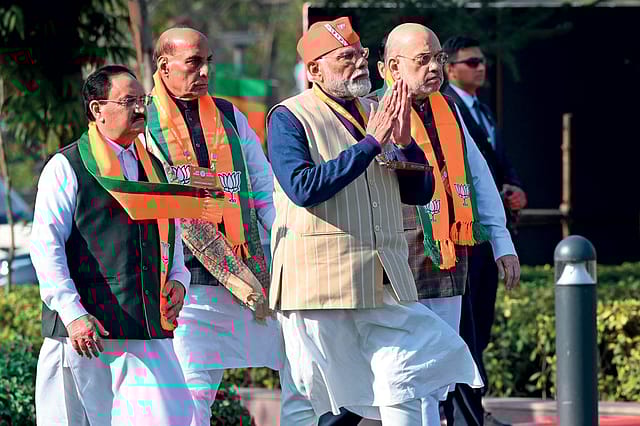
India's message on national security was unequivocal on Sunday: peace remains the stated objective, but preparedness for conflict is central to the country's defence posture.
Defence Minister Rajnath Singh warned Pakistan that India was prepared to carry out strikes against terrorism if the neighbouring country continued what he described as a "state policy of terrorism". Prime Minister Narendra Modi, meanwhile, recalled the 2016 surgical strikes against terror launchpads across the Line of Control (LoC), presenting them as a defining moment in India's response to cross-border terrorism.
The remarks, delivered through Singh's address at the NDTV Defence Conclave and Modi's monthly Mann Ki Baat programme, came as the government highlighted a broader defence strategy encompassing military readiness, technological self-reliance and the ability to respond to evolving security threats.
Singh's address also outlined how India intends to prepare for future conflicts, from artificial intelligence and autonomous systems to domestic manufacturing and the reduction of strategic vulnerabilities.

Losing Memory
16 Oct 2026 - Vol 05 | Issue 42
The making of a medical and social emergency
What did Rajnath Singh tell Pakistan about India's military readiness?
Singh's warning centred on the distinction between India's stated preference for peace and its willingness to use military force in response to terrorism.
"India believes in peace. India never wants war. India never wants to capture the land of any foreign country in the world," he said at the NDTV Defence Conclave. He added that there was a difference between peace and cowardice.
The Defence Minister said India would not compromise on national security and that dialogue had limits when a country provided shelter and support to terrorism directed against India.
"As long as our neighbour continues the state policy of terrorism, India is completely ready for every kind of strike against terrorism," Singh said.
He also referred to Prime Minister Modi's remarks at the 26th Shanghai Cooperation Organisation (SCO) Summit in Bishkek, where Modi had called for a strong international message against countries that use terrorism as an instrument of policy.
Singh's comments placed counterterrorism at the centre of India's security posture while reiterating that the country did not seek conflict or territorial expansion.
Why is India emphasising preparedness even while advocating peace?
For Singh, military preparedness is not simply a response to an immediate threat but a way to deter conflict.
Quoting the principle, "If you want peace, prepare for war," he said India's defence preparations were both complete and strong, while stressing that capabilities would continue to expand as security requirements changed.
He also invoked another saying: "The more you sweat in peace, the less you bleed in war."
The argument was that preparation during peacetime could reduce losses if conflict became unavoidable.
Singh said modern warfare had moved beyond conventional confrontations between soldiers and increasingly involved multiple domains, including land, air, sea, space, cyber operations, electronic warfare and information warfare.
Artificial intelligence, drones, autonomous systems and precision weapons, he said, were becoming increasingly important to military capability.
"The country that is ahead in technology will naturally have the advantage on the battlefield," he said, adding that India's defence strategy needed to anticipate the requirements of the next 10, 20 and 25 years.
How does Modi's recollection of the 2016 surgical strikes fit into India's counterterrorism strategy?
In his Mann Ki Baat address, Modi recalled the surgical strikes carried out by the Indian Army on September 28–29, 2016, against terrorist launchpads across the LoC in Pakistan-occupied Jammu and Kashmir.
The operation followed the September 2016 attack on an Indian Army camp in Uri, Jammu and Kashmir.
Modi described the strikes as a demonstration of India's resolve to respond to cross-border terrorism.
He also referred to the Balakot airstrike and Operation Sindoor, saying India had repeatedly conveyed that terrorist attacks would invite a strong response.
"Over the past decade—from the Balakot airstrike to 'Operation Sindoor'—India has repeatedly sent a clear message: if terrorists dare to cast a hostile eye on India, they will face a befitting response," he said.
The Prime Minister's remarks framed the 2016 operation as part of a continuing counterterrorism approach, rather than an isolated military episode.
The anniversary of the strikes, which marks 10 years in September 2026, has also brought renewed attention to how India has publicly articulated its response to cross-border terrorism.
What does India's defence strategy reveal about its approach to global power?
Singh also addressed India's place in the international order, invoking the concept of the "Thucydides Trap", which describes the risk of conflict when a rising power challenges an established one.
He rejected the idea that India should be understood through a binary of a status-quo power and a revisionist power.
"India is neither a status-quoist power nor a revisionist power. I believe we are a civilizational power," he said.
The distinction, as presented by Singh, was that India's international engagement should be guided by its own strategic interests rather than by assumptions about how rising powers inevitably interact with established ones.
He said India wanted cooperation and global stability but would not sacrifice national interests or strategic autonomy to achieve them.
This position also informed his remarks on defence partnerships and technology, where he stressed the need for India to develop its own capabilities rather than remain dependent on foreign suppliers.
How is India trying to reduce its dependence on imported defence technology?
A central theme of Singh's address was the shift from importing military technology to developing and defining it domestically.
"India should not just import technology. India should be in a position where India defines technology," he said.
The Defence Minister highlighted efforts to reduce vulnerabilities in critical sectors such as semiconductors, energy, data and supply chains.
He referred to initiatives aimed at strengthening domestic semiconductor manufacturing and reducing dependence on imported critical minerals, including the National Critical Mineral Mission.
He also pointed to the diversification of energy sources through renewable energy, nuclear power and green hydrogen, alongside strategic petroleum reserves.
The underlying objective, as Singh described it, was to ensure that weaknesses in essential supply chains did not become vulnerabilities during a security crisis.
For the defence sector, this means developing not only weapons and platforms but also the components, technologies and industrial capabilities needed to sustain them.
How much is India spending on defence, and what does it mean for domestic manufacturing?
India's defence allocation for 2026–27 stands at ₹7.85 lakh crore, according to figures cited by Singh. This compares with approximately ₹2.53 lakh crore in 2013–14.
Of the 2026–27 allocation, around ₹1.39 lakh crore has been earmarked for procurement from domestic industries under the capital acquisition budget.
Singh said the government was using defence procurement to support domestic manufacturing, modernise the armed forces and create opportunities for Indian companies.
He highlighted five positive indigenisation lists issued by the armed forces, covering approximately 509 defence equipment items, weapon systems and platforms identified for domestic production.
Defence Public Sector Undertakings have also issued six indigenisation lists, with the latest covering 405 items.
In addition, around 5,417 strategically important line replacement units, subsystems, spares and components have been identified for indigenisation, of which approximately 3,300 have already been indigenised, Singh said.
The stated objective is to build a domestic ecosystem that can support military requirements while creating opportunities for manufacturers, engineers and smaller suppliers.
Can India's defence industry become a major export engine?
India's defence exports reached approximately ₹38,424 crore in 2025–26, compared with ₹686 crore in 2013–14, according to Singh.
The government has set a target of approximately ₹50,000 crore in defence exports by the end of 2029.
Singh said Indian defence products were reaching more than 100 countries across Asia, Africa, Latin America and Europe.
He argued that exports were not merely an economic indicator but also a measure of confidence in India's technology, manufacturing quality and delivery capabilities.
The expansion of defence exports is closely connected to the government's broader effort to develop domestic production capacity and reduce reliance on imported military equipment.
Whether the sector can sustain this growth will depend on its ability to deliver reliable products, strengthen technological capabilities and compete in international markets.
What do the latest remarks indicate about India's security priorities?
Taken together, Singh's warning to Pakistan and Modi's recollection of the 2016 surgical strikes place counterterrorism and military preparedness at the centre of India's current security messaging.
But the emphasis extends beyond the possibility of military action.
Singh's address outlined a broader approach that combines deterrence with technological modernisation, domestic manufacturing, supply-chain resilience and strategic autonomy.
The government's stated ambition is to build a defence ecosystem capable of responding to immediate threats while preparing for the changing character of warfare.
The central question is no longer limited to whether India is prepared to respond to a security challenge. It is also whether the country can develop the industrial and technological capabilities needed to sustain that preparedness over the long term.