PM Modi at SCO: Terror warning, Shehbaz Sharif and everything that happened at the summit
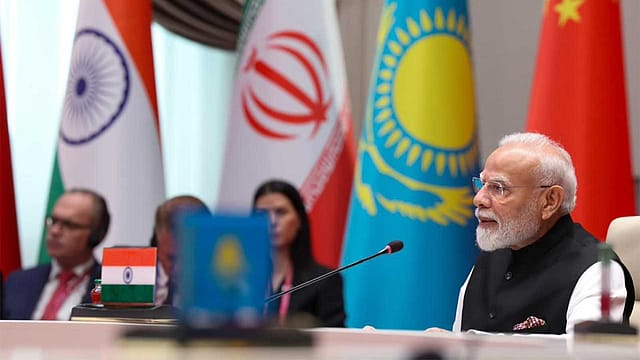
Sometimes the most interesting part of a summit is not just what was said. It is who was listening, what came before it and what happens after everyone leaves the room.
Prime Minister Narendra Modi’s appearance at the Shanghai Cooperation Organisation summit in Bishkek had all three.
With Pakistan Prime Minister Shehbaz Sharif among the leaders present, Modi used the SCO platform to make a strong case against terrorism, calling for the dismantling of the networks that finance, recruit and radicalise terrorists and provide them safe havens.
But terrorism was only one part of the story.
Modi also spoke about dialogue and diplomacy, regional connectivity, economic cooperation and the SCO’s role in shaping a more stable Eurasia. His presence in Bishkek came at the end of a two-country visit that had begun in Uzbekistan, giving the trip a wider Central Asia focus.

Zeroing In on ECI
09 Oct 2026 - Vol 05 | Issue 41
Constitutional legitimacy versus political opportunism
So, if you missed the summit, what exactly happened?
What did PM Modi say about terrorism at the SCO?
The sharpest part of Modi’s address was his message on terrorism.
He called on SCO members to dismantle the entire terrorist ecosystem — including terrorist financing, recruitment, radicalisation and safe havens.
He also argued that countries that use terrorism as an instrument of state policy or provide shelter and support to terrorists must receive a strong message.
Modi reportedly stressed the need to avoid double standards in the fight against terrorism.
The significance was hard to miss: Pakistan’s Prime Minister Shehbaz Sharif was among the leaders in attendance.
Why did Shehbaz Sharif’s presence matter?
Because Modi’s comments inevitably carried an India-Pakistan dimension even though Pakistan was not necessarily the sole focus of the remarks.
India has repeatedly raised concerns over cross-border terrorism at international forums. By making the argument at the SCO, New Delhi placed the issue within a broader multilateral security conversation.
Sharif was present as Modi called for action against the wider ecosystem supporting terrorism.
The setting therefore mattered almost as much as the words.
This was not simply Modi addressing Pakistan. It was India putting its counterterrorism position before a grouping that includes Pakistan, China, Russia, Iran and the Central Asian states.
What else did PM Modi talk about?
The Prime Minister also spoke about the need for dialogue and diplomacy to resolve conflicts, stressing that wars ultimately cannot provide a lasting solution.
His remarks placed security alongside development, connectivity and cooperation — reflecting India's broader approach to the SCO.
Modi's address covered a wider agenda including terrorism, peace, connectivity, economic development, digital cooperation and cultural exchange.
In other words, the speech was not simply a Pakistan-focused intervention.
It was India's pitch for how the SCO should approach the region's larger challenges.
What was Modi’s message on peace and diplomacy?
Alongside his warning on terrorism, Modi stressed the importance of resolving conflicts through dialogue and diplomacy.
That message comes against the backdrop of multiple conflicts and geopolitical tensions affecting the wider Eurasian region.
For India, the position is familiar: terrorism must be confronted firmly, but disputes between states ultimately require diplomatic solutions.
The combination allowed Modi to make two arguments at the same summit — security cannot be compromised, and diplomacy cannot be abandoned.
Why was the SCO summit important for India?
Look at the map.
The SCO brings together India, China, Russia, Pakistan, Iran, Belarus and the Central Asian republics, making it one of the few forums where all these countries sit around the same table.
For India, that makes the grouping particularly important for discussions around terrorism, energy, trade, connectivity, regional security and economic cooperation.
Modi's participation also came as India seeks to deepen its engagement with Central Asia.
The Ministry of External Affairs said his 2026 visit to Uzbekistan and the Kyrgyz Republic was aimed at strengthening India's strategic partnerships in the region.
What happened during Modi’s Uzbekistan visit before the SCO summit?
The Bishkek summit was the second leg of Modi's trip.
He first travelled to Tashkent for a bilateral visit with Uzbek President Shavkat Mirziyoyev.
During the visit, Modi highlighted cooperation between India and Uzbekistan in areas including trade and investment, digital connectivity, defence and energy.
He also visited the Shastri Memorial and the Mahatma Gandhi Centre at Tashkent State University of Oriental Studies — gestures that underscored the cultural and people-to-people links between the two countries.
The Uzbekistan leg therefore provided the bilateral side of the trip, while Bishkek brought the wider regional diplomacy into focus.
What does Modi’s SCO visit mean for India’s Central Asia strategy?
There is a bigger thread running through the entire trip.
India is increasingly looking at Central Asia not simply through the lens of geography, but through trade, energy, connectivity, technology and strategic cooperation.
Uzbekistan provides an important bilateral relationship. The SCO provides the multilateral platform.
Together, they allow India to engage with countries that sit at the crossroads of some of the world's most important trade and security routes.
What was the biggest takeaway from the SCO summit?
There were several.
The first was Modi's renewed push for a zero-tolerance approach to terrorism, including the financial and organisational networks behind terrorist attacks.
The second was the diplomatic backdrop: Shehbaz Sharif was in the room, giving Modi's remarks an unavoidable India-Pakistan resonance.
The third was that India's SCO agenda was much wider than terrorism. Modi also pushed dialogue, diplomacy, connectivity, economic cooperation and stronger engagement across Eurasia.
And perhaps that is the easiest way to read the Bishkek summit.
It was not one speech or one pointed remark.
It was India using a room filled with some of the world's most consequential powers to make several arguments at once — on terrorism, peace, regional cooperation and India's place in a changing Eurasia.
(With inputs from agencies)