Can MLAs Resign Their Way Out of the Anti-Defection Law? Madras HC Rules in AIADMK-TVK Case
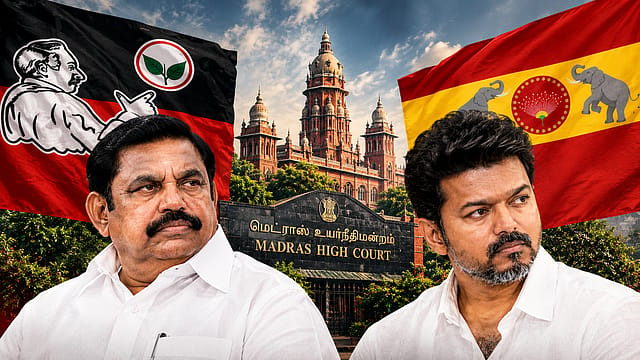
On Tuesday, the Madras High Court gave a ruling that settles one question in Tamil Nadu politics and leaves another open.
A bench of Chief Justice SA Dharmadhikari and Justice G Arul Murugan upheld the decision of Speaker JCD Prabhakar to accept the resignations of AIADMK legislators who quit the party after the Assembly elections and joined Chief Minister Joseph Vijay’s Tamilaga Vettri Kazhagam (TVK).
The court held that the resignations were genuine and that the Speaker was not expected to conduct a detailed enquiry into the process.
The court also said the resignations would not bar disqualification proceedings against the MLAs. It directed the Speaker to complete those proceedings within two months.
1. WHAT WAS THE FIGHT ABOUT?
AIADMK MLAs resigned from the Assembly and joined the TVK. The AIADMK challenged the Speaker’s decision to accept their resignations, arguing that he had acted too quickly and without proper checks.

Zeroing In on ECI
09 Oct 2026 - Vol 05 | Issue 41
Constitutional legitimacy versus political opportunism
The petitions were filed by AIADMK whip Agri Krishnamurthy and Ravi of the National People’s Power Party. They asked the High Court to quash the Speaker’s orders accepting the resignations.
2. HOW DID IT GET HERE?
The results of the Tamil Nadu Assembly elections were declared on May 4. The TVK won 108 seats, ten short of the 118 needed for a majority. It sought support from other parties and formed the government. In the confidence vote on May 13, it won 144 votes.
On May 11, the AIADMK had issued a whip asking its members to oppose the motion. On the day of the vote, 25 of its MLAs voted for the TVK government. Disqualification proceedings under the Tenth Schedule of the Constitution began on May 14.
Some MLAs later apologised for cross-voting, and the proceedings against them were dropped. On May 25, the MLAs in question resigned. The petitioners say the Speaker accepted the resignations the same day, a Gazette notification followed, and the MLAs joined the TVK.
3. WHAT DID THE COURT SAY?
The Speaker’s decision stands. The court upheld his acceptance of the resignations as genuine, and said the Speaker was not expected to carry out a detailed enquiry into the process.
But that ruling did not settle the separate question of whether the MLAs should be disqualified.
4. WHY DID THE AIADMK OBJECT?
The party said the resignations were accepted in a hurry. It pointed out that the resignations were submitted at around 2:30 pm on May 25 and accepted the same day, which was also the day the MLAs joined the TVK. In its view, that suggested the process was a formality.
It argued that Article 190 of the Constitution required the Speaker to inquire properly into whether the resignations were voluntary. It also said the AIADMK should have been given notice so that it could oppose them.
The party also alleged horse-trading, which means offering money or other benefits to persuade legislators to switch sides. The petitioners referred to a complaint on this to the Governor.
That was an allegation, not the court’s finding.
5. WHAT DID THE SPEAKER AND THE MLAs SAY?
The Speaker told the court that when the resignations were handed to him, he asked each MLA whether the decision was voluntary. He said he accepted them only after being satisfied that there was no undue influence or coercion.
Counsel for the Assembly Secretary argued that accepting a resignation does not wipe out disqualification proceedings for conduct before the resignation.
Senior Advocate CS Vaidyanathan said Article 190(3)(b) only requires the Speaker to check whether a resignation is genuine, not why the member is quitting. He noted that no one claimed the letters were written by anyone other than the MLAs.
Senior Advocate Menaka Guruswamy, for the MLAs, argued that not every vacated seat involves malpractice. She said resigning before joining another party is a legitimate way of expressing dissent.
6. DO MLAs HAVE TO EXPLAIN WHY THEY QUIT?
No. The key questions are: Is the resignation genuine? Was it submitted freely?
Under Article 190, an MLA resigns by writing to the Speaker. The Speaker accepts the resignation after satisfying himself that it is voluntary and genuine. The court said a detailed inquiry into the political reasons for quitting was not required.
7. THEN WHY IS DISQUALIFICATION STILL AN ISSUE?
Resignation and disqualification are separate questions.
The anti-defection law, in the Constitution’s Tenth Schedule, can disqualify legislators for voluntarily giving up their party membership or defying its voting instructions, subject to exceptions.
The court made clear that accepting a resignation does not automatically close that case. This matters because otherwise a legislator could defy the whip, resign before facing any consequence and return to politics under a new banner.
8. WHAT DOES “DEFYING THE WHIP” MEAN?
A whip is a party’s instruction on how its legislators should vote, usually on key matters such as a confidence motion.
Voting against it, or abstaining contrary to it, without permission can lead to disqualification proceedings. The law also allows the party to condone the breach.
9. WHAT HAS HAPPENED SINCE THE RESIGNATIONS?
Two of the MLAs, Maragatham Kumaravel and P Sathyabhama, contested by-elections in Maduranthakam and Dharapuram on the TVK’s whistle symbol and retained their seats.
Chief Minister Joseph Vijay called the results a victory for democratic values and a rejection of money-power politics. He said his party won without paying voters.
10. WHAT NEXT?
The resignations stand. The disqualification cases remain open.
The court has directed the Speaker to finish those proceedings within two months. Whether the MLAs broke the anti-defection law still has to be decided.