EXPLAINED | Can India End Highway Toll Jams by Taking Down the Barriers?
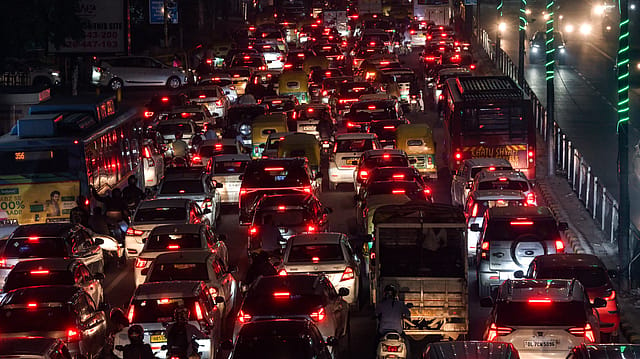
Your FASTag can pay the toll in seconds and you can still spend minutes waiting to reach the reader. The National Highways Authority of India (NHAI) wants to get rid of that wait. On November 6, the road transport ministry announced design rules that let vehicles pass under overhead readers and cameras without stopping at a booth. The change could clear queues caused by toll collection. How much faster the whole trip gets depends on what is holding up traffic beyond the plaza.
What exactly has NHAI changed?
It has told highway builders to design tolling zones for moving traffic. New four-lane and wider national highway projects must incorporate the layouts in their plans. Projects already awarded or under construction will make changes under their contracts. The rules cover where to put the overhead equipment, how many lanes to provide and how to alert drivers with signs and lighting.

The Era of Forever Wars
30 Oct 2026 - Vol 05 | Issue 44
Coping with an explosive Middle East
Why do FASTag lanes still jam?
FASTag made payment faster. A barrier lane still handles vehicles one at a time. Each driver slows, the reader checks the tag, the arm lifts and the vehicle pulls away. A failed read can hold up everyone behind it. A ministry assessment for 2024–25 put the average crossing time under electronic tolling at 40 seconds, compared with 12.23 minutes under earlier manual tolling. Those are averages for the older systems.
How will a toll be collected at highway speed?
A reader on an overhead frame, called a gantry, picks up the windscreen FASTag by radio. Cameras capture the registration plate so the system can identify the vehicle. The toll is charged through the FASTag account when the transaction goes through. This is what NHAI calls multi-lane free-flow tolling. Drivers can follow their lane and the posted speed limit while the equipment does the work.
Has an Indian toll queue actually disappeared?
There is an early sign on the Surat–Bharuch stretch of NH-48. India’s first site went live at Choryasi on May 1. On May 11, NHAI chairman Santosh Kumar Yadav reportedly said that peak-hour waiting at the toll gate had dropped from about five minutes to nearly zero. That is one reported result at one plaza. The November announcement gives no comparable figures across sites.
Where can I already drive through?
By October 1, NHAI had named seven operating sites. They include Choryasi in Gujarat, Mundka-Bakkarwala in Delhi, Gharaunda in Haryana, three on the Delhi–Jaipur stretch of NH-48, and Paranur in Tamil Nadu. The November guidelines set the design for future and ongoing projects. The ministry gave no date for converting every existing toll plaza.
Could the queue simply move down the road?
Yes. If a toll barrier is the choke point, taking it out lets vehicles pass without lining up to pay. If a busy junction, a lane closure or a narrow bridge limits how much traffic can get through, the queue can still form there. The practical test is how long drivers take to cover the stretch on both sides of the old toll gate at peak hour.
What if my FASTag fails or runs out of money?
At a free-flow site, the vehicle can keep moving and an electronic notice can follow. You have 72 hours from issuance to pay the ordinary toll or challenge an incorrect notice through the official portal. Miss the payment window and the charge doubles. On a ₹100 toll, that means ₹200. Check that your FASTag works, has enough balance and is linked to the right registration number.
How often does the bill go unpaid at the gate?
Nearly one in ten crossings at five early sites generated an unpaid-toll notice between May and July. There were reports of about 10.52 lakh notices across about 1.10 crore crossings. A notice records a toll that went unpaid at the time of crossing. Some drivers pay later. The figures show how often the system had to chase a payment after the vehicle had gone.
Will I pay less, or only for the kilometres I drive?
The new guidelines govern how roads are built and equipped to collect tolls. The fee itself follows separate rules and notifications for the highway stretch and vehicle category. The change uses FASTag and number-plate cameras. The government told Parliament it was still examining satellite-based tolling. Driving under a gantry does not, by itself, change how the amount is calculated.
What has worked on roads abroad?
In Florida, a study of the University Toll Plaza found that adding high-speed electronic lanes increased speeds in the express lanes by 57%. Delays in the remaining staffed cash lanes fell by about half. On France’s Paris–Normandy motorway, a tag can pay automatically. Without one or an automatic payment setup, drivers have 72 hours to pay after passing the gantry.
Why is Taiwan a particularly close comparison?
Taiwan switched to fully electronic, distance-based freeway tolls in December 2013. Gantries let it charge for the distance travelled after it removed the booths. There is a direct link to India. Taiwan’s Far Eastern Group says its tolling team helped build the systems at Choryasi and Gharaunda, adapting them to identify a wider variety of vehicles.
How will we know if the rollout is cutting jams?
Compare peak-hour journey times before and after conversion, including the road beyond the gantry. Then count how many crossings are paid automatically, how many generate notices and how many notices end in payment or correction. That will tell us whether drivers are getting through faster and whether the toll can still be collected reliably once the barrier is gone.