Monsoon Session: Parliament Hobbles On
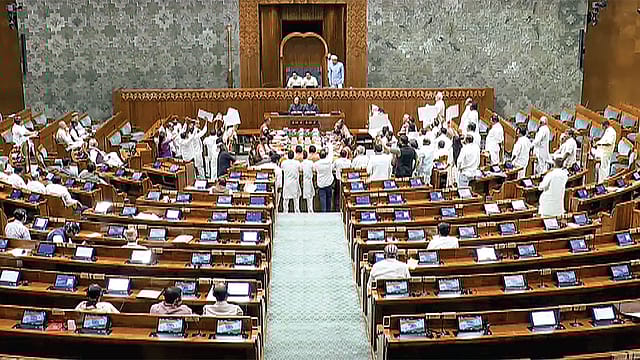
If one ignores the din and the noise, the Monsoon Session of Parliament turned out to be productive. Ten-odd pieces of legislation have been passed and a couple more could be cleared as well in what remains of the session’s last day. Two important Bills that were under consideration, the Delimitation Bill, and its cognate constitutional amendment and the FCRA Amendment Bill, could not be passed. The latter was referred to a Joint Parliamentary Committee (JPC). The Delimitation Bill was not introduced. These two are the only “achievements” of the Opposition.
The Monsoon Session was noisy as all sessions of Parliament have been since 2014. There is nothing surprising here for those who observe the political calculations of the Opposition. But even with these, no-holds barred, attempts to paralyse Parliament, the legislative agenda and the policy outcomes flowing from that have continued without major problems.
Rise of the Pivotal Power
18 Sep 2026 - Vol 05 | Issue 38
The BRICS declaration is a strategic victory for Modi
Poor tactics, dubious strategy
The Opposition’s tactics seen today were first launched in 2014, soon after the Narendra Modi government came to power, when the latter sought to amend the 2013 land acquisition law passed by the UPA government, The Right To Fair Compensation and Transparency In Land Acquisition, Rehabilitation and Resettlement Act, 2013. That law was designed to kill any land acquisition. While its objective was lofty—fairness in land acquisition by government—in practice it was meant to kill industrialization and set roadblocks for projects of national importance. After multiple Ordinances, the Bill could not be passed as the NDA government lacked a majority in the Rajya Sabha.
That tactic of derailing the government’s legislative agenda has now evolved into making all attempts not to let Parliament function. The simplest method is to create chaos in the two houses that their presiding officers are forced to adjourn daily sessions repeatedly. From slow beginnings, this method has touched a crescendo of sorts in recent years.
As a tactic, forcing adjournments might give a hurrah to the Opposition, at the strategic level, its logic is dubious. There is a two-fold calculation behind this: One, do not allow the houses to function and claim that the government cannot run Parliament even if it has a majority in the legislature. The “hope”—and it is no more than a hope—is that this will rub off the Modi government’s legitimacy something that will, ultimately, translate into electoral gains for the Opposition, especially the Congress party. Secondly, the idea is to derail the government’s economic objectives—higher economic growth leading to better incomes for citizens—and then claim that Indian’s are worse-off under the Modi government.
Both objectives have failed comprehensively. This should have been obvious after two repeated failures at the hustings, in 2019 and 2024. There is not one single session of Parliament since 2014 when the Opposition did not obstruct the functioning of the two houses. Yet, there were no commensurate gains at the electoral level. Similarly, India’s growth has continued and, on average, the country continues to post anywhere between 6.5% to 7% plus growth rates. The average (based on World Bank data) growth rate from 2014 to 2025 stood at 6.1%. This includes the pandemic year of 2020 when growth turned negative at -5.8%. This is apart from physical achievements in building infrastructure and rapid expansion of capital expenditure from 2020 onward.
So, what is the basis for this strategy of not letting Parliament function? In one line: it is unfathomable.
The truth of the matter is that even the BJP obstructed Parliament between 2004 to 2014—a full decade—yet it managed to prevail at the hustings in 2014 and has continued to do so for more than a decade. The reasons for its success and the UPA’s failure are different and are to be found at the ideological and policy implementation levels. For the NDA, obstructing Parliament was a sideshow of a sideshow; for the present-day Opposition, it is their mainstay.
This strategy has not worked and is unlikely to work. Its persistence has more to do with hope than any realistic calculation. This situation will continue even as the Modi government continues to push ahead with its policy objectives.