Red Reckoning
A senior leader of the Communist Party of India (Marxist), or CPM, I spoke to on September 12 at the Government Guest House in West Hill, Kozhikode, on the eve of a crucial three-day party conclave in this coastal city in northern Kerala, appeared crestfallen. He didn’t expect any major decision that would, according to him, upset “the status quo” and make the top leadership in Kerala accountable for its recent rout in the Assembly polls after 10 years of being in power. He used expressions such as “inertia” and “slippery slope” and “increasing geriatric behaviour” within the confines of his party that he also said “protected” the seniors from a “long overdue” scrutiny as though they were a “secret society”. He said, “I am just taking a break and going to chill here, this being a foodie’s paradise. Nothing is going to come out of this summit or whatever they call it to reverse the sagging fortunes of our party.”
But the outcome of the event surprised him.
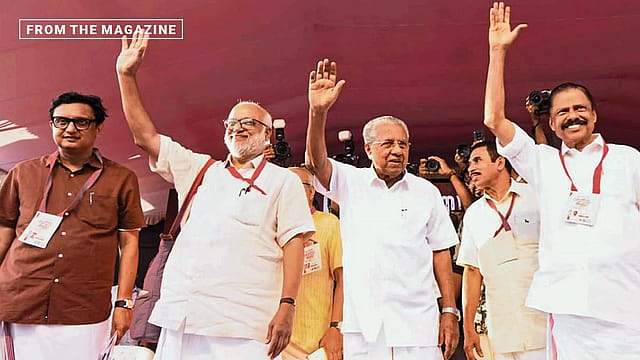
Of course, no one can blame him for being pessimistic about the top brass escaping criticism for their omissions and mistakes. That’s what he has seen for far too long now. For more than 25 years, discussions within the Kerala unit of CPM have been along predictable lines, never questioning the authority of former Chief Minister Pinarayi Vijayan, now Leader of the Opposition in the Assembly. The “extended meeting” (vipuleekrutha samsthana committee), which concluded on September 15 in Kozhikode—where the first cell of the communist party in Malabar was created in the late 1930s by four people—broke that habit. The meeting also included leaders from the student and youth wings of CPM who were not members of the state panel. There was a sense of vengeance among delegates, who surprised themselves by castigating the older leaders—who had revelled in their power and cultivated an aura of unassailability—for the poll reverses and the lost public credibility.

Zeroing In on ECI
09 Oct 2026 - Vol 05 | Issue 41
Constitutional legitimacy versus political opportunism
More importantly, the central leadership, headed by CPM politburo and its General Secretary MA Baby, acted decisively, forcing the state unit to elect unexpected faces to leadership positions that the current state grandees would have never picked. The central leadership—which had presided over a similar exercise in West Bengal where it decided to recruit younger faces to ride out the bad times—promoted to the state panel and the state secretariat some names considered persona non grata for the current leadership. The meeting, clearly at the instance of the politburo, censured CPM state secretary MV Govindan for disregarding popular opinion within the party by pushing for his wife’s candidature in this year’s elections.
Govindan, known for his narcissistic behaviour and tendency to speak without any sense of propriety at party forums and before the press, found himself mortified at the outcome which reflected the overall sentiment of the rank and file.
“It is not often that we find leaders taking the side of ordinary workers and lower-rung leaders in such meetings. In our party, the state leadership takes a decision and then thrusts it upon the lower committees. It has been so for decades now. Suddenly and unexpectedly, the extended state committee, encouraged by the central leadership, took decisions that included naming young people to the state committee and strengthening the crucial state secretariat (a panel selected from state committee members and the highest decision-making echelon in the state) by including people known for airing independent opinion instead of being the regular yes-men that our leadership usually promotes to ensure their ‘unquestioned’ position,” said a state committee member who went on to narrate the details of the discussions.
At the meet aimed to review the tragedy of errors that led to the Left shrinking electorally to its poorest show, especially at its last outpost of Kerala, a delegate from CPM stronghold Kannur, P Hareendran, started off by asserting that the report by the state panel placed the blame more on lower-level functionaries and grassroots level workers while the lion’s share of political miscalculations was committed by the state secretariat. Except for a few mentions, the mistakes at the top were not pointed out in the report, he averred. That a no-holds-barred attack against the leadership, especially against Govindan and Vijayan, came from their home district, Kannur, was enough to embarrass senior leaders. Hareendran’s views also set the tone of the discussions that followed.
A delegate says, “The discussions were impeccable and serious. Most participants who discussed the report highlighted true shortcomings of the leaders, including lack of collective decision-making and an ear to the ground. The leaders were dismissive of sentiments that rose from the lowest level panels of the party—which was why they chose the wrong candidates in party bastions of Taliparamba and Payyannur and lost to rebels from within the party who had quit and joined hands with Congress.” The person emphasised that the elevation of leaders of the stature of P Jayarajan to the state secretariat is a huge setback to leaders like Vijayan and Govindan who didn’t want to “hear” any dissenting voice.
P Jayarajan, despite charges of being involved in political violence, enjoys popularity among the cadre for his seemingly incorruptible image—each time his name was mentioned at the concluding public meeting held on the famous Kozhikode beach, a roar rose from the crowds, reinforcing his image as a leader worthy of respect and trust. Allegations of corruption against Vijayan and a few members of his family have lately added to fears among party workers and sympathisers that there is a huge dearth of popular leaders currently, in sharp contrast to the pantheon of leaders who often held sway over the people in the past, such as departed luminaries EMS Namboodiripad, VS Achuthanandan, AK Gopalan, EK Nayanar, and others. “Until VS passed away, we had leaders with high credibility even among their rivals. Now, there is a lot of uncertainty among party members because of a raft of factors, including the rising popularity of the Hindutva parties, which offer people another option in a state known for duopoly of the Congress-led United Democratic Front (UDF) and the CPM-led Left Democratic Front (LDF); plus, politics, we all know, is about perception and if your leaders do not attract admiration, political parties decline, sometimes, very quickly,” another state committee member tells Open, adding that the decision at this meeting is comparable to what is usually taken in elaborate state conferences. He is also glad that student leaders have been chosen to the state committee.
Others elevated to the state secretariat include MB Rajesh, former minister and MP, and V Sivankutti, former minister. Interestingly, John Brittas, leader of CPM in Rajya Sabha who is also a member of the central committee has been chosen as state secretariat member. Brittas, a prominent face of the opposition nationally, has lately become popular in the state as well thanks to his speeches and ability to connect with the masses, especially women and minorities. In that sense, this decision is a reward of sorts for the parliamentarian who has consistently raised the Left’s concerns in Rajya Sabha besides acquiring visibility as an opposition leader, quite disproportionate to the electoral prowess of his party in both Houses of Parliament.
The elevation of N Sukanya to the state committee is a personal setback of sorts for Govindan who had apparently vetoed her candidature in the last Assembly polls to make way for his wife. Among other additions to the committee are women leaders OS Ambika, Subaida Ishaq, and young faces Adarsh M Saji, M Vijin, Jaick C Thomas, M Sivaprasad, and PS Sanjeev.
MA Baby also made another symbolic move by giving a wide berth to KK Shailaja, Kerala’s former rock star health minister during the Covid pandemic who acquired a halo as a doer. While the state unit consistently sidelined her for the past few years, MA Baby invited her to address the crowds at the concluding public meet, emphasising the representation of women. It was a public display of recognition that had been routinely denied to her by the grandees who had also tried to denigrate her. In Vijayan’s second term from 2021 to 2026, she was kept out of the cabinet to accommodate favourites. In the 2026 polls, she was fielded from a seat that the Left was sure to lose. P Jayarajan, too, had been regularly pushed to the fringes despite his growing popularity and ability to poach leaders from even the Hindutva fold.

That such leaders are back in the limelight is expected to inspire lower-level leaders when a similar exercise happens, as planned, at the district level in the state. “Now party leaders have tasted victory in forcing their leaders to act and respect their wishes, which are essentially the wishes of the people because these are the leaders who deal directly with the general public on a daily basis and get regular feedback on the party and its policies,” says a senior CPM leader who adds that this means a “rectification” campaign is being set in motion. He also recalls an event: the choice of the council of ministers in 2021 which was over in a matter of less than half-an-hour because there were no questions asked. “Even if queries were raised, they were just perfunctory, never serious objections.”
That is why CPM in Kerala has come under attack from pro-Left political commentators as vigorously as from a section of the media—for authoritarian ways that have led to disenchantment within the ranks and without. Although the local media has been reportedly antagonistic towards the Left because any anti-Left news item is bound to get the highest views and audience engagement, the hubris that had set in within the top echelons of CPM proved counterproductive despite its government’s focus on development. For their part, CPM leaders contend they were unfairly targeted as being hand-in-glove with Hindutva forces, which alienated minorities from them.
Most delegates I met in Kozhikode were of the view that change has to come first from the leadership before they teach the lower committees to shed “parliamentary deviation” and similar excesses linked to power. “Absolute power had led them astray. They focused merely on their gains and those loyalists around them, not about the party. We didn’t learn from the West Bengal debacle,” one of them said.
Whether that is exaggeration or venting, Govindan has found himself in a tight spot. Many CPM leaders before him have been censured by the party, especially the higher bodies, but this time he got censured by the state panel that he himself heads. An indication of all this was clear in criticism aired earlier in the state committee by CPM leader P Sasi, usually an ally. The summit proved it was a reflection of popular sentiment. Unlike on previous occasions, the state leadership couldn’t use the proverbial sama-dana-bheda-danda (from persuasion to punishment) policy to silence dissent this time round.
Rajesh N, an enthusiastic CPM sympathiser at the public meeting where a massive crowd had gathered, said, “The turnout here is perhaps a reaction to the positive measures taken at the meeting.” Somehow, the excitement seemed contagious. Contrary to the claims made by a section of the state leadership that people made a mistake in voting them out, MA Baby said, addressing the public meet and leaving nothing to speculation, that when leaders make lapses, the public must point them out. The party must return to the masses and its roots, he said, snubbing his own leaders who tried to pass the buck. There was also an emphasis on eco activism and what Malayali public intellectual Sunil P Ilayidom recently described as Kerala’s “Leftwing life”, one shaped by Leftist ideals that champions pluralism and mutual respect rather than divisiveness and hate rooted in an “us versus them” mindset.