MK Stalin Sets Two Conditions for DMK Support to Delimitation Bill
Amid growing political debate over the proposed delimitation exercise ahead of Parliament's upcoming special sitting, DMK chief MK Stalin on Friday reiterated two demands to safeguard Tamil Nadu's representation in the Lok Sabha, asserting that the party would not compromise on the state's interests.
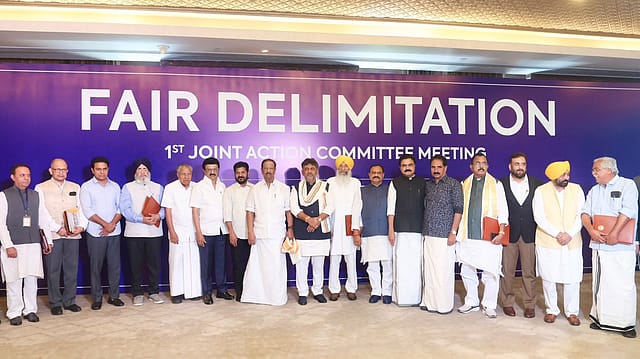
In a post on X, Stalin said the DMK had been among the first political parties to raise concerns over the implications of delimitation and recalled a meeting in Chennai where political leaders from across the country came together to demand safeguards.
“The DMK was the first in India to raise its voice against the dangers of delimitation! It was only in Chennai that political leaders from across the country came together for the first time to demand fair delimitation,” he wrote.
WHAT ARE THE DMK'S TWO DEMANDS?
Stalin reiterated two conditions concerning the allocation of Lok Sabha seats among states.

Anatomy Of A Stillborn Revolution
20 Nov 2026 - Vol 01 | Issue 01
Whatever Happened To The Cockroach Janta Party?
First, Tamil Nadu's existing 7.18 per cent share of Lok Sabha seats should not be reduced, even if the total strength of the Lower House is increased.
Second, the existing proportion of parliamentary representation among states, based on the 1971 Census, should remain unchanged for another 25 years.
“The DMK stands firm on these two demands and will continue to do so. There is no change in our position, and there is no question of any compromise!” Stalin said.
He also took aim at political opponents, saying media speculation and criticism would not weaken the party's resolve.
“Neither the speculations being circulated in the media nor the wails of backstabbers can shake our resolve. The DMK will never compromise on Tamil Nadu’s interests. Nor will it depart from its principles!” he added.

WHY ARE SOUTHERN STATES CONCERNED?
The delimitation debate has become a major concern for southern states, including Tamil Nadu, Kerala, Karnataka, Andhra Pradesh and Telangana. These states fear that a redistribution of parliamentary seats based on population could increase the representation of states with higher population growth while reducing their relative share.
The allocation of Lok Sabha seats among states has remained frozen on the basis of the 1971 Census. Under the existing constitutional provisions, this freeze is linked to the publication of the first Census conducted after 2026.
States that have made progress in population stabilisation have argued that they should not lose political representation as a consequence of controlling population growth.
SPECIAL SITTING ADDS TO DELIMITATION DEBATE
The issue has gained urgency ahead of Parliament's upcoming special sitting. The Lok Sabha Secretariat has announced that the second part of the Eighth Session of the Eighteenth Lok Sabha will begin on November 30 and is likely to conclude on December 3, subject to government business.
Union Parliamentary Affairs Minister Kiren Rijiju has said the government requested the Lok Sabha Speaker and the Rajya Sabha Chairman to reconvene the Lower House on November 30 and the Upper House on December 2 to transact essential government business.
The government has not specified which Bills will be taken up during the sittings. However, the announcement has intensified speculation over the possible introduction of the proposed Delimitation Bill and legislation concerning the implementation of women's reservation.
Parliament last met during the Monsoon Session, which concluded on August 13, with both Houses adjourned sine die. The proposed delimitation exercise is also being discussed in the context of a possible increase in the strength of the Lok Sabha to 850 seats.
With inputs from ANI