Modi Govt throws down the gauntlet on delimitation, women’s quota
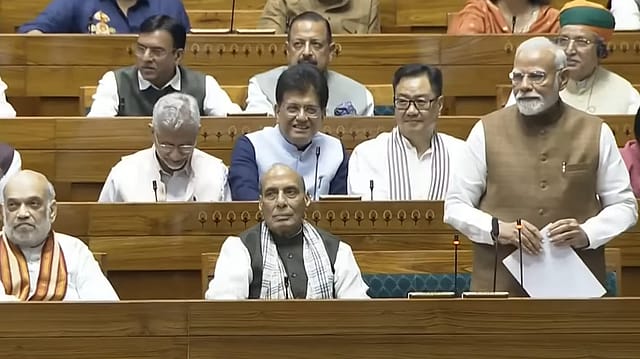
The gauntlet has been thrown. Home Minister Amit Shah’s challenge to Congress – “You cannot stop us” – referring to the passage of the 33% women’s reservation and delimitation bills – has shades of the colloquial Hindi phrase “Rok sako toh rok lo (Stop us if you can).”
The convening of Lok Sabha on November 30 and Rajya Sabha two days later sets the stage for a showdown on the delimitation constitution amendment that failed to get the required two-third majority in the lower House in April. The defeat, the first instance of the Modi government failing to pass a bill, came in the middle of a heated election campaign with Dravida Munnetra Kazhagam and Trinamool Congress determined to prevent the legislations from going through.
Changed Math
This time around, Congress depends on less reliable allies to stall the proposed delimitation. The Congress’s calculations hinge on keeping the “vote chori” and anti-SIR (special intensive revision) of electoral rolls upfront, hoping the issue will deter parties like DMK and Nationalist Congress Party (Sharad Pawar) from breaking ranks. Congress is also counting on disorder in the House preventing the legislations from being considered. A constitutional amendment bill cannot be passed amid bedlam by a show of hands and a voice vote. Votes must be recorded.

Anatomy Of A Stillborn Revolution
20 Nov 2026 - Vol 01 | Issue 01
Whatever Happened To The Cockroach Janta Party?
But this is at best a tricky strategy. It will be difficult to disrupt the House if it becomes apparent that a significant section of the Opposition is not on board. The main rationale of the opposition to the bills – that delimitation will erode the share of southern states in the next Lok Sabha – has been answered with Shah committing to ensure a minimum 50% increase in seats for all states. This will mean the regional distribution of seats will remain unchanged. Opposing delimitation per se is a weak argument. After all, the number of constituencies cannot be frozen in time.
Protecting the South
It can be argued that the delimitation should take place on the basis of the ongoing Census, but this will definitely result in a serious depletion of the south’s representation. The trends of the 2011 count where these states recorded a swifter fall in birth rates is bound to be confirmed in the next Census as well. In fact, the fall might well be steeper. It makes imminent sense to go by the 2011 Census, even if this is partly a matter of political expediency. Given the political hurdles in the way of fresh delimitation, no one is going to consider the next 25 years at the least.
There were three bills before the House in April. There was the 131st costitutional amendment that proposed increasing the strength of Lok Sabha from 550 to 850, sough to enable the 2011 Census being the basis for the redistribution and aimed to operationalize the 33% reservation for women in legislatures. The linked delimitation bill, which facilitate the setting up of a delimitation commission, and the Union Territories Laws (amendment) bill, were not pressed after the constitutional amendment bill fell in 298-230 vote – as the required special majority was not achieved.
DMK and Trinamool were strongly motivated by a desire to “oppose” the Bharatiya Janata Party (BJP) even as their senior leaders raised elaborate objections on grounds such as the overall rise of Lok Sabha seats from north India eroding the south’s say. Trinamool was swept out of office by a BJP tsunami and while the saffron party’s alliance with AIADMK came a cropper, DMK found itself turfed out by newbie actor Vijay. In any case, it became apparent that opposing delimitation did nothing to change the course of events in Tamil Nadu and West Bengal.
By the time the Monsoon session of Parliament was at hand, the government had, in fact, fixed its math. Though wary of articulating their plans, government managers were confident of the support of 22 DMK MPs and eight NCP(SP). In the meanwhile the Uddhav Sena suffered from more defections and six of its nine MPs joining the Shiv Sena led by Maharashtra deputy chief minister Eknath Shinde. Trinamool splintered within days of being ousted from office with 20 MPs and 58 MLAs parting ways with former West Bengal chief minister Mamata Bannerjee. In a House with 540 members, National Democratic Alliance (NDA) was tantalizingly close to the required 361 votes at the time.

CJP disruption
The dramatic emergence of the Cockroach Janata Party (CJP) which mobilized public discontent over the leak of the exam questions for undergraduate medical entrance tests put a spanner in the works for the NDA. The “march to Parliament” planned to coincide with the first day of the Parliament session led to widespread clashes between the protestors and the police in central Delhi. Ultimately it resulted in the resignation of education minister Dharmendra Pradhan. Given the fact that the government was on the backfoot, the INDIA bloc repeatedly blockaded Parliament.
This time around, Congress communications in-charge Jairam Ramesh on Friday re-iterated the party’s position, saying it is favour of maintaining the current strength of the Lok Sabha for another 25 years, continuing the current state-wise distribution of seats in the Lok Sabha and implementing one-third reservation for women and reservation within reservation for women belonging to Scheduled Castes and Scheduled Tribes from the 2029 Lok Sabha elections onwards. The Congress position adds up to a negation of the Modi government’s proposed Bills.
Forked check for Congress
The problem for Congress is that while it has claimed the government has failed to invite the party for talks, it is facing a trenchant BJP attack for “opposing” women’s reservation. While parties like DMK and Trinamool (Mamata) are chiming the “vote chori” tune, there Dravidian party remains extremely cut up over Congress’s decision to ally with Vijay after the Tamil Nadu polls. As for the eight Trinamool MPs still outside the NDA, there is no surety whether all of them will indeed turn up to vote in the House.
At a political level, Congress may find itself in the dock for blocking delimitation and women’s reservation without any good reason. Its attempts to conflate the anti-SIR campaign with the issue might not be easy to sustain once Parliament convenes. On the face of it, Congress could continue to disrupt proceedings. But this may them look more and more like a partisan exercise rather than any genuine concern over alleged government overreach.