Manoj Kumar Jha says the manner in which govt treats protesters, especially women, is deeply distressing
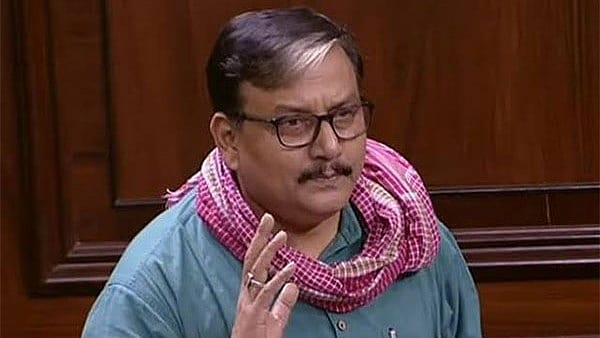
Noted parliamentarian and academic Manoj Kumar Jha has expressed shock at the brutality of the police crackdown on peaceful protesters demanding the resignation of Chief Election Commissioner Gyanesh Kumar over alleged irregularities in the Special Intensive Revision (SIR) of electoral rolls conducted by the Election Commission of India (ECI).
“I have been in public life and associated with numerous protests and people’s movements for more than three decades. Yet, I struggle to recall such a disturbing display of brutality and barbarism by the police against peaceful protesters,” Jha, Rajya Sabha MP and national spokesperson of the Rashtriya Janata Dal (RJD), told Open. An alumnus of Delhi University, where he did his MA and PhD, Jha has been professor at the Department of Social Work, University of Delhi.
His comments come in the wake of the massive mobilisation of forces by the Centre in the national capital and amid the savage use of force against peaceful young protesters as well as lawmakers, who have claimed they were targeted in heinous attacks by police and members of the paramilitary forces.

Zeroing In on ECI
09 Oct 2026 - Vol 05 | Issue 41
Constitutional legitimacy versus political opportunism
For instance, New Delhi-based researcher and social activist Arjun Unnikrishnan, who said he was badly beaten up by the police on October 11, told Open that he is still suffering pain in his head and shoulders. The 30-year-old law graduate with the NGO Centre for Financial Accountability (CFA) was picked up from Connaught Place (CP), where he had gone to watch the protests demanding the resignation of Chief Election Commissioner Gyanesh Kumar. “The pain is still there, although it is receding slowly,” he says, recalling the torture and the gruelling long hours that he and fellow detainees, several of them miners and a few others already wounded, had to endure at the hands of the police.
“I have decided to rest for a few days,” says the young man who had been picked up and released by the police on October 10, when the protests started. Day two, however, was vastly different: after he and 50-odd others were detained in a Delhi Transport Corporation bus near CP, they were taken to an area that, he says, was out of bounds for anyone other than the forces. “It was a fully barricaded area close to the LIC Building in CP, where we were first separated from the female protesters and then, after a series of ‘speeches’ given by ‘good’ and ‘bad cops’, taken into a van, where I was first punched in the face, like many others, and then kicked in the groin with boots,” he recalled, adding that some minors were also arrested and mistreated, and their phones taken away.
Among the several others savagely thrashed by the forces was John Brittas, MP of the Communist Party of India (Marxist), who was dragged away while speaking to journalists in CP and then pinned down to his seat by multiple policemen, causing suffocation. He was later admitted to a Delhi hospital for treatment. He argued his case before the Supreme Court without the help of an advocate, and he told the media later that he found the Chief Justice of India’s response to his plea welcome and sympathetic.
Petitions have also been filed in the apex court by various lawyers about how women protesters, including minors, were reportedly targeted for detention, sometimes alone, as in the case of AISA leader Neha Bora and social-media influencers such as Dhruv Rathee. Various Left-wing student and youth leaders, as well as Youth Congress leaders, were reportedly mercilessly beaten up. Congress leader Rahul Gandhi held a press conference along with some of them to highlight alleged police atrocities, especially since October 10, when the Cockroach Janata Party (CJP) called for protests demanding Gyanesh Kumar’s ouster.
Police action continued even on October 16, which this writer witnessed in Central Park, Connaught Place (CP). Various anti-protest groups were also present in CP where they hurled abuses at protesters and on some occasions resorted to violence. Protesters claim these groups walked away with impunity because the police connived at their activities. The Centre had meanwhile denied any wrongdoing, although Delhi Police had offered an apology before the Supreme Court for imposing too many restrictions on the movement of people and Metro services in the national capital, in defiance of the court’s directions.
In light of such events, says Jha: “What we are witnessing raises a question far more profound than the conduct of the police on any particular day. Are we witnessing a fundamental shift in the democratic sensibilities of the Indian state? Has the government decided to substitute the argument of force for the force of argument, simply because it no longer possesses the latter?”According to him, the manner in which protesters are being treated, particularly women, is deeply distressing and utterly indefensible. A democracy reveals its character not in how it treats those who applaud the government but in how it responds to those who question it, he argues, adding, “When peaceful dissent is met with brute force, it is not the protesters who diminish democracy. It is the state that diminishes itself.” Writing in the Indian Express earlier, Jha had sharply attacked the Centre for denotifying Jantar Mantar as a designated site for protests. He wrote in his column that the thinking behind the decision exposed the growing fragility of a political establishment increasingly uncomfortable with the physical presence of dissent. In another column in the daily, he had noted, “People come together because they no longer believe that silence is an answer. And they protest because they retain the hope that what appears inevitable can, in fact, be challenged and changed.”