How Amit Shah Avoided A Trap And Put Cong In Dock
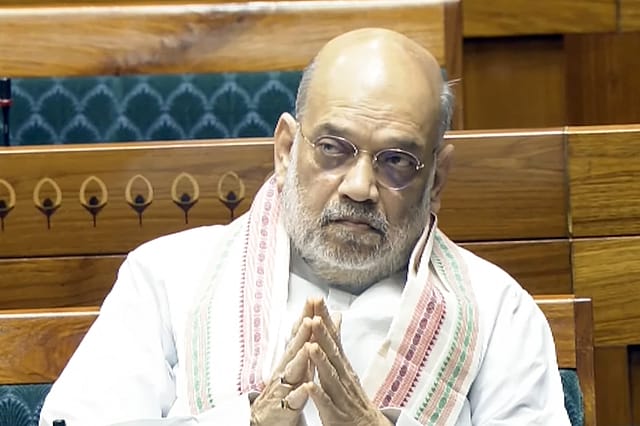
Around 40 minutes into home minister Amit Shah’s speech ahead of the vote on the Constitution amendment seeking to increase the strength of the Lok Sabha to a maximum of 850, Congress leader K C Venugopal rose to ask if the government will write a guaranteed increase of 50% seats for every state into the bill and if it would be ready to delink the delimitation process with the reservation being considered for women in legislatures. It was crucial moment in the two-day discussion on the Modi government’s proposals to implement the 33% reservation for women and simultaneously increase the number of MPs in Lok Sabha.
The cat and mouse game had been played out since the morning of April 16 and a denouement was at hand. Despite the serious legislative business at hand, the events had all the elements of a political potboiler, with the principal opponents looking to lure the rival into a false move. The gauntlet Venugopal threw before Shah sought to take on the minister over his accusation that Congress and its allies were sabotaging women’s reservation due to political considerations and as the Alappuzha MP sat down, the House waited to see if Shah would take the bait.

Look Who's Talking Regime Change
23 Oct 2026 - Vol 05 | Issue 43
An ambush and a counter
The home minister’s combative manner is sometimes misunderstood. It masks a subtle political mind and Shah immediately saw through the ambush. The 50% guarantee could be inserted into the Bill, he said, seeking an nour to circulate an official amendment. But delinking the delimitation Bill was another matter. “Venugopal ji has spoken about delimitation as per 2026 population…I will not fall for this deception (Mein is jhanse mein nahin aaoonga),” Shah said. He then proceeded to flip the script, saying “I want to tell the country’s women that the Congress proposal is yet again an alluring trap to ensure women’s reservation does not happen before 2029 (when the next Lok Sabha election is due).”
Many on the Opposition benches appeared to grasp that a pivotal moment in the debate had passed and Shah went on to hammer away at Congress for blocking the 131st Constitutional amendment and the accompanying proposals for delimitation. Slipping a gear or two, he pinned down Congress benches under withering fire, saying the party has been obstructionist and a nay-sayer, opposing every issue of national importance from withdrawal of Article 370 from Jammu and Kashmir, construction of the Ram Temple, rollout of the Goods and Services Tax, criminalisation of triple talaq, the campaign against Naxalism, surgical strikes on terror launch pads in Pakistan-occupied Kashmir and even Operation Sindoor.
Who won the debate?
Who won the laurels and whether the defeat of the three Bills in Lok Sabha will work to Bharatiya Janata Party’s favour and its claim that Congress and the INDIA bloc thwarted women’s reservation will resonate with the public is matter of debate and proof is awaited. Going by the worried expressions of many Opposition MPs, including several women, the matter is far from settled. Shah drove home his point that absent any evidence that the legislations were defective, the only reason for Congress’s opposition was a fear that the Modi government will earn plaudits. “The Prime Minister has already said so, he is willing to give you the credit…don’t oppose the bills for that reason,” the minister said. The Modi government, he added will defeat the INDIA bloc “conspiracy to delay implementation of the women’s quota beyond 2029.
The home minister set out the reasons for the accompanying delimitation, arguing that the freeze on the strength of the Lok Sabha imposed in 1971 could not continue. He pointed out that carrying out a delimitation on basis of population alone is no longer feasible. The population trends revealed by the 2011 Census would almost certainly be amplified by the 2026 count and this spells a steep decrease in seats in all five southern states of Telangana, Andhra Pradesh, Karnataka, Kerala and Tamil Nadu. There was, indeed, no other option for the government but to bring forward proposals that protect proportional representation of all states and prevent worsening existing imbalances. The idea of the 50% increase, Shah had said earlier, was also intended to ensure that the number of “open” seats do not shrink. Opposition leaders would not admit it, but their MPs and those from the treasury benches are united in an deeply existential fear that reservation of 33% seats as per the current strength of Lok Sabha will render them irrelevant.
Another shot
The home minister offered several reasons why the Bills were brought to Parliament at this particular point in time and said there is a desire to implement women’s reservation at the earliest. He pointed out the Census was delayed due to Covid and over the past few months the Centre was involved in discussions over whether a caste count should be made part of it. This was no easy decision given that such an exercise has not happened since 1931. Though he did not mention it, the agitation against the Citizenship Amendment Act that saw riots in Delhi in February, 2020, and the “Hum kagaz Nahin dikhaenge (we will not show documents)” stir was a serious deterrent to the conduct of a Census as well.
The discussion on the legislations in the midst of the campaigns to the Tamil Nadu and West Bengal assemblies was definitely a factor in the voting. Dravida Munnetra Kazhagam (DMK) and Trinamool Congress (TMC) leaders were keenly aware that passage of the Bills would certainly be a boost for BJP and its allies, particularly with all political parties recognising that women voters were increasingly outnumbering men at the polling booths. It just might be possible that once the heat of the elections abates and the results are out, a fresh push can be considered. But that is in the future.