EXPLAINED | What Is the BJP–SP Poster War in Uttar Pradesh Really About?
A red cap, bundles of cash and figures associated with muscle power occupy one side. A saffron-clad representative listening to ordinary citizens occupies the other.
The message: remember what Uttar Pradesh was like before us—and look at it now.
That is the argument in a poster shared through BJP’s Uttar Pradesh social-media handle. It depicts the earlier administration through allegations of corruption and criminal influence, while presenting the current government as responsive to citizens.
BJP is approaching the 2027 Assembly election after nearly a decade in power. Its campaign combines claims about its achievements with a continuing argument about the alternative.
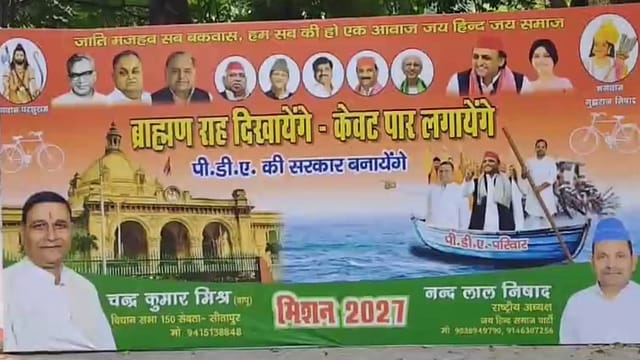
Now comes a different picture outside Samajwadi Party headquarters: Akhilesh Yadav aboard a boat, accompanied by a message about Brahmins, Kevats and a PDA government.
Losing Memory
16 Oct 2026 - Vol 05 | Issue 42
The making of a medical and social emergency
The posters offer two ways of looking at the election: why the government deserves another term, and who could come together to replace it.

FIRST, HOW LONG HAS BJP GOVERNED UTTAR PRADESH?
Continuously since March 2017.
Yogi Adityanath first took office on March 19, 2017, and began his second term on March 25, 2022. As of October 25, 2026, that amounts to approximately nine years and seven months.
BJP is, therefore, in its tenth year, seeking a third consecutive term. It completes ten years in government on March 19, 2027. “Nearly a decade in power” is the accurate description now.
That tenure matters. Voters have a long governing record to assess, while the party has a substantial record to promote.
WHAT IS BJP’S “THEN VERSUS NOW” POSTER TRYING TO SAY?
It asks voters to compare two governing periods through contrasting scenes.
The “then” side associates the earlier administration with money, intimidation and political protection. The “now” side presents access to government through a public grievance hearing.
The poster’s structure makes its argument easy to follow. BJP wants its tenure judged partly against the SP government that preceded it. Improvements claimed under Yogi become reasons to continue; allegations about the earlier administration become reasons to reject a return.
IS BJP’S CAMPAIGN MAINLY ABOUT ATTACKING SP?
Its announced programme extends considerably further.
The Seva Sankalp Abhiyan, scheduled from September 17 to October 17, combined promotion of the Modi and Yogi governments’ achievements with yatras, public interactions and cleanliness drives.
Its planned Seva Setu camps were intended to help eligible people enrol in schemes involving pensions, health, housing, toilets and ration cards.
The campaign thus connects publicity with an opportunity for direct contact over public services.
Organisational preparations also include regional meetings, feedback about constituencies and legislators, and communication through posts and reels. A roadside poster is one visible part of a larger operation involving party workers, government-performance claims and digital distribution.
WHY KEEP RETURNING TO SP’S RULE AFTER NEARLY A DECADE?
Because an election involves choosing between available alternatives as well as assessing the incumbent.
BJP’s comparison invites voters to ask two questions together: what has the current government delivered, and what might change if SP returns?
That gives the earlier administration a continuing role in the campaign, even as the present government approaches ten years in office.
For readers, the distinction is useful. A poster explains the comparison a party wants voters to make. Assessing that comparison requires evidence about governance, public services, employment and safety.
The campaign’s claims and the government’s measurable performance belong in the same discussion, but they are different kinds of evidence.
WHAT IS AKHILESH’S BOAT TRYING TO SAY?
The latest poster presents a proposed coalition as a shared journey.
Its message says Brahmins will show the way, Kevats will ferry the passengers across, and together they will form a PDA government.
PDA stands for Pichhde, Dalit and Alpsankhyak: backward communities, Dalits and minorities. Naming Brahmins alongside it signals an invitation beyond those categories.
Kevat imagery also carries a familiar Ramayana association with the boatman who helps Rama cross the river. The poster brings community identity and religious symbolism into one picture.
This is outreach, however—not evidence that either community has collectively changed its political preference. Nor does the poster alone establish a formal change in what PDA stands for.
IS THIS SIMPLY BJP’S HINDUTVA VERSUS SP’S CASTE POLITICS?
That would miss important parts of both campaigns.
BJP’s outreach includes welfare access and governance claims alongside its political and religious messaging.
SP combines representation and reservation arguments with religious references. During its September PDA Yatra event in Rae Bareli, Akhilesh also challenged BJP over temple-related controversies and its association with bulldozers.
Both parties are addressing overlapping concerns about identity, recognition, services and security. A single poster may emphasise one element without describing the whole campaign.
CONGRESS TOO WANTS A SLICE OF POSTER WAR
A poster war has erupted outside the Uttar Pradesh Congress Committee headquarters in Lucknow, with banners proclaiming “200 seat haq hai hamara” (200 seats are our right), signalling the party’s growing ambition ahead of the 2027 Assembly elections.
The campaign comes amid reports that the Congress has submitted a wishlist of 200 constituencies to its INDIA alliance partner, the Samajwadi Party, intensifying tensions over seat-sharing. Featuring Rahul Gandhi and Priyanka Gandhi Vadra, the posters reflect pressure within the Congress to seek a larger share of the 403-member Assembly rather than remain the junior partner in the alliance.
The Congress is seeking to build on its improved performance in the 2024 Lok Sabha elections, when it won six seats in Uttar Pradesh, led in 38 Assembly segments and finished second in another 42.
WHO IS PUTTING UP THE ATTACK HOARDINGS?
The answer differs from poster to poster.
Some material comes from official party accounts. Other posters carry the names of individual politicians or organisations. Some remain unclaimed.
The October 23 Lucknow hoarding alleging SP’s links with criminal figures appeared after Akhilesh visited Azam Khan in jail. Its installers were not immediately identified. Separately, police in Ballia reportedly told a news agency that nobody had claimed responsibility for attack hoardings there.
SP accused BJP of involvement. That accusation remains attributed. A message benefiting a party does not, by itself, establish who commissioned or financed it.
WHY ALL THE FOOD RHYMES?
They turn an accusation into something short and repeatable.
An October 3 poster installed by SP leader Mohammad Ikhlaq used a kachori-and-samosa rhyme to question trust in BJP and the Election Commission. Later anti-SP hoardings used tea, samosas and rasmalai to package allegations about criminal associations.
The familiar vocabulary makes the message easy to remember. Photographs and videos can then carry it far beyond the original location.
A catchy rhyme helps circulate an allegation. It does not verify it.
CAN THE POSTERS TELL US WHO WILL WIN?
They reveal what campaigners want people to remember.
BJP’s comparison foregrounds governance under Yogi and allegations about the earlier SP administration. SP’s boat presents an expanded coalition capable of bringing political change.
Neither establishes how voters will respond.
That will depend on experiences, candidates, alliances, local issues and the credibility of competing promises.
The posters simplify the choice each campaign wants to present. Voters will decide whether that picture matches their Uttar Pradesh.