Economics of Aspiration: The Driving Force Behind BJP's Victories
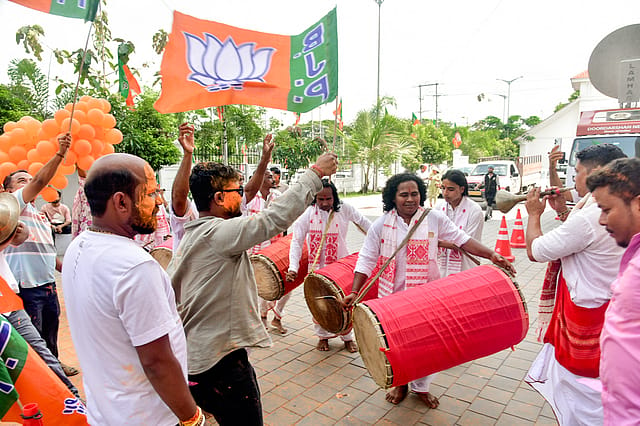
Statistics cannot capture the excitement of electoral politics but they do reflect the sombre realities that often dictate choices made by voters. The political earthquake in West Bengal on Monday and the resounding third victory for the BJP in Assam reflect these prosaic realities that are often not captured in the electric headlines of the day.
In May 2011 when Mamata Banerjee ended 34 years of Left rule in the state, hopes were high that West Bengal would move towards a brighter future, away from economics of stagnation and the politics of obstruction. Some economic statistics of the time when Banerjee entered the Writers’ Buildings are instructive. That year (2011-12), West Bengal’s per capita Net State Domestic Product (NSDP) (in constant terms) was Rs51,543. States like Tamil Nadu, Karnataka and Gujarat were far ahead in the race for economic well-being and prosperity. These comparisons are unfair: these states had pursued very different economic policies and their politics, too, was very different. Closer home, a state like Odisha was more in line. Odisha’s per capita NSDP was less than that of West Bengal in 2011 at Rs48,387. Even a geographically challenged Union Territory like Andaman and Nicobar Islands (A&N), was ahead at Rs89,100.

Greening the Future
23 Jul 2026 - Vol 05 | Issue 30
Securing a sustainable India
By the time Banerjee’s Trinamul Congress (TMC) was ousted, these states had galloped ahead of West Bengal. In what rankles regional pride, Odisha had a higher per capita NSDP than West Bengal in 2024-25: Rs96,224 (Odisha) and 82,781 (WB). Even A&N Islands had marched ahead (Rs89,100).
These figures, as said earlier, do not capture the beats of daily life that goes into making political choices but they certainly inform them. The fact that West Bengal gained the perception of being “left behind” had gained ground during the tumultuous years of Left rule. Under Banerjee, that feeling gained ever more ground. Big infrastructure and developmental projects bypassed the state even as states in the West and South competed with each other ferociously to get them.
The case of Assam presents a very different contrast.
In 2016, when BJP came to power in Dispur for the first time, Assam’s per capita income was quite low by national standards. For the longest time, the state’s geographic isolation from centres of commerce and its lack of industries held it back. Its “export” of resources to other parts of India had caused disquiet and even agitation for long in the state. A decade later, not only has per capita income grown smartly (it has grown by 109%) and is now higher than that of West Bengal. In these years, a major infrastructure push—highways and other infrastructure—has improved connectivity immensely. To top it all, Assam has now set its sights on bigger goals. The state managed to attract a $3 billion Outsourced Semiconductor Assembly and Test (OSAT) plant that is being established in Morigaon district of the state. With that OSAT plant will comes scores of vendors and engineering jobs that a state like Assam could only dream of in an earlier time.
Such projects are not just a matter of economies of agglomeration but also of political will to secure them. There is no reason why West Bengal could not have done this earlier, if not decades earlier. But instead of a supportive environment for industrialisation, West Bengal chose the path of Left militancy.
ASPIRATION DRIVEN POLITICS
The victories garnered by the BJP on Monday speak of desires that are different from what the Opposition has on offer. The politics of identity—the workhorse of Opposition politics from the banks of the Hooghly to the Cauvery in the South—is now near the end of its shelf-life. There will be periodic attempts to resuscitate this politics but as half a dozen or more leading states power ahead economically, citizens in states that have been left behind will demand change. At that point, it will become very difficult for politicians ruling these states to change their playbook. Identity politics belongs to a different world and the politics of development to another one. The fall of wickets in West Bengal is a harbinger of these changes and desires on the part of Indians who want more.