Defence Minister Rajnath Singh meets US, Japan, Australia defence chiefs: What India’s Indo-Pacific push means
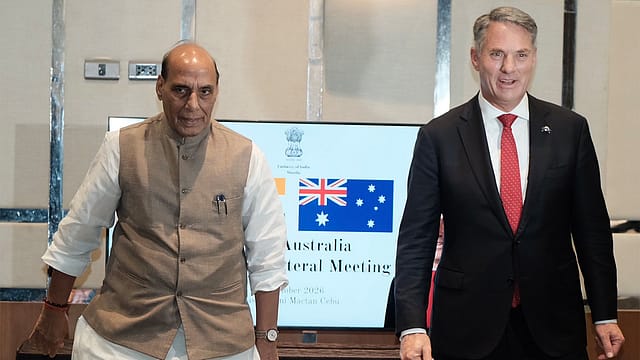
Three key defence partners, one regional security forum and a shared focus on the Indo-Pacific. Defence Minister Rajnath Singh’s meetings with his American, Japanese and Australian counterparts in Cebu, the Philippines, on Wednesday underline how India is seeking to strengthen its defence relationships while navigating an increasingly complex regional security environment.
The discussions took place on the side-lines of the 13th ASEAN Defence Ministers’ Meeting-Plus (ADMM-Plus), being held on October 28 and 29. According to updates from the Ministry of Defence and statements by the ministers, the agenda spans military technology, information-sharing, interoperability and wider regional security concerns. The meetings also build on partnerships that India has been developing over several years.

Look Who's Talking Regime Change
23 Oct 2026 - Vol 05 | Issue 43
What did Rajnath Singh discuss with the US defence chief?
Singh met US Secretary of War Pete Hegseth to review progress under the 10-year India-US Defence Framework. In a post on X, Singh said the discussions covered military technology, information-sharing and co-production, describing the partnership as important to a free, open and secure Indo-Pacific.
Hegseth said the two sides marked the framework’s first anniversary and explored ways to strengthen cooperation further. The framework, signed in 2025, provides a longer-term direction for defence collaboration.
For India, the emphasis on co-production and technology matters because deeper industrial cooperation could expand domestic manufacturing capabilities and reduce reliance on imported equipment in selected areas. However, the latest meeting announcement does not establish that any new defence contract or production agreement was signed.
Why are India and Japan strengthening defence ties?
Singh also met Japanese Defence Minister Shinjiro Koizumi, reviewing existing cooperation and exploring new areas of collaboration. Singh said the India-Japan Special Strategic and Global Partnership remained important to maintaining a peaceful and open Indo-Pacific.
The relationship extends beyond defence procurement to maritime security, military exchanges and coordination on regional challenges. Japan’s role is significant because the country sits at the intersection of major East Asian sea routes and security concerns, while India has a strategic interest in keeping the wider Indo-Pacific stable and accessible.
The meeting signals an effort to sustain momentum in bilateral ties, although the public statements did not announce a specific new defence pact.
What did India and Australia agree to work on?
In talks with Australian Deputy Prime Minister and Defence Minister Richard Marles, Singh discussed defence cooperation, military interoperability and regional security. Interoperability, the ability of different armed forces to operate together effectively, can matter during joint exercises, maritime monitoring and humanitarian assistance or disaster-relief operations.
Singh also invited Marles to attend Aero India 2027, scheduled to take place in Bengaluru in February. The invitation offers another opportunity for defence officials and industry representatives to engage on military aviation and related technologies.
India and Australia have expanded defence engagement as both countries place greater emphasis on maritime security and cooperation in the Indo-Pacific.
Why does the ASEAN defence meeting matter to India?
ADMM-Plus brings together the 11 ASEAN member states and eight dialogue partners: India, the US, China, Russia, Japan, South Korea, Australia and New Zealand. The forum provides a platform for discussing shared security challenges and building practical cooperation.
According to the Ministry of Defence, India has been an ASEAN dialogue partner since 1992 and is co-chairing the ADMM-Plus experts’ working group on counter-terrorism with Malaysia for 2024–2027. The Philippines chairs the forum in 2026.
For India, the meetings reinforce its Act East policy and its engagement with Southeast Asia. The broader objective is to strengthen partnerships without relying on a single relationship to meet every security need. Whether these diplomatic discussions translate into more joint exercises, technology transfers and concrete agreements will determine their longer-term impact on India’s defence capabilities.
(With inputs from ANI)