What Is Oggy Janata Party? New Social Media Movement Targets CJP Founder
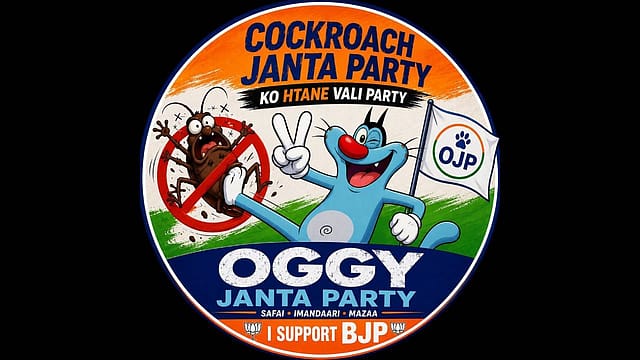
A new social media-driven political parody outfit called the “Oggy Janata Party” (OJP) has emerged as an unlikely rival to the viral “Cockroach Janata Party” (CJP), sparking a fresh wave of online political satire and debate.
The newly created OJP describes itself as a “parody opposition” to the Cockroach Janata Party and claims its primary mission is to expose the alleged political background of CJP founder Abhijeet Dipke. According to OJP, Dipke previously worked as a volunteer associated with the Aam Aadmi Party’s social media and election campaign ecosystem.
The development has added another layer to the already unusual rise of the Cockroach Janata Party, which first gained attention online after adopting imagery inspired by recent remarks attributed to Chief Justice of India Surya Kant, in which unemployed youth were allegedly compared to “parasites” and “cockroaches.” The CJP had attempted to reclaim the insult through satire and political messaging aimed at frustrated young Indians.
Now, OJP has positioned itself as a counter-narrative to that movement.
The name “Oggy Janata Party” itself is a pop-culture reference to the popular animated television series Oggy and the Cockroaches. Using humor, memes and sarcasm, OJP has built its online identity around opposing the symbolism adopted by CJP.
In one of its widely circulated posts, the group shared a collage of Indian freedom fighters while mocking the idea of young people embracing the “cockroach” label. The caption read: “In a land shaped by the sharpness of swords, the youth are proud to call themselves ‘cockroaches’. This is actually a symptom of the country’s unemployment problem.”

Exclusive: To the Heavens and Back
19 Jun 2026 - Vol 04 | Issue 76
Shubhanshu Shukla relives the space odyssey that put India into orbit
The statement appeared to frame the growing trend not merely as internet satire, but as a reflection of deeper economic frustration among India’s youth.
Does OJP carve its own niche?
Apart from targeting the Cockroach Janata Party, OJP has also attempted to carve out its own political identity through issue-based messaging. The page recently released a six-point manifesto centered on animal welfare and rights. Its proposals include free healthcare for stray animals, stronger laws against animal cruelty, and broader public awareness regarding animal protection.
The group has also commented on national issues, including the NEET examination paper leak controversy, indicating that it intends to engage with broader socio-political discussions beyond meme culture.
Despite its humorous presentation, the page has rapidly gained traction online. OJP’s Instagram account has already crossed 9,000 followers within a short period. The account bio explicitly states that the organization is not backed or supported by any political party, seemingly in response to speculation regarding its motivations.
Is Internet culture around the rise of CJP and OJP?
The rise of both CJP and OJP reflects how internet culture, political satire and youth frustration are increasingly merging on social media platforms. What began as meme-driven commentary is now evolving into a broader digital conversation around unemployment, political identity and online activism.
Whether the Oggy Janata Party remains a short-lived internet parody or develops into a larger satirical movement, its emergence has undoubtedly intensified one of the internet’s most unusual political face-offs.