A Hard Line On Stray Dogs
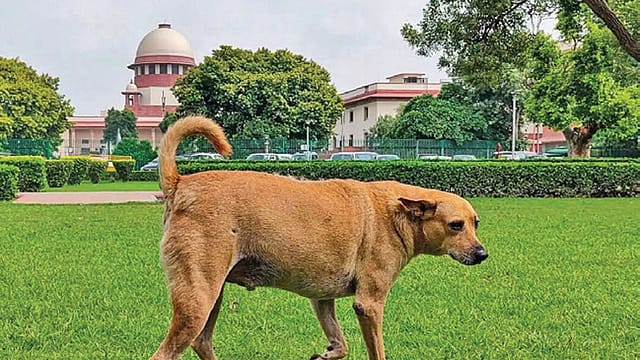
We all grew up hearing that dog bites man is no news. Turns out, it very much is.
Jokes apart, a three-judge bench of the Supreme Court has shown unusual seriousness about a basic civic right: the freedom to move through public spaces without the fear of dog attacks. That concern underpinned the court’s recent decision to stand by its November 2025 verdict directing all states and Union territories to remove stray dogs from the vicinity of public institutions, which include schools, colleges, hospitals, bus stands, railway stations and other crowded spaces. The court also made it clear that stray dogs picked up for sterilisation and vaccination cannot simply be released back into the same localities. Earlier, this was done keeping in mind that dogs are territorial.
While it is not wrong to say that many stray dogs are harmless, India has witnessed repeated cases of packs turning aggressive, targeting children, senior citizens and passersby, at times fatally. The court observed that the problem had assumed alarming proportions. Hence the directive: states must establish Animal Birth Control centres, stock anti-rabies vaccines, relocate strays to designated shelters and, in cases involving rabid or dangerous dogs, administer euthanasia. High courts, the bench said, should oversee implementation. The implication is sweeping: authorities can no longer afford ad hoc responses to the stray-dog crisis. India’s combined population of pet and stray dogs is estimated at 10.2 million.
Animal rights groups and dog lovers have long opposed confining stray dogs to shelters alone, arguing that overcrowding could worsen disease transmission, including rabies. Adoption, many argue, remains one of the more humane and sustainable ways of reducing the risks posed by stray populations while rehabilitating animals.
Globally, concerns persist over the cruelty often inflicted on stray animals, as well as the possibility of euthanasia being misused by authorities as a shortcut by replacing the harder, long-term responsibility of building functional shelters and managing dog populations humanely.