‘We Spent Entire Nights on the Road’: A Shimla Hill is Sinking, and Families Are Watching Their Homes Crack
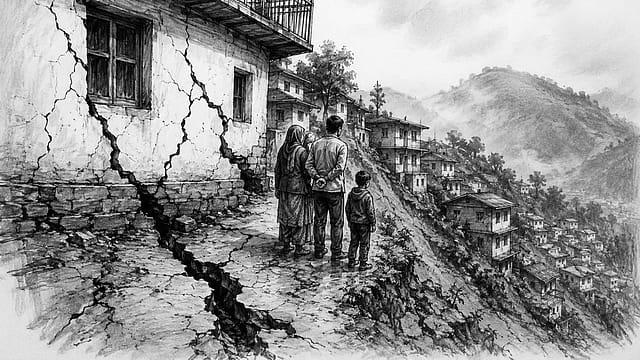
Every time Ram Krishna Sharma repairs his house, the cracks return. He has filled them, patched the walls and spent another ₹2.5 lakh to ₹3 lakh trying to hold together the home his family built with its savings.
Then the earth moves again. The cracks reopen. And Sharma is back where he started.
This has become life in Shakrala village near Shimla, where a hillside beneath and around homes has been gradually sinking, leaving families caught between the fear of staying and the impossibility of walking away. Residents estimate that nearly 100 to 150 houses lie in the wider affected Shakrala-Malyana area. Some say the problem has persisted for years. Others say it has worsened sharply during the monsoon and after excavation began for nearby four-lane road construction.

Rise of the Pivotal Power
18 Sep 2026 - Vol 05 | Issue 38
The BRICS declaration is a strategic victory for Modi
Nobody, however, has been able to tell them conclusively why their land is sinking. “For the last two to three years, the land has been continuously sinking. Cracks keep appearing again and again,” Sharma said. “We repair them, but after some time the cracks return.”
For a family, a crack across a wall can begin as a construction problem. In Shakrala, repeated cracks have become something else: a warning they don't know how to read.
Is the four-lane construction responsible? Is rainwater seeping into the ground? Is wastewater destabilising the slope? Is it a combination of factors? “We still do not know the exact reason,” Sharma said. Residents have approached the administration. A team visited the area earlier, according to Sharma. But the question that matters most remains unanswered.
Why is the hill moving?
“We have already informed the administration and a team had also visited earlier, but so far no concrete result has come out,” he said. How many times can you repair a sinking home? For Sharma, the cost is already running into lakhs. “I have spent around ₹2.5 to 3 lakh again on repairs,” he said. “After repairing, the cracks appear again, and we have to spend money once more.” He says almost every family around him is confronting some version of the same problem.
And behind those repair bills lies a much bigger calculation. These aren't simply damaged structures. They are homes built with years, sometimes lifetimes, of savings. “We want the government to find a permanent solution and determine the reason for the land sinking,” Sharma said. “We have invested our lifetime savings in these houses.”
If the damage continues, residents say they should at least be compensated. But money cannot answer the more immediate question confronting families whenever the rain becomes heavy: Is it safe to sleep inside tonight?
‘People in the family say we should shift’
For Gulab Singh, the anxiety goes back much further. He says he has watched the problem develop since around 2010. His house has four storeys and a fifth-floor roof. Instead of being a source of security, its size now adds to his anxiety. “There is always a fear that something may happen,” Singh said.
Repairs have become routine. Damage is already severe in the lower reaches, he said, and now the land around his own home has begun sinking. His family has discussed the obvious solution: Leave. “We are definitely scared. People in the family say that we should shift from here, but what can we do?” he said. Then comes the sentence that explains why families remain on a hillside they fear may no longer be stable: “We have invested everything here.” “As long as we can stay, we are staying.”
Did the four-lane project make things worse?
Residents are careful about drawing a direct causal link. They say cracks existed before the four-lane road construction began and acknowledge that rainwater and wastewater could also be contributing to the problem. But several insist that something changed after excavation work started nearby. “The cracks had started earlier, but after the four-lane cutting work began here, they doubled,” one resident said. “We cannot say that the four-lane construction alone is responsible, but after the work started, the cracks became much wider.”
Heavy rain, residents say, has compounded the problem. That distinction is important: residents have suspicions, but there is no conclusive scientific assessment establishing what is causing the land movement. And that uncertainty is precisely why they are demanding one. Residents spent lakhs trying to fix the water problem themselves Priya Chauhan believes uncontrolled wastewater and rainwater are among the biggest concerns. “The main reason for the cracks in the houses is the wastewater that is flowing openly here. Rainwater is also flowing openly,” she said.
Residents haven't simply waited for authorities to intervene. Chauhan says families collectively spent around ₹7 lakh to ₹8 lakh from their own pockets to improve drainage, install pipelines and divert wastewater and rainwater away from vulnerable areas. Some houses are now connected to those pipelines. Many still aren't. Residents had also been told that drainage or sewerage pipelines would be installed, Chauhan said, but the promised work has yet to materialise on the ground.
A few months ago, residents called engineers associated with the four-lane project to inspect the area. According to Chauhan, they were told that settlement was occurring across the slope from the road downwards and that wastewater needed to be managed quickly. So residents began laying pipelines themselves. But downhill, the signs of movement are harder to ignore. Walls are cracking. Floors are settling. Basements are sinking. “Our basement is also sinking,” Chauhan said. Then came the nights they were too afraid to sleep at home Last year's heavy rainfall transformed an anxiety residents had lived with into something more visceral. As the rain intensified, so did the cracks.
Families looked at their walls and decided they could no longer take the risk. They went outside. “Last year, when there was so much rain, the cracks increased significantly,” Chauhan recalled. “We spent entire nights outside on the road.”
This year's rainfall has been comparatively lower so far, she said. The fear hasn't gone anywhere. The cracks are still there. So are the homes. So are the families inside them.
What do Shakrala's residents want now?
Not another patch-up job. They want experts to establish what is happening beneath their feet through a detailed soil and geological investigation.
They want proper drainage. They want an engineering solution capable of stabilising the affected area. And if their homes have been damaged beyond what repeated repairs can reasonably fix, they want compensation. Above all, they want certainty.
For years, families in Shakrala have responded to a moving hillside in the only ways available to them: filling cracks, laying pipes, spending savings and, when the rain becomes frightening enough, sleeping outside. But you can repair a wall only so many times, you can divert only so much water. And you can spend only so many nights on the road before confronting the question hanging over this Shimla hillside: What happens when the next crack is one they cannot repair?
(With inputs from ANI)