Union Cabinet Passes Resolution Hailing PM Modi's 25 Years as Head of Government
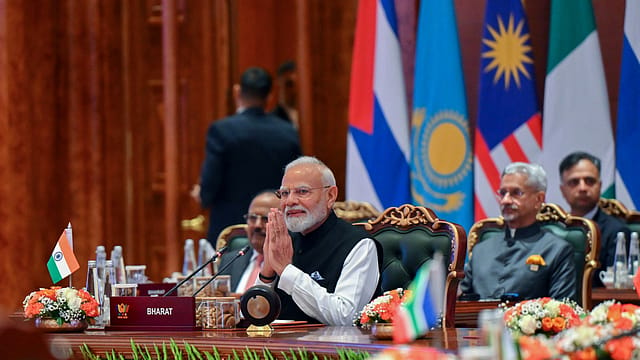
The Union Cabinet on Tuesday passed a resolution congratulating Prime Minister Narendra Modi on completing 25 years of continuous leadership as head of government. The milestone falls on Wednesday, October 7.
Information and Broadcasting Minister Ashwini Vaishnaw briefed reporters after the meeting. He said Modi's long service reflects the public's trust and "a vibrant example" of Indian democracy, where a person from a humble background can rise to become Prime Minister.
The resolution describes the period as more than a customary tribute and says it is guided by the principle of "Nation First and Citizen First." It cites three mandates in Gujarat and support in three successive Lok Sabha elections as evidence of public trust.
FROM GUJARAT TO DELHI
Titled "From Gujarat to India a development vision grows," the first section traces how initiatives from Gujarat went national. It names SWAGAT, a programme through which Modi personally heard citizens' grievances and which won the UN Public Service Award in 2010.
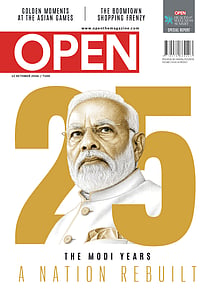
The Modi Years
02 Oct 2026 - Vol 05 | Issue 40
A Nation Rebuilt
SWAGAT, it says, later inspired PRAGATI, which brings governments together to review stalled projects. It also cites Jyotigram, the scheme of separate agricultural electricity feeders, as a model that spread nationwide.
WELFARE AND THE POOR
The resolution links Modi's concern for the poor to his own experience, watching his mother struggle with everyday hardship and seeing deprivation on his travels. It points to nearly 60 crore Jan Dhan accounts, over 4 crore homes, and 25 crore people moving out of poverty, along with water and healthcare programmes.
It also cites about 3.5 crore women becoming Lakhpati Didis, the Nari Shakti Vandan Adhiniyam for women's reservation, PM-KISAN transfers of over ₹4 lakh crore, and PM-JANMAN for particularly vulnerable tribal communities.
REFORM, INFRASTRUCTURE AND INDUSTRY
Under "An unwavering commitment to reform," the Cabinet lists GST, welfare-delivery reforms and the replacement of colonial-era laws. It says public capital expenditure rose from ₹2 lakh crore to over ₹12 lakh crore, alongside highway expansion and railway electrification. Electronics production grew from around ₹2 lakh crore to more than ₹13 lakh crore, it says, and it cites defence production and semiconductor manufacturing.
The text credits Jan Dhan, Aadhaar and mobile connectivity for improving welfare delivery and UPI for transforming payments. It also lists India's own Covid vaccines, the Chandrayaan-3 landing near the Moon's south pole, private space participation, and work in AI, quantum technology and biotechnology.
CRISES AND SECURITY
On "Steadfast leadership through turbulent times," the resolution says Modi united the country during Covid and backed domestic vaccine development. It says timely decisions and energy security measures helped India withstand disruption during the West Asia crisis.
On security, it cites the 2016 surgical strikes, the 2019 Balakot air strikes and Operation Sindoor in 2025 as marking national red lines. It places these alongside the removal of Article 370, One Rank One Pension and the creation of the Chief of Defence Staff post, and credits action against Maoist violence and peace efforts in the Northeast.
The resolution cites consensus at the G20 and BRICS, advocacy for the Global South, the African Union's inclusion in the G20 and Vaccine Maitri. It notes that Modi has received honours from 36 countries.
The final section brings together climate action, from a dedicated department in Gujarat to renewable energy expansion, with yoga, millets, Kashi Vishwanath Dham and the consecration of Ram Lalla. It ends by renewing the commitment to a prosperous, self-reliant and developed India by 2047.
Modi first took oath as Gujarat Chief Minister on October 7, 2001, replacing Keshubhai Patel. He held the post for more than 12 years before becoming Prime Minister in May 2014. He has led the BJP to victory in the 2014, 2019 and 2024 Lok Sabha elections. In March 2026, he passed the record for the longest continuous period as head of an elected government in India, counting his Gujarat and prime-ministerial tenures together.
His Gujarat years also included the 2002 riots, over which his government drew sustained criticism. The figures and achievements in the resolution are the government's own claims.
Vaishnaw spoke a short distance from Akashvani Bhavan, where Opposition MPs led by Rahul Gandhi were holding a dharna against the Chief Election Commissioner.
With inputs from ANI