Tourists Welcome. How Many Can Shimla Take?
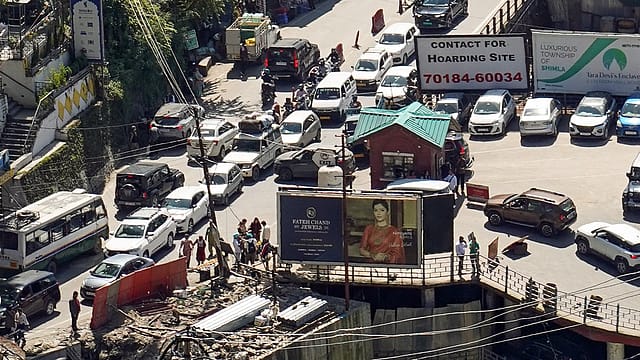
A long weekend in the hills promises an escape from traffic. Then everyone brings a car.
In Shimla district, police recorded around 70,000 vehicles over the latest long weekend, including nearly 40,000 from beyond Himachal Pradesh. More than 200 personnel, including 26 riders, were deployed. The city was divided into five sectors. Diversion stickers helped direct vehicles towards appropriate routes. Officers worked through the day to keep traffic moving.
It was a substantial exercise in managing arrivals. It leaves a more difficult question: how much demand should a mountain destination be expected to absorb?
Additional Superintendent of Police Mehar Panwar told ANI that the existing traffic plan would be strengthened for the coming tourist season. More vehicles were expected; the police were preparing for them.

Losing Memory
16 Oct 2026 - Vol 05 | Issue 42
The making of a medical and social emergency
That is a reasonable operational response. It is also where the remit of traffic policing meets the limits of tourism policy. An officer can clear a junction. The officer cannot expand a water source, increase sewage-treatment capacity or give a resident back the time lost on a congested commute.
A destination’s ability to accommodate visitors involves considerably more than getting their vehicles through it.
FIRST, COUNT THE RIGHT THING
The weekend figure needs careful handling. The report refers to vehicles entering Shimla district, which is much larger than the city. It does not establish that 70,000 tourist cars occupied the city simultaneously. Nor does registration beyond Himachal Pradesh establish that every vehicle was carrying holidaymakers.
The account also does not explain whether the total represents unique vehicles or recorded movements. Panwar identified another contributor to congestion: resurfacing between Mashobra and Dhalli Chowk, where traffic was being regulated through a single lane.
These distinctions matter. A district-wide traffic count cannot be divided by city parking spaces to produce a credible measure of overload. A temporary road bottleneck cannot establish the environmental consequences of an entire tourism model.
Nevertheless, the weekend offers a useful test of what authorities measure. The police can explain how many vehicles were recorded and how many personnel were deployed. A fuller assessment would also establish parking occupancy, passenger movement, water demand, waste loads and the effect on essential services.
“Traffic managed” tells us something important. It does not tell us enough.
THE COST BEYOND THE CONGESTION
Shimla has already experienced what happens when pressure on essential services becomes a threat to everyday life and tourism itself.
The World Bank’s account of the city’s 2018 water crisis identifies several interacting causes: declining traditional sources, population growth, increasing tourist numbers, ageing infrastructure and inefficient management. Responsibilities were fragmented, and substantial quantities of water were lost before reaching consumers.
The same account records improvements after institutional reforms and the establishment of Shimla Jal Prabandhan Nigam Limited. Treating the city as permanently trapped in its 2018 crisis would therefore be misleading.
Indeed, a World Bank update published in March 2026 describes continuing improvements in Shimla’s water governance, including independent water-quality monitoring and better cost recovery.
The lesson is more useful than a simple warning that tourists consume water. Tourism demand interacts with resident demand, the condition of infrastructure and the competence of the institutions running it. A town can improve its services. It also needs to understand how much additional pressure those improvements can safely accommodate.
The evidence available for this weekend does not establish that tourist arrivals caused a water shortage or overwhelmed sewage treatment. Those claims require contemporaneous data. What the traffic surge warrants is scrutiny of how the different systems are assessed together.
A hotel may have a room available while the road serving it is congested. A parking facility may have space while the neighbourhood’s water supply is under pressure. Spare capacity in one system cannot substitute for capacity in another.
MORE PARKING, THEN WHAT?
Shimla has been investing in infrastructure.
Its government-owned Smart City company reports 24 completed parking facilities accommodating approximately 5,500 vehicles, with seven more under construction. It also lists two bus stands and a 23-kilometre pedestrian-path network. These are the company’s project figures, rather than an independently verified inventory of every functioning parking space in the city.
The investments matter. The next question is how they operate as a connected transport system.
Where is parking located? Can visitors leave their vehicles before reaching congested neighbourhoods? Is the onward service frequent, affordable and practical for someone carrying luggage or travelling with children? Does it accommodate older people and those with disabilities?
Parking construction alone cannot answer those questions. Its effect depends on where it intercepts traffic and what alternative journey it enables.
A visitor asked to abandon a car without dependable onward transport will experience a restriction. A visitor offered a convenient transfer may experience a better holiday.
ZERMATT’S USEFUL DISTINCTION
Zermatt provides a practical example.
Visitors driving towards the Swiss resort can park at Täsch and transfer to a shuttle train. The Matterhorn Terminal offers 2,100 covered parking spaces; the onward journey to the car-free village takes 12 minutes. Parking and the final leg of the journey are organised together.
Shimla cannot simply reproduce Zermatt. It is a state capital with hospitals, offices, schools, deliveries and regional traffic moving through it. Its transport geography and public resources are different.
But the distinction is transferable: welcoming a visitor does not require accommodating that visitor’s private car throughout the destination.
For Shimla, that suggests examining peak-period vehicle access alongside peripheral parking and dependable shared transport. Residents, essential services, workers and visitors with mobility needs would require appropriate arrangements.
The service has to make the restriction workable. Otherwise, the queue merely moves to the transfer point.
A LIMIT MUST MEAN SOMETHING
Japan’s Mount Fuji offers another approach. The Yoshida Trail’s published rules for the 2026 climbing season include a ¥4,000 fee, a reservation facility and a daily limit of 4,000 climbers, with specified exemptions for mountain-lodge guests.
A mountain trail is easier to regulate than a functioning city. Its numerical limit offers no ready-made answer for Shimla. What matters is that access rules are communicated before visitors arrive.
Himachal Pradesh already has experience of this approach. Rohtang’s official tourism-permit system lists daily quotas of 800 petrol and 400 diesel vehicles.
The relevant debate is therefore about the design of restrictions, their purpose and their fairness. Should peak-day access to particular areas depend on booked parking? When should vehicles be directed to a transfer facility? What conditions would require tighter controls?
A scientifically informed capacity assessment should guide those decisions. It would need to distinguish between neighbourhoods, seasons and types of visitor, while preserving essential access.
There is little value in announcing that a destination has a carrying capacity if no operational decision changes when pressure approaches it.
A TOURISM TAX IS NO MAGIC CURE
Charging visitors is an obvious option. Venice demonstrates why it requires scrutiny.
In September, Reuters reported that officials were considering increasing the city’s day-tripper access charge, with a senior official arguing that the existing €5–€10 fee was too low to deter overcrowding. A higher rate remained a proposal.
A charge can raise revenue while leaving peak demand largely intact. That may still help pay for services, but revenue collection and congestion reduction are different outcomes.
Any similar measure for a hill destination should state which outcome it seeks. If the objective is fewer vehicles at busy times, the test is whether vehicle pressure falls. If the objective is financing sanitation and transport, the receipts and expenditure should be transparent.
Pricing also raises a question of access. Making a destination more expensive can exclude lower-budget travellers without necessarily producing the best environmental result. Affordable buses, shared transfers and clear rules should be central to the design.
WHO BENEFITS FROM A BUSY WEEKEND?
The economic case for tourism deserves more than a passing acknowledgement. Hotels, restaurants, transport operators, guides and shopkeepers depend on visitors. Arbitrary restrictions can hurt precisely the people whose livelihoods a destination needs to protect.
That makes the quality of tourism demand important.
The tourism office in Italy’s Braies valley explains its summer access controls partly through a local economic problem: short visits brought traffic without much spending in the valley. Its combined ticket includes parking, a bus if needed and a voucher redeemable with participating local businesses.
This does not prove the model should be copied in Shimla. It illustrates a better question than how many vehicles arrived: how much local benefit accompanied the burden?
A tourism assessment should examine visitor spending, length of stay and employment alongside public-service costs. It should also consider who receives the income and who bears the inconvenience. The shopkeeper may welcome the rush; the same person may struggle to travel home through it.
Residents’ interests and tourism livelihoods frequently belong to the same household.
GIVE THE TOWN A SAY IN THE SCORECARD
Shimla needs a tourism scorecard that connects demand with the services sustaining the destination.
At a minimum, peak-period reporting should distinguish unique city entries from district movements and through-traffic. It should track parking occupancy and public-transport performance alongside water availability, waste collection, sewage treatment and emergency access.
Those indicators should inform publicly explained responses. Authorities could pilot parking reservations or vehicle-access windows on selected peak days, strengthen shared transfers and evaluate the results before expanding restrictions.
Success would mean protecting mobility and essential services while maintaining local economic benefit. It would also mean acknowledging where an intervention failed.
Sending visitors towards nearby villages requires the same discipline. Dispersal can spread income, but places with smaller water systems and limited waste collection should not inherit congestion they are less equipped to handle.
The weekend’s police deployment deserves to be judged on its own terms: keeping a difficult traffic situation under control. The larger policy question remains with the institutions deciding how tourism grows.
Another long weekend will bring another test.
Before then, Shimla needs more than an assurance that the next wave of vehicles can be managed. It needs a clear account of what a successful tourist season should deliver to the people who live there.
The holiday ends on Monday. The town still has to work on Tuesday.
With inputs from ANI & agencies