The Invisible French Giant: How Sarovar quietly became India's third-largest hotel company
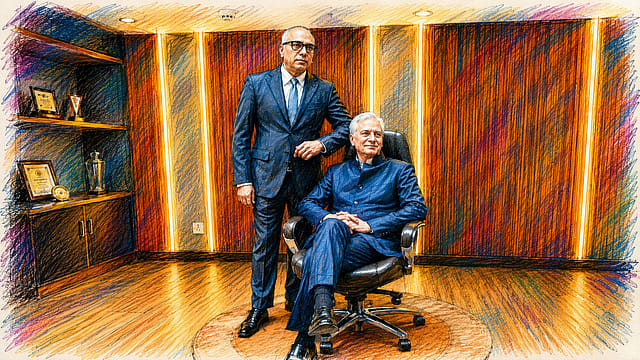
Four people. One table. Two telephones. Only one worked.
The office looked nothing like the birthplace of one of India's biggest hotel companies. The ceiling was crumbling. Chunks of plaster occasionally fell without warning. Visitors walked in, glanced around the room, and then looked at the two men who had willingly walked away from celebrated careers at The Oberoi Group.
One former colleague couldn't hold back.
"Ajay, what on earth are you doing here?"
It was a fair question.
This was the mid-1990s. India's hotel industry had a peculiar shape. At one end stood the grand old names that defined luxury. At the other were forgettable lodges and guest houses. Between the two lay an empty space that almost nobody thought was worth chasing.
Rise of the Pivotal Power
18 Sep 2026 - Vol 05 | Issue 38
The BRICS declaration is a strategic victory for Modi
Most people looked at that gap and walked away. But two hoteliers walked towards it.
One was Anil Madhok, who had left The Oberoi Group after more than two decades to place an audacious bet almost nobody in Indian hospitality was willing to make. The other was Ajay Bakaya, his trusted lieutenant, who joined him about a year after the venture was born, when the company was still little more than an idea and an unwavering conviction.
They didn't arrive with a business plan thick enough to impress investors. There were no consultants. No market reports. No venture capital. No grand vision document pinned to the wall.
Just one stubborn belief.
If India could build world-class luxury hotels, surely it deserved dependable hotels for everyone else.
Bakaya remembers the India they were betting on with remarkable clarity. "You had the upper end, which was expensive and luxurious. And then you had rubbish," he recounts. “There was very little in between.”
Years later, people would ask whether they had always imagined building one of India's largest hotel companies. Bakaya laughs at the suggestion.
"We built our company brick by brick. There were no grandiose plans."
Brick by brick wasn't a metaphor. It meant travelling overnight on state transport buses because flights were unaffordable. It meant making long-distance calls before seven in the morning because STD tariffs were cheaper. It meant one management contract at Mumbai's Marine Plaza generating enough fees to keep the fledgling company alive while they chased the next assignment.
And it meant making one promise to employees and never breaking it.
"There has never been a delay in salary payments in this company," Bakaya says with quiet pride. "Where the money came from is another story," he grins.
Perhaps that's why almost nobody noticed what they were building. Not when they were travelling from city to city persuading hotel owners to trust an unknown company. Not when every new contract simply bought them the chance to chase another.
Three decades later, the irony is hard to ignore.
Millions of Indians know the names of the world's biggest hotel chains. Far fewer know the company that quietly grew in the shadows of all of them.
That company is called Sarovar.
Today, Sarovar operates more than 160 hotels across over 95 destinations, manages 11,000-plus operational keys, has the second-largest destination footprint in India after Taj Hotels, and has quietly become India's third-largest hotel company by portfolio size, behind only Taj Hotels and Marriott International.
While the numbers are impressive, the anonymity is even more remarkable.
While India's hospitality industry spent three decades celebrating luxury, global brands and marquee addresses, Sarovar quietly built one of the country's largest hotel empires by pursuing a market almost everyone else had dismissed.
To understand how it pulled that off, you have to go back to an India where travellers had only two choices: Luxury or rubbish.
Bakaya wasn't exaggerating.
Travel across India in the mid-1990s and the choices were brutally simple. If your wallet was deep enough, you checked into The Oberoi, Taj or ITC. If it wasn't, you settled for a lodge, a guest house or whatever happened to be available.
The gap between the two was enormous. And strangely, almost nobody wanted it. Luxury carried prestige. Budget promised volumes. The middle had neither.
Madhok saw something else: Opportunity.
After more than two decades at The Oberoi Group, he had walked away to build something of his own. Bakaya, meanwhile, was still in Australia, weighing whether to continue overseas or return home.
The decision, as it turned out, wasn't made in a boardroom. It was made at home.
"My wife said, 'Enough of this adventure business. Let's go back to our own country," recalls Bakaya.
He picked up the phone.
"I'm thinking of coming back to India."
Madhok didn't hesitate. "Come. This is what we've set up."
Then came the sentence that would shape the next three decades. "If you and I can't run hotels in this country, then nobody can."
There was no elaborate strategy session. No consultant or five-year business plan. Just two career hoteliers convinced they understood India well enough to spot what everyone else had missed.
At that moment, though, seeing the opportunity was the easy part. There was only one question: How do you convince a hotel owner to trust a company that barely existed?
The Hotel Company Nobody Knew Had to Sell Trust First
In the early years, Sarovar wasn't competing against Taj or Oberoi. It was competing against doubt.
Every hotel owner asked the same question in different ways: Who are you? Why should I trust you with one of the biggest investments of my life?
Madhok and Bakaya quickly realised they weren't merely selling a management contract. They were selling conviction.
The company's first assignments came one by one. Dr Shailendra Mittal of Trade Wings, one of the early believers, entrusted the team with the management of Majorda Beach Resort in Goa. Marine Plaza in Mumbai followed soon after. The hotel hadn't even opened when Bakaya joined, but the contract would prove invaluable.
"The fee we were getting from that one hotel kept us going," Bakaya recalls. "It also gave us visibility."
They needed both.
Cash was tight. Every management contract financed the chase for the next one. There was no marketing war chest, no brand powerful enough to open doors on its own.
They had to earn their way into every hotel. Sometimes, that meant taking chances.
Bakaya remembers visiting a property in Amritsar and coming away unconvinced. "I told the owners, 'You can't do this hotel. You're running it as a personal guest house. Converting it is going to be too complicated.'"
Back in the office, Madhok disagreed. "Oberoi has been trying to enter Punjab for years," he told Bakaya. "You have one coming. Let's give it a shot."
They did.
The experience taught them something that would become increasingly important as Sarovar expanded: Perfect hotels were rare and committed owners mattered more.
The company stopped obsessing over flawless properties and began paying closer attention to the people behind them. Because a management contract might put Sarovar's name on a hotel, but the relationship with the owner would determine whether that hotel worked.
For Bakaya, that relationship increasingly began with something decidedly unglamorous: A sheet of paper.
Even today, when prospective owners walk into his office, he doesn't begin by talking about brands, occupancy or grand projections. And then he starts doing the maths.
"How many rooms?
How much equity?
How much debt?
Can you service it?
If you can't service the debt, don't build the hotel."
It is an unusual sales pitch. Most hotel management companies want another hotel. Bakaya first wants to know whether the owner should build one at all. "Put yourself in the owner's place. Think like the owner. You won't go wrong."
Those words became Sarovar's operating philosophy. A hotel management company couldn't prosper if the person who had put his money into the hotel didn't.
"Your survival depends on his survival," Bakaya says.
Sometimes that meant advising an owner not to overbuild. Sometimes it meant telling him that the project simply wasn't financially viable. Sometimes it meant sacrificing the possibility of another management contract rather than signing a hotel that could eventually sink the person building it.
It wasn't the quickest way to grow. But it created something harder to replicate. "We have owners who have been with us for 25 to 30 years," Bakaya says. "Our renewal rate is over 90 per cent because there is that strong relationship."
One owner in Agra became perhaps the most poignant example. He eventually lost his hotel because of financial difficulties. The asset disappeared from his hands. His faith in Sarovar didn't. Until his last days, Bakaya recalls, the owner continued recommending the company to others because he believed Sarovar had acted in his best interest even when the business itself had failed.
That relationship says more about Sarovar's early growth than any marketing campaign could. One owner spoke to another. One recommendation opened another door. And slowly, the company that had begun by asking owners to take a chance on it reached a point where owners were persuading other owners to do exactly that.
The question was no longer simply whether Sarovar could grow. It was where it would go next. Growth wasn't simply about adding more hotels. It was about deciding where to add them.
In the late 1990s and early 2000s, much of India's organised hospitality industry was chasing the obvious markets. Delhi. Mumbai. Bengaluru. Chennai. Prestige came from marquee addresses. The big chains wanted a piece of the same cities.
Sarovar looked elsewhere.
While Everyone Chased the Metros, Sarovar Went Looking for Bharat
Beyond the metros, another India was beginning to travel. Pilgrims heading to temple towns. Sales teams visiting industrial clusters. Families travelling for weddings. Government officials on transfer. Then there were students, doctors, small entrepreneurs. They needed hotels too.
Sarovar began following them.
Over time, that decision would give the company one of its most distinctive advantages. Today, Sarovar has a presence across more than 95 destinations, giving it the second-largest destination footprint in India after Taj Hotels. Around 65 per cent of its portfolio sits in tier II and III markets. "That's where India's travel story is unfolding," says Jatin Khanna, Sarovar's Chief Executive Officer.
But following India beyond the metros exposed another reality.
India wasn't one market. A pilgrim checking into a hotel in Ayodhya wasn't looking for the same experience as a consultant flying into Gurugram. A family holidaying in Goa had different expectations from an entrepreneur spending a night in Rajkot. The owners were different. The travellers were different. The cities were different. One brand couldn't stretch endlessly across all of them.
So, Sarovar began building a family of brands.
Its flagship Sarovar Portico became the workhorse. With around 80 hotels, it accounts for more than half of Sarovar's portfolio and stretches across business cities, leisure destinations and pilgrimage centres. Sarovar Premiere sits above it for the upscale traveller. Hometel caters to the value-conscious business segment. Grand Continent adds to its affiliated model. And through Louvre Hotels Group's international portfolio came brands such as Golden Tulip, Royal Tulip and Tulip Inn. Sarovar also manages partner brands including Park Plaza, Park Inn and Radisson.
On paper, it can look like an alphabet soup of hotel brands. There is a logic to it. The strategy wasn't to launch brands for the sake of having more brands. It was to put the right flag on the right hotel in the right market.
And therein lay Sarovar’s edge.
An owner building in a pilgrimage town doesn't necessarily need the same product as one developing a hotel in a major commercial hub. A leisure destination can support a proposition that might make little sense in an industrial city. Price points change, guests change, and expectations change.
The brand has to follow.
That is why Sarovar's multi-brand play is less about segmentation on a PowerPoint and more about the messy realities of India.
The approach has also allowed it to enter markets where a single rigid brand might struggle to fit. Golden Tulip, for instance, has emerged as one of Sarovar's fastest-growing brands, with its portfolio nearly doubling in recent years. Across the network, occupancy levels hover around 70 per cent, ahead of the organised industry's average.
There is an irony here.
Sarovar began by spotting the space between luxury hotels and everything below them. Then, as India changed, it kept slicing that middle more finely. Different cities. Different travellers. Different brands.
The company didn't become one of India's largest hotel operators by planting the same hotel everywhere. It grew by refusing to treat India as if everywhere were the same. And eventually, that ability to understand India caught the attention of someone far beyond it.
Then France Came Calling for the Indian Hotel Giant
By 2017, Sarovar had spent more than two decades building the kind of company it had never particularly bothered to advertise. Someone in France was paying attention.
Louvre Hotels Group, one of Europe's largest hospitality companies, was looking for a meaningful play in India. It had choices. Build from scratch, franchise its brands, find a local partner or buy its way into the market. It chose Sarovar.
The attraction wasn't merely the number of hotels the company had accumulated. It was what would have been far harder for a foreign operator to build from scratch: local knowledge, reach and, most importantly, a network of Indian hotel owners who trusted the people running the company.
"They wanted a strong Indian partner," Bakaya recalls. "They recognised the platform we had built, the owner relationships we had developed and the understanding we had of the Indian market."
In 2017, Louvre Hotels Group acquired a majority stake in Sarovar. On paper, an Indian hotel company had acquired a French parent. The more interesting question was what would happen next.
Acquisitions have a habit of changing companies. New owners arrive with new systems, new targets, new reporting structures and, frequently, new ideas about how the acquired company ought to be run.
Louvre could have tried to make Sarovar more French. Instead, it decided to let Sarovar remain Sarovar.
"They were very clear," says Khanna. "They didn't want to change the way Sarovar functioned. They wanted us to retain our DNA."
That gave both sides something the other lacked. Louvre brought global scale, international distribution, technology platforms, reservation systems, a larger platform and access to brands such as Golden Tulip, Royal Tulip and Tulip Inn.
Sarovar brought India. Not India as a market report. India as lived experience. Sarovar continued working closely with Indian owners and expanding into markets it understood.
The acquisition changed Sarovar's passport. It didn't change its personality.
That distinction matters because the company was approaching another transition, one every founder-led institution eventually has to confront.
Madhok had built it. Bakaya had helped turn that audacious bet into an institution. Now came a harder question: Could Sarovar outgrow its founders without outgrowing what they had built?
For Sarovar, that question arrived with a change in leadership.
The New CEO Had One Job: Don’t Break What Wasn’t Broken
When Khanna took over as Chief Executive Officer, he wasn't walking into a turnaround. There was no broken business to rescue, no crisis demanding a dramatic reinvention.
He was inheriting something arguably harder to handle: A company that already worked. Three decades of owner relationships. A renewal rate north of 90 per cent. A footprint stretching across India. A culture that had grown organically around Madhok and Bakaya rather than being manufactured in a consultant's presentation.
The temptation for any new CEO is to leave his fingerprints on the place. Khanna's first instinct was different.
"One thing I told myself was: don't break what was never broken."
There is more strategy packed into that sentence than it appears. Preserving Sarovar couldn't mean freezing it in time. The traveller was changing. Owners were changing. Technology was changing. India itself was changing.
The challenge was to figure out what needed to move and what couldn't be allowed to.
Khanna found his answer by looking backwards. He describes Sarovar's journey through what he calls the three Cs.
The first was clarity. The founders saw an opportunity others ignored. The second was confidence. Walking away from successful careers to build something from scratch required conviction. The third was consistency. “Every hotel carrying our name had to deliver the same experience," he says.
Clarity. Confidence. Consistency. The first two had built Sarovar. The third would determine whether it could remain relevant.
Because the India checking into hotels today is very different from the India Madhok and Bakaya encountered in the mid-1990s. Back then, simply offering a dependable hotel between luxury and rubbish solved a problem. Today, dependability is the starting point. Guests want more. They want the hotel to feel connected to the city outside it. They want local food, local stories and experiences that don't make Amritsar feel interchangeable with Kochi.
Sarovar has begun responding in small but telling ways.
There is Food Gully, an initiative built around regional street food. Breakfast menus change with geography rather than forcing the same buffet across the network. The idea is straightforward: consistency in standards shouldn't mean sameness in experience.
That distinction also captures the tightrope Khanna is walking: Make Sarovar younger without making it unrecognisable; modernise without homogenising; grow without abandoning the owner-first philosophy that got it here.
And grow it must.
Sarovar's managed hotel portfolio generated around ₹2,000 crore in revenue last year. The target is to take that to around ₹2,300 crore in 2026. For a company whose founders insist there were "no grandiose plans", that is a sizeable ambition.
But perhaps the more revealing part is how Sarovar intends to get there.
There is no attempt to suddenly become something it isn't. The roadmap continues to lean on deeper penetration into India's growth markets, stronger owner partnerships and disciplined expansion. The numbers will change. The hotels will change. The traveller certainly will. Khanna's job is to make sure the company's instincts don't. Because institutions don't endure by preserving everything. They endure by knowing what is worth preserving.
Sarovar was about to discover just how much that mattered. The test wouldn't come from Marriott, Taj or another competitor. It wouldn't come from a new brand or a changing traveller. It would come when travellers disappeared altogether.
Then the Guests Disappeared
In 2020, the pandemic brought India's hospitality industry to a standstill. Hotels emptied almost overnight. Occupancies collapsed. Revenues vanished. Across the industry, operators shut floors, cut costs and scrambled to survive.
For Sarovar, it turned three decades of philosophy into a brutally practical question: What happens to a company built around people and relationships when there are suddenly no guests?
Bakaya found his answer in a hotel lobby. One of Sarovar's properties had been converted into a COVID hospital. The doctors and nurses were ready. The infrastructure was ready. The hotel staff wasn't. They were terrified. Nobody knew enough about the virus. Nobody knew what walking into that hotel could mean for them or their families.
Bakaya couldn't order that fear away. So, he did something else. He walked into the hotel himself. And sat down in the lobby. "I told everyone, 'I'm sitting here. Whoever wants to join me can join me.'"
Then he waited. One employee came in. Then another. Then another. Before long, the team was back. Nobody needed another speech. The man asking them to walk into a hotel filled with COVID patients was already sitting inside it. For a company that had spent decades talking about relationships, the pandemic stripped the word of all corporate comfort.
Now it had consequences.
The same was true of Sarovar's relationship with hotel owners. Their properties had lost guests. Revenues had cratered. Debt hadn't disappeared merely because travellers had.
The old Bakaya principle suddenly sounded less like philosophy and more like an instruction manual for survival. "Your survival depends on his survival." Protect the owner. Protect the people. Keep the hotels standing. Then wait for the traveller to return.
Eventually, they did.
Occupancies recovered. Travel resumed. Hotels reopened. But COVID had revealed something numbers couldn't. A company can talk about culture for decades. You discover whether it actually has one when the business disappears.
For Sarovar, the pandemic tested almost every belief on which Madhok and Bakaya had built the company: relationships over transactions, people before properties, owners as partners, leadership by example.
The hotels survived. So did the relationships. And perhaps that was fitting. Because Sarovar had never really been built by rooms, restaurants or lobbies. It had been built by the people who kept showing up. Even when the rooms were empty.
And that takes us back to where it began.
Four people. One table. Two telephones. Only one worked. The ceiling was falling. An old Oberoi colleague walked in, surveyed the place and stared at Bakaya.
"Ajay, what are you doing here?"
Bakaya remembers his answer: "I am looking at tomorrow."
Tomorrow took a while to arrive. Three decades later, Sarovar has more than 160 hotels across over 95 destinations and has quietly become India's third-largest hotel company by portfolio size.
Yet, somehow, it remains the giant hiding in plain sight. Khanna laughs about it. "We never get quoted anywhere ever that we are the largest this or that."
Everyone else, he says, can announce what they have built on LinkedIn and social media. "I cannot write because nobody is listening to me."
Maybe that's Sarovar's problem. Maybe that's also the reason this story exists. For 30 years, while everyone was looking elsewhere, Sarovar was looking at tomorrow. And almost nobody noticed when tomorrow arrived.