SATYA NIKETAN COLLAPSE | Delhi to Mandate Structural Audits for PGs, Schools and Nursing Homes
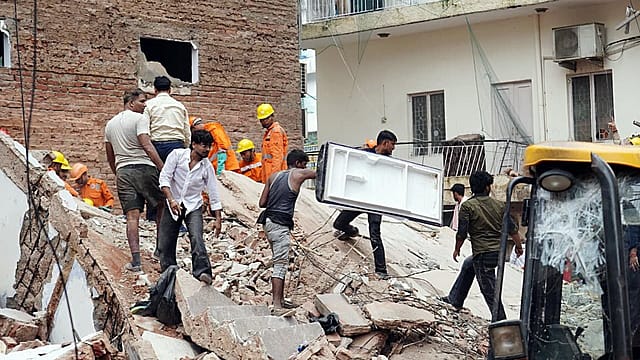
The Delhi government will introduce mandatory structural audits and periodic safety certification for buildings operating as paying guest accommodation, schools, nursing homes and other public-use facilities, Chief Minister Rekha Gupta announced on Monday.
Buildings that fail to secure the required safety clearance will not be allowed to continue such activities.
The announcement follows the collapse of a five-storey boys’ PG in Satya Niketan near Delhi University’s South Campus, which killed six people and left several others injured.
“The government, in collaboration with the Municipal Corporation, is formulating a policy mandating that any building intended for public use, whether a PG, nursing home, school or any other facility, must undergo periodic structural audits and safety certification,” Gupta said after revisiting the collapse site.

Zeroing In on ECI
09 Oct 2026 - Vol 05 | Issue 41
Constitutional legitimacy versus political opportunism
Without certification, she said, “no public activity will be permitted there”.
The proposed policy could significantly widen Delhi’s building-safety regime by linking permission to operate a public-facing establishment with evidence that the structure remains fit for occupation.
Its effectiveness, however, will depend on who conducts the audits, how frequently certification must be renewed and whether the results are independently verified.
Unsafe PGs to Be Shut, Evacuated Students Shifted
Gupta said the government would not allow students to remain in unsafe PG accommodation.
Students evacuated from buildings around the collapse site are being temporarily housed in college hostels. The administration is also contacting the families of those affected and arranging assistance for them, she said.
The chief minister promised action against officials whose negligence or failure of oversight contributed to the conditions surrounding the disaster.
“No one will be spared,” she said, adding that action would be taken against any government employee found responsible.
The Delhi government has already ordered a magisterial inquiry into the collapse, while police have registered an FIR against the building owner. The inquiry is expected to examine the legality of the structure, its conversion into a high-occupancy PG and the nature of the work reportedly being undertaken before it fell.
Did Work in the Basement Trigger the Collapse?
Delhi minister Manjinder Singh Sirsa said preliminary information indicated that the building was approximately 40 to 50 years old and that work undertaken in its basement may have triggered the collapse.
“The information received so far indicates that attempts were made to carry out work in its basement, which caused this accident,” Sirsa said.
That remains a preliminary assessment, not the final finding of the inquiry.
Investigators will have to determine whether any load-bearing wall, column, foundation or structural support was disturbed. They must also establish whether the work was authorised, who commissioned it and whether a qualified structural engineer supervised it.
Earlier reports citing police had also indicated that repair work was underway in the basement when the building came down at approximately 1.30 pm on Sunday. Reuters reported that the property comprised a basement and five upper floors and functioned as guest accommodation.
The building was reportedly operating as a boys’ PG called Hostel Daze. Its sanctioned building plan and permitted occupancy have not yet been publicly disclosed.
Why Can’t the Adjoining Dangerous Building Be Demolished Immediately?
The MCD has ordered the demolition of Property No. 13, an occupied structure adjoining the collapsed building, after declaring it “ruinous/dangerous”.
The owner or occupier was given three days to demolish it. If the order is ignored, the corporation can carry out the demolition and recover the expense as tax arrears.
Sirsa said the building had been evacuated and would be demolished, but removing it immediately could endanger the ongoing operation.
The adjoining structure is also believed to be 40 to 50 years old and is currently unstable. Rescue teams do not yet have a complete assessment of the debris and ground conditions beneath it.
“The adjacent building will definitely be demolished,” Sirsa said. “But the challenge right now is that the structure is unstable. We do not yet know the condition beneath the accumulated debris.”
The NDRF must clear the wreckage of the collapsed PG without destabilising the neighbouring property or endangering rescuers.
MCD Orders Crackdown on Illegal High-Rises
The MCD has separately ordered the immediate identification and sealing of unauthorised buildings with more than four floors across Delhi, according to reports.
The direction suggests that the government’s response will extend beyond Satya Niketan to illegal high-rise construction elsewhere in the capital.
But a citywide sealing campaign will require clear criteria.
An unauthorised floor is a regulatory violation, but demolition and evacuation decisions must also consider the building’s structural condition, occupancy and immediate risk. Residents removed from unsafe properties will require temporary accommodation, particularly in student and low-income rental clusters.
The Satya Niketan tragedy has already exposed the scale of that challenge.
The neighbourhood was originally developed with small residential plots. Many have since been expanded vertically and converted into PGs, hostels, shops and restaurants to serve the large student population around Delhi University’s South Campus.
Higher occupancy produces higher rental income. It also places additional structural, electrical and evacuation pressure on buildings originally designed as modest family homes.
Why Is a New Audit Policy Necessary?
Delhi already conducts an annual pre-monsoon survey to identify dangerous buildings.
By late June 2026, the MCD had reportedly inspected approximately 27.84 lakh properties and classified only 19 as dangerous. One of those was in the South Zone.
The Satya Niketan collapse has raised urgent questions about whether the existing exercise can detect internal structural weaknesses, unauthorised additions and dangerous alterations.
A surface inspection may identify a leaning wall, visible crack or damaged balcony. It may not reveal removed structural supports, foundation damage, corroded reinforcement or work being undertaken inside a basement.
Mandatory structural certification for high-occupancy buildings could address that gap if qualified engineers are made personally accountable for their findings and the reports are subject to municipal verification.
Without those safeguards, the new requirement risks becoming another certificate purchased, filed and forgotten.
What Happens Next?
The Delhi government and MCD must now define the proposed policy’s scope and enforcement mechanism.
The rules will need to specify which properties qualify as public-use buildings, the interval between audits, the credentials required of structural engineers and the penalties for owners who conceal alterations or obtain fraudulent certificates.
The government must also decide whether audit results will be placed in a searchable public database.
That would allow students, parents, patients and schoolchildren’s families to check whether a building has valid structural certification before entering it.
Meanwhile, rescue and debris-clearing operations continue at Satya Niketan. The government says the adjoining building will be demolished once the site is stable enough for the work to proceed safely.
Delhi’s new policy has been announced after six people died.
Its real test will be whether it can identify the next dangerous building while people are still living inside it.
With inputs from ANI