Satya Niketan Building Collapse: Six Dead, MCD Orders Demolition of Adjoining ‘Dangerous’ Property
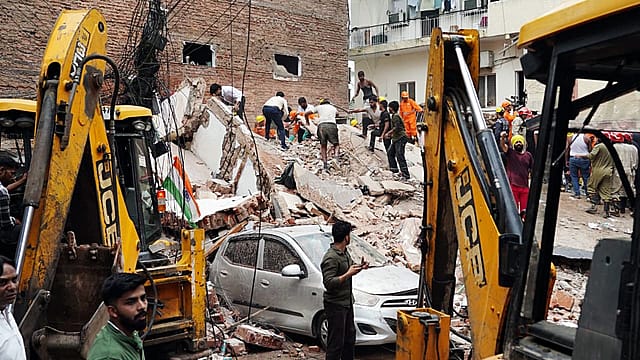
For months, it stood five storeys high in a congested Satya Niketan lane.
Students slept there. A medical shop operated below. Repairs were reportedly undertaken in its basement. Rooms designed for a small residential plot were converted into beds for a swelling population of young tenants.
Then, at approximately 1.30 pm on Sunday, the building folded. Six people were dead by Monday morning.
Rescuers from the NDRF, Delhi Fire Service and police searched through broken concrete with dogs, machines and bare hands. Families moved between hospitals carrying photographs. Students waited for names to emerge from the debris.
Only after the collapse did Delhi’s civic machinery begin looking properly at the buildings still standing.

Losing Memory
16 Oct 2026 - Vol 05 | Issue 42
The making of a medical and social emergency
The Municipal Corporation of Delhi ordered the owner of Property No. 13 in Satya Niketan, adjoining the collapsed structure, to demolish it within three days. The building, the order said, was occupied and in a “ruinous/dangerous condition” that threatened residents, visitors, passers-by and the neighbourhood.
If the owner refuses, the MCD says it will demolish the structure and recover the cost as tax arrears.
The notice may prevent another collapse. It also raises the question that now hangs over Satya Niketan: How did danger become visible only after six people were buried next door?
What happened in Satya Niketan?
A multi-storey building being used as a boys’ paying guest accommodation, reportedly named Hostel Daze, collapsed near Delhi University’s South Campus on September 6.
The structure was approximately 40 to 50 years old and had a basement with five floors above it, according to preliminary police information. Repair or construction work was reportedly underway in the basement when it came down.
That sequence has not yet been established as the cause.
Work in the basement can weaken a building if load-bearing walls, columns, foundations or structural supports are disturbed. Water accumulation can also affect soil and foundations. But determining whether any such intervention triggered this collapse will require structural examination, building plans, contractor records and testimony from survivors and workers.
The police have registered an FIR, and teams were reportedly searching for building owner Hariram Bansal. The Delhi government has ordered a magisterial inquiry.
AIIMS said its trauma centre received ten victims. Five were brought dead and a sixth died during treatment. Three remained admitted, including one who underwent surgery on a limb, while another was discharged after observation.
International reports initially described dozens as feared trapped, but authorities had not established a reliable occupancy figure during the early hours of the rescue. Reuters reported that the building included a basement and five upper floors and that repair work was believed to have been underway below.
The final number of people inside must come from the investigation, not the estimates made while rescuers were still digging.
What has the MCD ordered now?
The MCD has issued a demolition order for Property No. 13, an occupied building adjoining the collapse site.
Its executive engineer for the South Zone concluded that the property was in a condition that endangered people inside and around it. The owner or occupier has been given three days from receipt of the notice to demolish it. If the direction is ignored, the corporation can undertake the demolition itself and recover the expense from the owner.
The adjoining building had already been evacuated as a precaution. Visuals from the area reportedly showed iron supports placed beneath a balcony, while concerns were raised about an apparent tilt in the structure.
This order does not establish that Property No. 13 caused the neighbouring collapse. Nor does it explain whether it had been dangerous before Sunday or was destabilised when the adjoining building came down.
Those are crucial distinctions. The MCD must disclose when Property No. 13 was last inspected, what that inspection found, whether unauthorised additions had been made and whether Sunday’s collapse created or aggravated its present condition.
Without that chronology, the demolition order treats the danger but conceals its history.
What powers does the MCD have over dangerous buildings?
Section 348 of the Delhi Municipal Corporation Act empowers the municipal commissioner to act when a building appears ruinous, is likely to fall or otherwise endangers occupants, neighbours or people passing nearby.
The commissioner can order the owner or occupier to demolish, secure or repair the structure. If the risk is immediate, the corporation can take protective action itself.
The same provision allows the civic body to require a protective fence or enclosure while the danger is being addressed. Section 349 separately empowers it to order occupants to vacate certain unsafe buildings.
Section 491, also cited in the Satya Niketan notice, permits the commissioner to delegate powers to municipal officers. It is essentially what enables an authorised executive engineer to issue such a direction on the commissioner’s behalf.
The Delhi Municipal Corporation Act therefore gives the MCD substantial preventive authority.
The problem is not the absence of power. It is discovering the danger before the building falls.
Didn’t the MCD survey Delhi’s buildings before the monsoon?
It did. That is the most uncomfortable figure in this tragedy.
By late June 2026, the MCD had reportedly inspected approximately 27.84 lakh buildings against a target of nearly 32.56 lakh under its annual pre-monsoon survey. Only 19 were classified as dangerous.
Think about that finding. In a city of ageing colonies, unauthorised floors, crowded rental properties, unapproved conversions and continuous structural alterations, the survey concluded that roughly one building in every 1.46 lakh inspected was dangerous.
Weeks later, a five-storey student accommodation collapsed in Satya Niketan. Another occupied building beside it was suddenly dangerous enough to require demolition within three days.
The MCD should now answer whether either property appeared in the 2026 survey.
If they were inspected and cleared, what did the inspection miss?
If they were not inspected, how was such a large building in a student hub excluded from a survey presented as covering nearly 28 lakh properties?
If the buildings were altered after inspection, were those works authorised and monitored?
The figure of 19 dangerous buildings could signify an extraordinarily safe city. Delhi’s collapsing buildings suggest a more troubling explanation: its safety survey may be counting doors faster than it is examining structures.
Why can a survey of 28 lakh buildings miss an unsafe PG?
The scale of the exercise almost guarantees shallowness unless it is backed by structural expertise, reliable records and risk-based targeting.
A basic visual inspection from the street can detect obvious cracks, tilting walls, falling plaster or a visibly weakened balcony. It cannot reliably assess corroded reinforcement, compromised foundations, removed load-bearing walls or alterations inside a basement.
A building may look upright from outside while its structural safety is being dismantled within.
Annual municipal surveys have repeatedly been criticised for depending heavily on external visual assessment. Engineers cannot meaningfully examine millions of properties within a few months if inspection means little more than observing the façade and recording an address.
A credible system would combine visual checks with sanctioned building plans, age, number of floors, complaints, previous notices, commercial conversion, occupancy load and records of alteration.
A 50-year-old residential structure carrying five floors, a basement, a commercial establishment and a student PG should attract more scrutiny than a recently completed low-rise home.
Treating both as identical survey entries converts inspection into arithmetic.
Was the collapsed building legal?
The full record has not yet been made public.
The MCD reportedly identified it after the collapse as an unauthorised ground-plus-four structure. Other accounts describe a basement and five upper levels. The apparent discrepancy may reflect different ways of counting the ground floor, but the sanctioned plan should settle it immediately.
The corporation must disclose: What construction was legally sanctioned on the plot? When were additional floors built? Was the basement approved, and for what use? Was the property authorised to operate as a high-occupancy PG or private hostel? Did it have the required fire-safety and structural-stability clearances? Were any notices, sealing orders or demolition proceedings previously initiated?
These are not procedural details. Each identifies a possible point at which the collapse could have been prevented.
An illegal floor does not construct itself. A basement is not altered invisibly. Dozens of students do not move into a residential property without electricity usage, water demand, rent payments, advertising and neighbourhood knowledge.
Unauthorised buildings survive through a chain of visibility without intervention.
How did Satya Niketan become a vertical student colony?
The answer begins with geography.
Satya Niketan sits beside Delhi University’s South Campus and close to colleges including Sri Venkateswara, Maitreyi, Motilal Nehru, Atma Ram Sanatan Dharma and Ram Lal Anand. Thousands of students arrive from outside Delhi, while institutional hostel capacity remains limited.
Private landlords fill the gap.
Satya Niketan was developed in the late 1960s with small residential plots, many measuring approximately 40 square metres. Over decades, market demand converted those homes into restaurants, cafés, PGs and private hostels.
The economics reward density.
One additional floor creates more rooms. Smaller rooms create more beds. More beds produce higher rent from the same plot. A basement becomes commercially valuable. Staircases, exits, ventilation and structural load become costs to be squeezed.
Students often accept the bargain because the alternative is a longer commute, higher rent or no room near campus.
This is why the collapse cannot be reduced to one negligent owner.
The owner may bear criminal and civil responsibility if violations or dangerous alterations are established. But the market was created by inadequate student housing, enabled by municipal blindness and normalised by a neighbourhood in which residential buildings became vertical dormitories.
Has Satya Niketan seen this before?
Yes. In April 2022, a three-storey building in Satya Niketan collapsed while renovation work was underway. Two labourers were killed.
The civic body said the owner had been warned in March against undertaking repairs in the approximately 25-year-old building. Officials claimed the police had also been informed and asked to stop the work.
Yet the renovation reportedly continued. That earlier collapse established three facts four years before the present disaster.
Old buildings in Satya Niketan were being altered. Civic notices were not necessarily stopping the work. Structural intervention could become fatal.
Sunday’s collapse, also reportedly associated with work in an older building, therefore cannot be dismissed as an unforeseeable accident in an unsuspected neighbourhood.
Satya Niketan had already delivered its warning. Delhi recorded it as an incident instead of treating it as intelligence.
Is this merely a monsoon problem?
Rain can expose weakness. It does not manufacture every weakness.
During the monsoon, water can enter cracks, weaken masonry, erode soil around foundations and increase loads on roofs. That is why the MCD conducts its dangerous-building survey before the rainy season.
But blaming the monsoon too quickly can turn weather into an alibi.
The Satya Niketan building was reportedly old, heavily occupied and undergoing work in its basement. Whether rain played any role remains for investigators to determine.
The collapse is better understood as a structural-governance problem aggravated, in some cases, by weather.
Buildings generally do not kill merely because it rains. They kill when age, overloading, poor maintenance, unauthorised alterations and weak enforcement are allowed to accumulate until rain, excavation or one removed support supplies the final push.
Who can be held responsible?
The building owner will be central to the investigation. Police must establish who authorised the basement work, who carried it out and whether the risks were known.
A contractor or engineer may also face scrutiny if structural work was undertaken negligently or without approval.
The PG operator’s role must be examined separately if it was not the owner. Investigators should establish how many students were accommodated, whether occupancy and safety requirements were followed and whether tenants were warned about the repairs.
Municipal accountability cannot stop with saying that the building was unauthorised.
Officials must explain when the violations began, who was responsible for inspecting the ward, whether complaints or property records revealed the commercial use and why enforcement did not occur before the collapse.
A magisterial inquiry can reconstruct the chain.
Its value will depend on whether it names each broken link instead of placing the entire tragedy beneath the convenient label of “illegal construction”.
Will demolishing the adjoining building solve the problem?
It may remove one immediate danger. It will not make Satya Niketan safe.
The MCD now needs a building-by-building structural audit of high-occupancy PGs in Satya Niketan and other student clusters around Delhi University. That audit cannot be limited to viewing façades.
Sanctioned plans must be compared with the structures that exist. Basements and additional floors must be inspected. Owners should be required to produce recent structural-stability certificates from accountable engineers. Occupancy, staircases, exits, electrical systems and fire preparedness must be checked together.
Students displaced from unsafe accommodation will also need somewhere to go. An indiscriminate sealing drive without a housing plan could push them into cheaper and even less visible buildings.
Enforcement must therefore be paired with an official registry of compliant PGs, public safety ratings and expanded university accommodation.
Parents sending a child to Delhi should not have to judge structural engineering from photographs on a rental website.
What is the question Delhi must answer now?
Not whether Property No. 13 should be demolished. If it is genuinely at risk of falling, it must be secured or removed before it claims another life.
The real question is why the order arrived on September 6, 2026. Why not during the pre-monsoon survey? Why not when an old residential colony became a dense commercial student quarter? Why not after two labourers died in another Satya Niketan collapse in 2022? Why not when unauthorised floors rose above plots never designed to carry them?
Delhi inspected nearly 28 lakh buildings and found only 19 dangerous. Then one building collapsed, six people died and danger suddenly appeared next door. The MCD has given an owner three days to demolish a building. Delhi has had years to demolish the system that allowed it to become dangerous.
With inputs from ANI & agencies