Who Was Sajjan Kumar? Congress Heavyweight, 1984 Riots Convict and the Long Road From Parliament to Prison
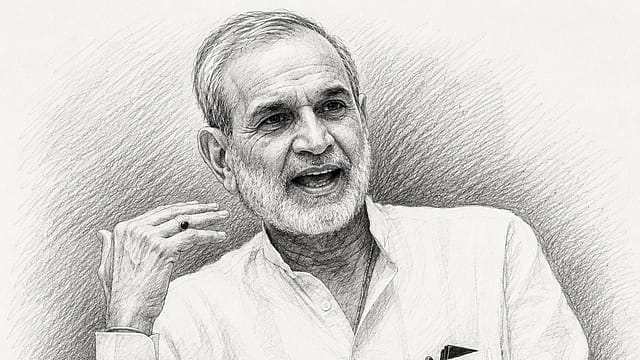
Former Congress MP Sajjan Kumar, one of the most prominent political figures convicted in cases arising from the 1984 anti-Sikh riots, died at the age of 80 on Thursday. He was brought dead to Delhi's Safdarjung Hospital, according to hospital sources cited by ANI. Contemporary reports also confirmed his death while serving a life sentence.
Kumar's death closes a life but not the larger judicial story of 1984. More than four decades after the violence, cases and appeals connected to the riots have continued through Indian courts. Kumar himself experienced virtually every turn that long process could take: investigation, trial, acquittal, reversal, conviction, life imprisonment, another conviction and another life sentence.
The Modi Years
02 Oct 2026 - Vol 05 | Issue 40
A Nation Rebuilt
His first major conviction came only in 2018, 34 years after the riots. So who was Sajjan Kumar, what exactly was he convicted of, why did justice take decades, and what cases remained contested at the time of his death?
Who was Sajjan Kumar?
Kumar was a Congress politician and three-time parliamentarian who represented constituencies in Delhi. His political career would eventually be overshadowed by allegations concerning his role in the violence against Sikhs that erupted after Prime Minister Indira Gandhi was assassinated by two of her Sikh bodyguards on October 31, 1984. More than 2,700 Sikhs were reportedly killed in Delhi during four days of violence. Of 587 FIRs registered in the capital, only 28 cases had resulted in convictions by late 2025, including 13 murder cases. Kumar became one of the most high-profile former politicians to be convicted for crimes committed during that violence.
Why was Sajjan Kumar serving a life sentence?
Actually, Kumar had been handed life imprisonment in two separate cases. The first was the Raj Nagar/Palam Colony case. Five members of a Sikh family were killed and a gurdwara was burnt during the violence of November 1-2, 1984. A trial court had acquitted Kumar. But on December 17, 2018, the Delhi High Court reversed that acquittal and convicted him, sentencing him to imprisonment for the remainder of his natural life. The court directed him to surrender by December 31, 2018. That judgment became a landmark moment in the long legal reckoning over the riots.
What was the second case in which he received life imprisonment?
It concerned the killing of Jaswant Singh and his son Tarundeep Singh in Saraswati Vihar on November 1, 1984. The prosecution's case was that Kumar led a mob that burnt the father and son alive and looted and destroyed their home, according to multiple media reports.A Delhi court convicted him in February 2025. Special Judge Kaveri Baweja subsequently sentenced him to life imprisonment. The prosecution had sought the death penalty, describing the murders as exceptionally brutal. The court agreed that the crimes were "brutal and reprehensible", but considered mitigating factors including Kumar's age, illnesses and conduct in prison and chose life imprisonment instead. He was also fined more than Rs 2.4 lakh, with the sentences ordered to run concurrently. The case itself illustrated the extraordinary length of the judicial process. The FIR was registered in 1991 on the basis of an affidavit filed by the complainant before the Justice Ranganath Mishra Commission in 1985. The conviction came four decades after the killings.
What evidence led to the 2025 conviction?
Witness testimony proved crucial. The court relied, among other evidence, on testimony from the complainant's daughter, who had been 14 at the time of the killings. Judge Baweja rejected arguments questioning the witnesses' ability to identify Kumar decades later. The court found their depositions consistent and held that the evidence established that Kumar had instigated the armed mob responsible for killing Jaswant Singh and Tarundeep Singh. That made the 2025 verdict Kumar's second life sentence arising from the 1984 violence.
Was Sajjan Kumar convicted in every 1984 riots case against him?
No. That is what makes his legal history considerably more complicated than a simple progression from accusation to conviction. In September 2023, a Delhi court acquitted Kumar in a case concerning the killing of seven Sikhs in Sultanpuri. Then, in January 2026, a Rouse Avenue court acquitted him in another case arising from violence in the Janakpuri-Vikaspuri area. In that case, the court found an absence of admissible and reliable evidence establishing Kumar's presence at the crime scene or participation in the violence. The allegations related to killings and attacks during the riots, including the deaths of Sohan Singh and Avtar Singh. The acquittal, however, did not affect the life sentences he was already serving in the other cases.
Why did the cases against Sajjan Kumar take so long?
That question extends far beyond Kumar. The judicial reckoning over the 1984 violence has stretched across commissions, committees, police investigations, reopened cases, special investigation teams, trials and appeals. The numbers underline the problem. More than four decades after the riots, The Indian Express reported in 2025 that Delhi had seen just 13 murder convictions, fewer than the number of commissions and committees that had examined aspects of the violence. Kumar's own trajectory captured that delay starkly. The riots occurred in 1984. His first life sentence came in 2018. His second came in 2025. In the first case, the conviction required the Delhi High Court to overturn an earlier acquittal. In the second, the underlying complaint dated back to an affidavit filed in 1985.
Why was the 2018 Delhi High Court judgment so significant?
Because the judgment went beyond Kumar's individual criminal liability and addressed the larger difficulty of prosecuting mass violence decades after it occurred. The Delhi High Court convicted Kumar in the killing of five Sikhs in Palam Colony and sentenced him to imprisonment for the remainder of his life. In doing so, the court examined the institutional failures surrounding mass crimes and the difficulties victims encounter when politically influential actors are accused. For Kumar personally, the verdict transformed his legal position completely: a man acquitted by the trial court was now a convict required to spend the rest of his life in prison. He surrendered in December 2018 and remained incarcerated thereafter.
What happens to the pending legal proceedings after his death?
Kumar's death ends the possibility of him personally serving further punishment, but it does not erase the judgments already delivered or the historical and judicial record created by the cases. At various stages, his convictions and acquittals had generated appeals before higher courts. His 2018 conviction, for example, had been challenged before the Supreme Court, while appeals relating to acquittals were also pursued in the Delhi High Court. The precise procedural fate of each pending proceeding will depend on its nature and the orders passed by the respective courts. What remains unchanged is the extraordinary timeline. 1984: the killings; 2018: Kumar's first life sentence; 2025: his second; and 2026: his death at 80 while still a prisoner. For the families whose cases travelled through courts for decades, Sajjan Kumar's death is therefore not simply the death of a former politician. It is another marker in a judicial reckoning with 1984 that has already lasted more than four decades.
(With inputs from ANI)