Sails in the Missile Age: Why the Indian Navy Still Needs INS Sudarshini
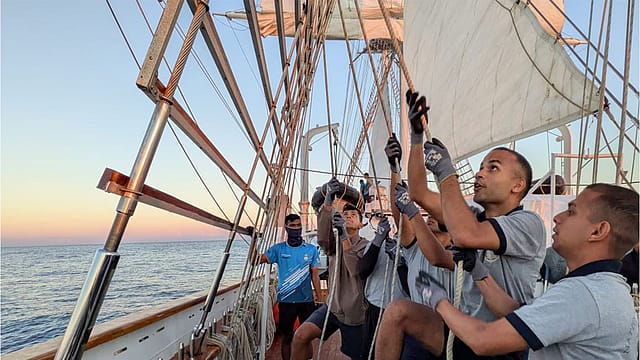
A modern naval career can begin with a very old challenge: getting a sailing ship across an ocean.
For INS Sudarshini, that challenge meant 19 days between Cape Verde and Antigua, negotiating strong winds and heavy swells under sail. The crew maintained watches, handled sails together and practised traditional navigation. The ship reached Antigua on May 27, completing its first Atlantic crossing.
Now the Indian Navy’s three-masted training vessel has returned to Alexandria, Egypt, arriving on September 23 during its ongoing Lokayan 26 expedition.
The port call raises a question more interesting than the ceremonial welcome: what does a sailing ship teach people preparing to serve in a technologically sophisticated navy?

Zeroing In on ECI
09 Oct 2026 - Vol 05 | Issue 41
Constitutional legitimacy versus political opportunism
What is INS Sudarshini doing in Egypt?
Sudarshini is making its second Alexandria visit of the deployment. The programme includes meetings with Egyptian naval officials, visits aboard each other’s ships and professional exchanges. The Navy says the Mediterranean passage has also given trainees practical experience in manoeuvring at sea and handling sails. The stop therefore combines two purposes running through the expedition: developing sailors and maintaining relationships with foreign navies.
What exactly is Lokayan 26?
It is a planned 10-month transoceanic expedition that began from Kochi on January 20, 2026. Its announced itinerary covers approximately 22,000 nautical miles, 18 foreign ports and 13 countries. That distance is roughly 40,700 kilometres. But the voyage has training stops and international engagements along the way: it is neither a continuous ocean crossing nor a race. The launch plan provided for more than 200 Indian Navy and Indian Coast Guard trainees to receive sail training over the course of the deployment. That figure is the expedition’s training target, not a claim that 200 trainees are aboard simultaneously.
What kind of ship are we talking about?
Built by Goa Shipyard, Sudarshini is a 54-metre sail training ship with 20 sails covering more than 1,000 square metres. It was commissioned on January 27, 2012, and is the Indian Navy’s second sail training ship. Its description as a three-masted “barque” refers to the arrangement of its sails. In this configuration, the forward and main masts carry square sails, while the rear mast carries sails aligned along the vessel’s length. The US Coast Guard’s Eagle uses the same broad arrangement. The design makes the work of sailing a collective undertaking: multiple sails, lines and people must function together.
Why train with sails in the age of missiles and advanced electronics?
Because operating equipment and understanding how a vessel behaves at sea are connected skills. Under sail, the relationship between wind, waves, current and the ship’s movement becomes particularly immediate. Trainees must judge changing conditions, communicate decisions and coordinate their actions. The US Coast Guard Academy gives a useful explanation for retaining sail training: it places cadets in situations that classrooms and modern ships cannot reproduce in the same way, developing ship-handling, judgement and teamwork.
For Sudarshini, the Indian Navy identifies seamanship and navigation shaped by wind and waves as the central training benefit. The underlying lesson is straightforward: better technology still needs people who understand the environment in which it operates.
What does “seamanship” actually mean here?
It means the practical skills needed to handle a vessel safely. Sudarshini’s Atlantic passage provides concrete examples: keeping watch, coordinating sail handling and navigating through difficult conditions. Watchkeeping means assigned personnel remain on duty to monitor the ship and its surroundings; the work continues while others rest. There is also a leadership lesson. The Coast Guard describes life aboard Eagle as an opportunity to apply classroom theory while managing the demands of living and working together at sea. Seen that way, a training ship is a workplace where judgement, communication and cooperation have consequences that everyone aboard can feel.
What was special about the Atlantic crossing?
It was Sudarshini’s first. The ship sailed from Mindelo in Cape Verde to Antigua in 19 days, arriving on May 27. The Defence Ministry described the passage as continuously under sail, with heavy swells and strong winds testing the crew. During that leg, Sudarshini passed 10,000 nautical miles travelled since leaving Kochi. The milestone belongs specifically to this ship. The same official account records an earlier Atlantic crossing by INS Tarangini in 2007. Calling it the Indian Navy’s first Atlantic crossing would therefore be wrong.
Where has the expedition taken it?
The voyage has connected the Arabian Sea, Red Sea, Mediterranean and Atlantic. Its earlier Alexandria arrival was on March 1, following a northbound Suez Canal transit after leaving Safaga. It subsequently participated in France’s Escale à Sète maritime festival and crossed the Atlantic to Antigua. Later stages included the Azores and Portugal; Lisbon, reached on August 22, was its 15th port visit. Those are different operating environments within one deployment: ocean passages, a major canal and approaches to foreign ports. The variety gives the route its training value. Counting nautical miles alone cannot capture the different situations trainees encounter.
Why does the Suez passage matter?
The canal connects the Red Sea and Mediterranean, making it a crucial link on this route. Sudarshini’s March transit covered the approximately 193-kilometre waterway before its first Alexandria call. The Navy identified the passage as a major training highlight. Its educational value is easy to understand: navigating a confined canal presents a different problem from crossing open water. A useful training voyage exposes crews to both, rather than repeating the same conditions. Alexandria also provides an opportunity for direct engagement with the Egyptian Navy, giving the geographical stop a professional purpose.
Is India unusual in keeping a sailing ship?
No. Other maritime services also use tall ships to train future officers. The US Coast Guard Academy says every cadet spends at least six weeks aboard Eagle, learning seamanship, navigation, teamwork and leadership. Italy’s Amerigo Vespucci has a long history of training naval cadets. The Italian Navy identifies both education and naval diplomacy among its missions. The common logic is that handling a sailing vessel develops habits that remain relevant after trainees move to other ships: observing conditions, making decisions and relying on a crew. Sudarshini sits within that wider training tradition.
What does India gain from the foreign port calls?
Access to people as well as ports. The announced Lokayan programme combines training with interaction with foreign naval trainees and maritime partnership engagements. In Alexandria, the planned cross-deck visits allow personnel to go aboard each other’s vessels and exchange professional experience. The diplomatic logic is that repeated professional contact can build familiarity between services. A tall ship also gives the host public an accessible way to encounter another country’s navy and maritime traditions. These are opportunities for cooperation; a ceremonial welcome alone cannot demonstrate how much a defence relationship has strengthened.
And what is MAHASAGAR doing in a sailing story?
MAHASAGAR stands for “Mutual and Holistic Advancement for Security and Growth Across Regions”. India has presented it as a vision for engagement with the Global South, and the Navy explicitly links Lokayan 26 to it. For this expedition, the practical expression is training, naval interaction and maritime outreach. The accompanying phrase Vasudhaiva Kutumbakam means “the world is one family”. Both provide the diplomatic framing; the ship’s work gives that framing something tangible.
What should readers watch beyond the arrival photographs?
The skills acquired and the relationships sustained. The useful questions are how much demanding sea experience trainees receive, what responsibilities they learn to handle and whether professional exchanges lead to continuing contact. That is an editorial yardstick, rather than an outcome established by the latest port-call announcement. The published accounts document the itinerary and training activity; they do not provide an independent assessment of training results. Sudarshini’s clearest achievement so far is concrete: its crew took the ship across the Atlantic under sail. The enduring purpose is to send people into the wider fleet with better judgement about the sea, their ship and one another.
With inputs from ANI & agencies