Rijiju Rejects ‘60-Km China Incursion’ Claim, Flags PLA Activity on Arunachal Ridgelines
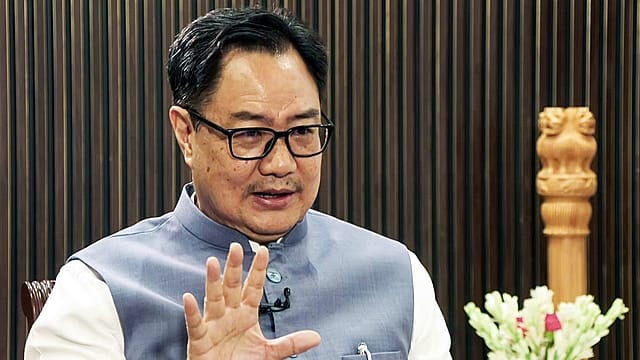
Union Minister Kiren Rijiju has rejected claims that Chinese forces have entered 60km inside Arunachal Pradesh but acknowledged increased military activity on some ridgelines along the disputed frontier.
Fresh from a visit to the remote border settlements of Maza, Galemo and Taksing, Rijiju said he had travelled to the region to inspect strategic roads and accelerate pending infrastructure projects. “Border areas are tough but Narendra Modi government is committed to border development,” he wrote on X. “Borders were neglected in the past but it’s top priority now.”
His intervention followed the circulation of photographs and videos purportedly showing a deep Chinese incursion into Arunachal Pradesh. Rijiju said some of the images had been taken in Bangladesh or elsewhere and warned that using unrelated visuals to make sweeping territorial claims could confuse the public and damage the morale of Indian forces.

Rise of the Pivotal Power
18 Sep 2026 - Vol 05 | Issue 38
The BRICS declaration is a strategic victory for Modi
But he stopped short of dismissing every concern raised from the ground. “The concern expressed by some villagers in Arunachal regarding the border problem is genuine,” Rijiju said, pointing to the absence of a mutually demarcated boundary between India and China.
The two countries are separated by the Line of Actual Control, whose alignment remains disputed in several sectors. Without an agreed boundary marked on the ground, patrols can operate according to competing perceptions of the LAC, producing face-offs and conflicting accounts of intrusion.
Rijiju said Chinese troops had not captured Indian villages. However, he conceded that PLA activity had increased on some upper ridgelines. “They have set foot on some land because there is no demarcation,” he said. “On the top ridgelines, Chinese army activity has certainly increased, and the villagers expressing concern about that is valid. We should take that very seriously.”
The minister framed border roads as India’s answer to the infrastructure advantage China built over several decades. He accused previous Congress governments of leaving forward areas underdeveloped while Beijing constructed roads and military facilities across the frontier. Rijiju cited former defence minister AK Antony’s 2013 admission in Parliament that India had historically followed the belief that an “undeveloped border is safer than a developed border”. India began reversing that approach before the Modi government assumed office, although construction has accelerated substantially in recent years.
Rijiju said roads now reach forward locations that had remained cut off for decades. He pointed to the connection to Maza, described as the final border point in the Asapila range, and the road to Taksing. The Border Roads Organisation established connectivity to Maza in December 2022. Its TCC-Maza road was subsequently prepared for inauguration, while the TCC-Taksing road was completed in 2025, according to a Press Information Bureau release.
These roads serve two purposes. They allow the Army and Indo-Tibetan Border Police to move personnel and supplies more quickly, while giving isolated villages access to markets, healthcare and government services.
They also carry a strategic cost. Better roads make forward areas easier for India to defend, but construction close to the disputed boundary can trigger objections from Beijing. China claims Arunachal Pradesh as “South Tibet”, a position India has repeatedly rejected.
Rijiju said the government would address local fears while protecting Indian territory, but urged political leaders and social-media users to distinguish verified developments from sensational claims. “The India-China border issue is a serious subject,” he said. “Do not make false claims on such a sensitive matter.”
His message drew a careful line: the viral claim of a 60km incursion was false, he said, but the pressure along the frontier was real. That is why the road-building race matters. In Arunachal Pradesh, infrastructure does more than connect a village. It establishes access, sustains patrols and strengthens India’s ability to hold the ground it claims.
(With inputs from ANI)