‘Rajneeti Is Not Bad. Politicians Have Made It Bad’: Shripad Naik on Power & Public Trust
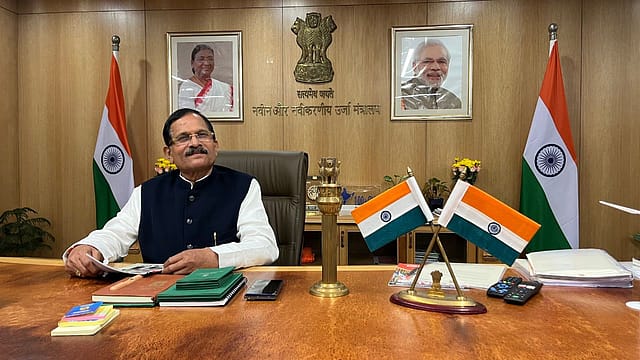
Shripad Naik remembers the words that followed a ministerial convoy.
“Chor ja raha hai, chor ja raha hai.” (A thief is going by.)
He once travelled with a red beacon himself. In an exclusive conversation with OPEN Digital, the memory surfaces as he discusses the suspicion that accompanies political office.
“When a convoy used to pass earlier, the aam janta used to say, 'Chor ja raha hai, chor ja raha hai,” he says.
For Naik, that reflexive distrust unfairly bundles an entire profession into one accusation. “One bad neta taints the rest," he says.
Yet his response to young people disillusioned with politics is to ask them to enter it.

Zeroing In on ECI
09 Oct 2026 - Vol 05 | Issue 41
Constitutional legitimacy versus political opportunism
“They must come. We need good people. Rajneeti is not bad. Politicians have made it bad. When good people come, the bad will get replaced. If they won’t come, how will Rajneeti change for the better?”
It is the most arresting passage in a conversation that moves from Goa to Delhi, from the reputation of politicians to the responsibilities of government. At 74, the six-time MP is keen for a new generation to step forward, while remaining determined to continue his own work.
As Union Minister of State for Power and New and Renewable Energy, that work involves a transition whose consequences reach from electricity bills and farm incomes to industrial growth. His political argument is about restoring faith in public service. His ministerial brief requires delivering something people can judge every time they flick a switch.
FROM THE POND TO THE OCEAN
Naik explains his journey through a comparison drawn from water.
"Goa, as my state, is a pond. Delhi, as the national capital, is an ocean,” he says. “In the pond, you are a big fish. In the ocean, you have more responsibility, more to do for the country, and nowhere to hide.”

The move taught him that “you have to come out of your comfort zone and take up more challenges.”
First elected to Parliament in 1999, Naik has won six consecutive Lok Sabha elections, most recently in 2024. His ministerial assignments have spanned Culture, Tourism, AYUSH, Defence, and Ports, Shipping and Waterways. He became the first minister to head the newly created AYUSH ministry in November 2014; the power and renewable-energy responsibilities followed in June 2024.
Across those assignments, Goa has remained the place he misses.
“When I am in Delhi, I miss Goa food. I miss my family,” he says. “But Delhi work is bigger, and the responsibilities are huge, so we get along.”
The answer is matter-of-fact. Home pulls in one direction; the responsibilities of office occupy the other. His pond-and-ocean metaphor captures both the distance travelled and the adjustment demanded by national politics.
BEYOND THE CAPACITY TARGET
When the conversation turns to energy, Naik leads with scale.
He puts India’s installed renewable-energy capacity, including large hydro, at almost 300 GW, and points to the country reaching a 50 per cent share of installed electricity capacity from non-fossil sources in June 2025. The next ambition is 500 GW of non-fossil capacity by 2030, alongside the longer journey towards net zero by 2070.
These milestones describe the generating capacity built. The practical challenge is making power available where and when it is needed. Solar and wind output varies; transmission, storage and the wider electricity system determine how effectively it can serve consumers.
Naik frames his priorities around that requirement.
“Our focus must be on reliable, affordable and secure energy while creating economic opportunities for our people,” he says.
Solar and wind, he says, “will remain central to our progress,” complemented by hydropower, bioenergy and green hydrogen.
“The ministry is working to strengthen the grid so that renewable power can move across the country,” he adds.
That movement matters as much as the installations themselves. Electricity generated in one region must reach demand elsewhere, and an expanding renewable system needs infrastructure capable of handling both its volume and variability.
For households and businesses, the ultimate measure is dependable supply at an affordable price. Capacity targets set the direction; the everyday experience of electricity determines how that progress is felt.
A BUYER FOR THE FARMER’S WASTE
Bioenergy brings the discussion closer to the ground.
Crop residue, organic waste and other biomass offer a connection between energy policy and the rural economy. Material that carries little value—or creates a disposal problem—can become an input for fuel production.
“Otherwise treated as waste, these can be turned into a valuable source of energy, cleaner fuel and income,” Naik says. “Farmers can earn more from crop residue. Bioenergy links energy security, agriculture, waste management and prosperity.”
The appeal is straightforward. A farmer gains another potential source of income. A plant gains raw material. Waste acquires a market.
Making those relationships dependable is harder. Crop residue has to be collected, stored and transported. Plants need a sufficiently reliable supply to operate, and producers need buyers for their output. The opportunity rests on a chain of transactions that must work for everyone involved.
Naik acknowledges the obstacles.
“This comes with its own challenges, such as stock availability, supply chain, access to finance, technological innovation and a dependable market,” he says.
For a farmer, the calculation begins with whether collecting and selling residue is worthwhile. For an entrepreneur, it includes the cost of securing feedstock and the certainty of finding customers. The environmental promise needs a business model that can sustain it.
“We have to work together to strengthen indigenous technologies, domestic manufacturing and innovative models,” Naik says.
His emphasis gives bioenergy a wider role in the transition: a way to connect cleaner energy with production, employment and agricultural livelihoods.
AI AT THE SWITCHBOARD
Naik also sees a role for artificial intelligence in managing the power system.
“Today is the age of AI, and none of our life aspects are untouched by it,” he says. “The ministry is looking at how artificial intelligence can improve grid management and service delivery, with the aim of reliable supply and better consumer service. Technology becomes meaningful only when it improves the lives of our people,” he says.
His answer sets out an ambition rather than a specific deployment. The test he identifies is service: whether digital tools help make the system more reliable and useful to consumers.
It is a practical standard for a sector in which technical progress can otherwise be expressed largely through capacity figures and infrastructure milestones. The consumer encounters the result through supply, billing and the response when something goes wrong.
THE ARGUMENT OVER OPPOSITION
On political criticism, Naik is less conciliatory.
“This is what the Opposition does. Whenever it finds something, even a minor issue, it exaggerates it to create negative feelings among people about the government,” he says.
He argues that opposition should contribute to better governance.
“It should be constructive and should help the government bring improvements. But today, we are seeing that the way they oppose everything is not right and does not help the country’s development.”
His remarks express a familiar frustration from the government benches. They also sit alongside his broader concern about how politics is perceived: criticism of individual conduct can, in his telling, harden into distrust of everyone in public life.
“Because of a handful of bad politicians, the entire neta fraternity is painted with the same brush.”
He credits Prime Minister Narendra Modi with removing red beacons from ministers’ cars and argues that VIP culture has receded. The memory of the passing convoy nevertheless remains vivid enough to enter his account of the profession.
The symbol has changed. Earning public trust remains a continuing task.
AN OPEN DOOR, NO EXIT DATE
Asked what he would do if he were not in politics, Naik says he would remain involved in social work: “so much is being done and so much is left.”
There is no retirement timetable.
“Till the time I get the opportunity to be in the country’s seva, I will be doing it,” he says. “There is no retirement in politics and public life.”
For Gen-Zs, who are considering stepping into politics, he offers an appeal rooted in personal conduct and obligation.
“Go ahead with truth. Keep authenticity in your heart. You have your family and friends, but you also have your country. We are fortunate that we live in a free country, a democratic one. Desh seva is bhagwaan ki seva,” he says.
Service to the country is service to God.
The man who remembers being on the receiving end of the public’s suspicion still believes politics is worth entering. His invitation to the next generation is also an explanation of why he intends to stay.