Rajnath Singh warns Pakistan of a bigger strike if terror attacks continue; watch
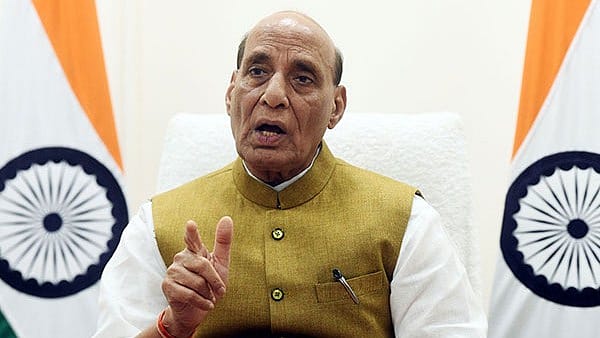
Can a country pursue peace while warning that it is prepared to strike harder if attacked? Defence Minister Rajnath Singh says the two are not contradictory. Addressing the Times Network National Defence Conclave 2026 in New Delhi on Thursday, October 15, he said India’s commitment to peace should not be mistaken for weakness, arguing that military strength and capability are essential to preserving it.
“Wishing for peace is an integral part of our civilisational consciousness and cultural values,” Singh said, describing dialogue, coexistence and peaceful solutions as central to India’s cultural outlook. But, he added, the country’s preference for peace should not be confused with an inability or unwillingness to defend itself. His remarks came with a pointed warning to Pakistan: if further terrorist activity originates from its territory, India could launch a strike bigger than its previous operations.

Zeroing In on ECI
09 Oct 2026 - Vol 05 | Issue 41
Constitutional legitimacy versus political opportunism
Rajnath Singh recalls Uri, Pulwama and Operation Sindoor
Singh cited three major episodes to explain what he described as India’s evolving response to terrorism: the surgical strikes following the 2016 Uri attack, the Balakot airstrikes after the 2019 Pulwama attack, and Operation Sindoor following the killing of civilians in Pahalgam in 2025.
He said Operation Sindoor targeted terrorist hideouts in Pakistan and marked a decisive response to terrorism. Referring to the earlier operations, Singh said India had responded whenever terrorists attempted to shed blood on Indian soil. “If any further terrorist activity occurs from Pakistan’s side, there will be a strike even bigger than the last time,” he said.
The minister also claimed that the operational lifespan of most terrorists had shortened since 2014, saying security forces were eliminating many within a year of their taking up arms. This was his assessment of India’s counterterrorism efforts.
Captain Smith Machhar’s courage becomes a message against terror
Singh also invoked Captain Smith Machhar while speaking about the power of individual courage in confronting hatred and violence. “The courage of a lone individual who believes in humanity can outweigh the intentions of a lone wolf filled with hatred,” he said, arguing that the determination of a person committed to humanity could overcome the power of terror.
Machhar, an Indian pilot who was seriously injured in an attack by his co-pilot aboard a flydubai flight, was praised for his actions during the September 2026 incident. Israeli President Isaac Herzog had reportedly announced plans to honour him with the Presidential Award for Civilian Heroism.
India’s defence strategy shifts towards self-reliance
Beyond counterterrorism, Singh said India’s defence capabilities and approach to national security had changed significantly over the past 12-and-a-half years. He attributed this shift to reforms under Prime Minister Narendra Modi, changes in working methods and a different approach to preparedness.
According to Singh, India’s defence strategy is no longer confined to meeting immediate military requirements. It is increasingly focused on building a self-reliant, future-oriented ecosystem capable of responding to emerging security challenges. The emphasis on domestic capability also reflects a broader government push to strengthen defence manufacturing and reduce dependence on overseas suppliers.
The central message of Singh’s address was that India sees peace and preparedness as complementary rather than competing priorities. Whether that approach can deter future attacks remains a question for the region’s security landscape. For now, the minister has reiterated that India intends to retain the capacity to respond, and has warned that any future response could be more forceful than the last.
(With inputs from ANI)