Delhi’s Post-Diwali Air Pollution Is a ‘Public Health Emergency': Environmentalists
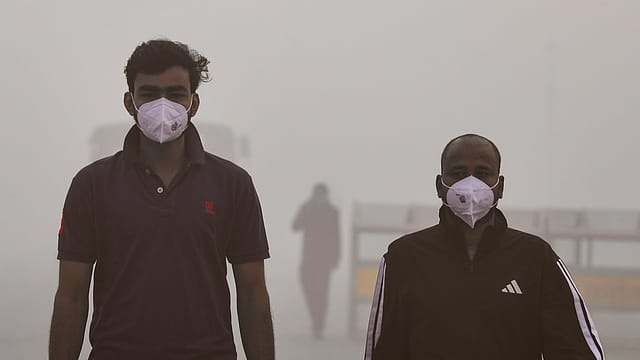
Delhi’s air pollution has worsened sharply after Diwali, with the Air Quality Index (AQI) crossing 400 at several monitoring stations and environmentalists describing the situation as a public health emergency. They say firecracker emissions have added to the particulate pollution already affecting the capital, while unfavourable meteorological conditions are preventing pollutants from dispersing.
Residents woke up on Monday to a thick blanket of smog and poor visibility. Under the Central Pollution Control Board’s (CPCB) classification, an AQI reading of 401–500 falls in the severe category. Environmentalists have warned that the impact of the celebrations could persist for several days.
Bhavreen Kandhari, an environmentalist, said Delhi was already struggling with toxic air before Diwali and that firecrackers had added another significant burden. She warned that the continuing pollution posed particular challenges for people with respiratory problems and other health conditions.

The Era of Forever Wars
30 Oct 2026 - Vol 05 | Issue 44
Coping with an explosive Middle East
“The celebrations may be over, but the pollutants continue to stay,” Kandhari told ANI, describing the situation as a public health emergency.
AQI READINGS AND THE LIMITS OF THE SCALE
Kandhari also pointed to the limitations of the official AQI scale, which ends at 500. Readings above 400 are classified as severe, leaving the scale unable to distinguish between different levels of pollution beyond its upper limit.
She cited readings shared by citizens on social media and said PM2.5 concentrations had reportedly risen from around 300 in the morning to approximately 1,000 at night. These figures were not identified as official CPCB measurements.
Kandhari said the deterioration was foreseeable because weather conditions were unfavourable and enforcement of restrictions remained inadequate. The early warning system had forecast severe air quality for the next few days, she said, adding that stagnant conditions would allow pollutants to remain over the city.
FIRECRACKERS ADD TO AN ALREADY SEVERE CRISIS
Environmental activist Vimlendu Jha also criticised the failure to enforce restrictions on firecrackers, saying they were burst in several parts of Delhi despite directions from the Supreme Court.
Jha said government monitoring stations recorded AQI levels approaching or exceeding 500, while private air-quality monitors reported substantially higher readings during Diwali night and the following morning.
According to him, readings on private monitors rose from around 400 before the celebrations to between 1,200 and 1,500 after roughly three hours of firecracker bursting. He said this indicated a sharp increase in PM2.5 concentrations.
Jha cited studies reporting substantial spikes in particulate matter during Diwali and said firecrackers had compounded pollution from the capital’s year-round sources. He estimated that the immediate impact could last between one and three days.
POLLUTION EXTENDS BEYOND DELHI
Jha said air pollution could not be treated as a problem confined to Delhi because pollutants travel across administrative boundaries. The Indo-Gangetic Plain, he argued, needed to be addressed as a connected airshed rather than through measures focused on individual cities.
He criticised the Central and state governments for relying heavily on bans, restrictions and the Graded Response Action Plan (GRAP), arguing that these interventions did not address the underlying sources of emissions.
The activist said tackling the crisis required sustained funding, political commitment and a coordinated approach linking air quality with public health.
ARTIFICIAL RAIN IS NOT A LONG-TERM SOLUTION
Jha also questioned proposals to use artificial rain, or cloud seeding, to bring down pollution levels in Delhi. He said authorities should concentrate on controlling emissions at source rather than relying on temporary interventions.
He described artificial rain as an expensive measure and said there was insufficient verified evidence to establish it as a solution to urban air pollution. He similarly dismissed smoke towers, smoke guns and water sprinkling on roads as inadequate responses to the scale of the crisis.
On proposals such as the odd-even vehicle scheme and work-from-home arrangements, Jha said restrictions could produce only marginal reductions in pollution and could not substitute for structural changes.
Citing Beijing and London, he said both cities had invested resources and adopted systematic approaches to tackle air pollution. India, he argued, needed a similar long-term strategy across the entire airshed.
With inputs from ANI